Roland Juno-106 (1984–1988): The Analog Workhorse That Defined a Decade
A six-voice polyphonic powerhouse with built-in chorus and full MIDI integration, the Juno-106 brought lush, stable analog synthesis to studios and stages worldwide—just as the digital revolution was kicking into high gear.
Overview
If the 1980s had a sonic fingerprint, the Roland Juno-106 would be at its core. More than just another analog synth, it was the democratization of rich, warm polyphony—accessible, reliable, and dripping with character. Released in 1984 at a time when many manufacturers were flirting with digital oscillators and abandoning analog architecture, Roland doubled down on analog warmth but wrapped it in modern convenience. The Juno-106 wasn't the flashiest synth on the market, nor the most complex, but it was the one you could count on to deliver buttery pads, punchy basslines, and shimmering chords night after night, gig after gig. It became the backbone of pop, new wave, synthpop, and early house music—not because it was rare, but because it was everywhere.
What set the Juno-106 apart wasn't a radical redesign, but a series of smart, pragmatic refinements over its predecessor, the Roland Juno-60. Most crucially, it added full MIDI implementation—MIDI In, Out, and Thru—making it one of the first affordable polyphonic analog synths to seamlessly integrate into the rapidly MIDI-fying studios of the mid-80s. No more patch cables just to sync your sequencer. Suddenly, the Juno-106 could talk to drum machines, sequencers, and other synths, turning it into a central node in the emerging electronic music ecosystem. And with its legendary built-in stereo chorus—lifted directly from the Roland CE-1 analog chorus pedal—its sound was instantly wider, deeper, and more professional than nearly anything in its price class.
Specifications
| Polyphony | 6 voices |
| Oscillators | 1 DCO per voice (programmable waveforms: sawtooth, square, pulse, triangle) |
| LFO | 1 LFO (waveforms: triangle, square, sample & hold, noise) |
| Filter | 1 VCF per voice (24dB/oct low-pass, 12dB/oct high-pass), resonant |
| Envelopes | 1 ADSR (filter), 1 AR (amplifier) |
| Keyboard | 61 keys (full-size, velocity and aftertouch sensitive) |
| Display | 16-character LED display |
| Memory | 128 patch memory locations (64 factory, 64 user) |
| MIDI | MIDI In, Out, Thru |
| Audio Outputs | 1x 1/4" stereo output, 1x 1/4" headphone output |
| Audio Inputs | 1x 1/4" external audio input (for filter processing) |
| Dimensions | 995 mm × 375 mm × 110 mm (39.2" × 14.8" × 4.3") |
| Weight | 13.5 kg (29.8 lbs) |
| Power Supply | DC 9V (external adapter: PSA-120S or equivalent) |
| Current Draw | 500 mA |
| Country of Manufacture | Japan |
| Original MSRP | $1695 (1984) |
Key Features
- Built-in stereo chorus effect (CE-1 derived): This wasn’t just a gimmick—it was alchemy. The chorus circuit, borrowed from Roland’s standalone CE-1 pedal, used bucket-brigade devices (BBDs) to create a lush, analog shimmer that made even a single sawtooth wave sound like an ensemble. It’s the reason Juno-106 pads have that “holy choir from a VHS tape” quality. And because it’s stereo, panning the output across a mix gave productions an unprecedented sense of space. Turn this off, and the Juno sounds thin. Turn it on, and it’s instant 1985.
- Full MIDI implementation: At a time when many synths treated MIDI as an afterthought (or ignored it entirely), the Juno-106 embraced it. With MIDI In, Out, and Thru, it could be controlled by a sequencer, transmit note data to other gear, and sync modulation parameters. This made it a linchpin in MIDI chains—especially when paired with machines like the TR-909 or MC-500. It wasn’t just programmable; it was networked.
- DCOs for rock-solid tuning: Unlike true VCOs, which drifted with temperature, the Juno-106’s digitally controlled oscillators stayed in tune for hours. This wasn’t “cold” digital sound—it was analog tone with digital stability. For gigging musicians tired of retuning between songs, this was revolutionary. And yes, purists whine about DCOs lacking “drift,” but try telling that to the guy playing “Take On Me” live in 1986 while sweating under stage lights.
- External audio input for filter processing: One of those “why didn’t everyone do this?” features. Plug a drum machine, a vocal, or even a Game Boy into the 1/4" input, and route it through the Juno’s sublime 24dB/oct resonant low-pass filter. Suddenly, your Juno isn’t just a synth—it’s a tone-shaping module for your entire rig.
Historical Context
The Juno-106 didn’t emerge in a vacuum. It was the direct successor to the Roland Juno-60, a synth beloved for its sound but hamstrung by its lack of MIDI. By 1983, MIDI was no longer a novelty—it was becoming essential. Competitors like the Korg Poly-800 were pushing prices down with cost-cutting measures (like mini-keys and simplified architecture), but often at the expense of playability and sonic richness. The Juno-106 struck a near-perfect balance: full-sized keys, aftertouch, a professional build, and that irreplaceable Roland chorus—all for $1,695, a price that made it accessible to working musicians, not just studio elites.
Released in 1984, the Juno-106 arrived as analog synthesis was being declared “dead” by some, with FM synths like the Yamaha DX7 dominating the charts. Yet the Juno-106 proved there was still life in analog—especially when it could play nicely with digital gear. Its successor, the Roland Alpha Juno 1, would arrive in 1985 with digital control and a smaller form factor, but at the cost of some of the 106’s hands-on immediacy. The 106 remained in production until 1988, a testament to its staying power. It was used by artists from Duran Duran and Depeche Mode to Prince and Pet Shop Boys—not because it was cutting-edge, but because it was trusted.
Collectibility & Value
Today, the Juno-106 is everywhere—and yet, it’s never been more desirable. With “common” rarity but “very high” desirability, it’s the synth equivalent of a vintage Levi’s 501: mass-produced, but now iconic. In 2025, a working Juno-106 typically sells for $800 to $1,400, depending on condition, case, and functionality. Fully serviced units with replaced membrane switches and upgraded power regulation can command the upper end (or more). The market is flooded with broken units, though—so caveat emptor.
The two most notorious failure points are the membrane switches (those flimsy rubber buttons above the display) and the VCA/VCF ICs (specifically the BA662 chips, which degrade over time and cause voices to drop out or sound thin). Many units also suffer from failing power supplies—using the original PSA-120S or a properly regulated 9V DC adapter is critical. Savvy buyers look for units with retrofitted buttons, new BA662s, and clean keybeds. Bonus points if it still has its original case (often lost to time). Despite its age, the Juno-106 remains a studio staple—its sound is simply irreplaceable in certain contexts. You can emulate it with plugins, but you can’t replicate the feel of those keys, the glow of that LED display, or the way the chorus hits your ears like a warm memory.
eBay Listings
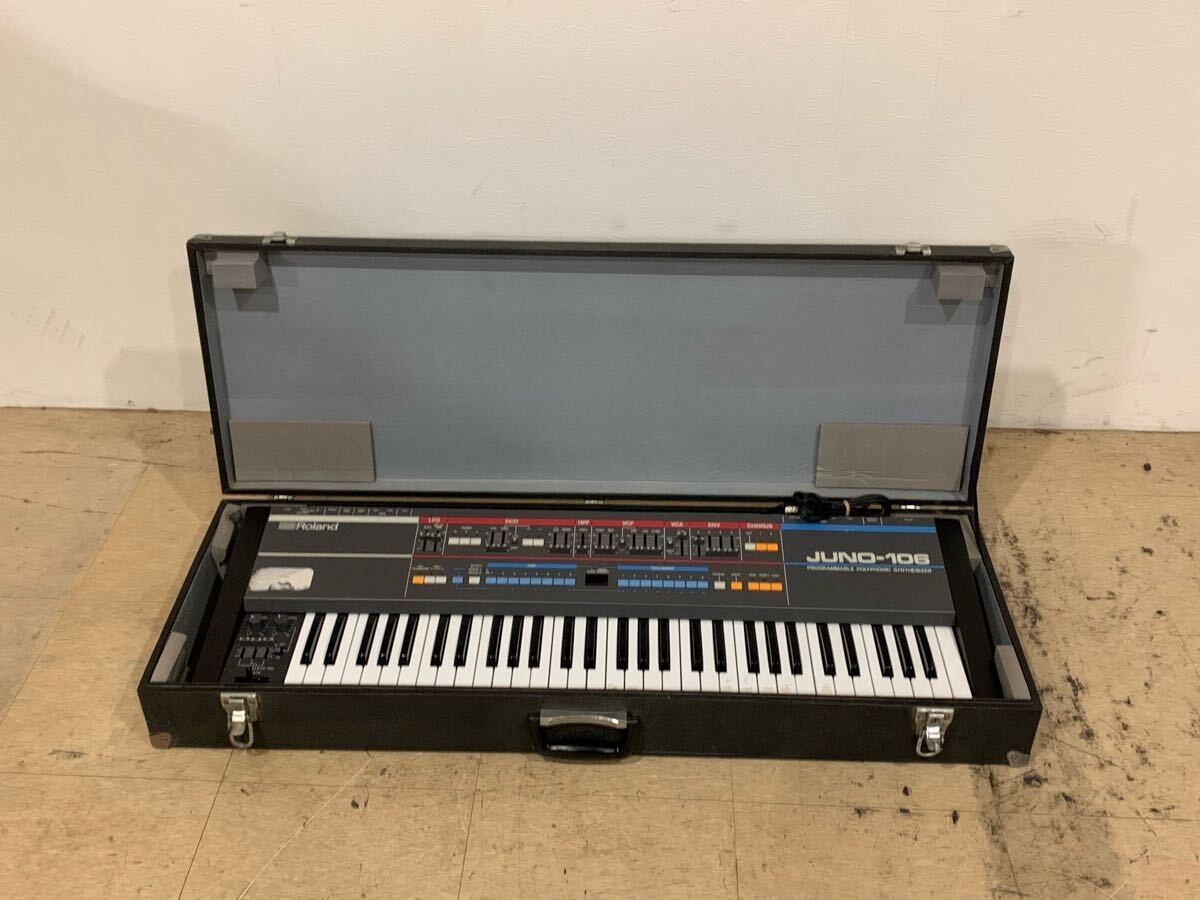


As an eBay Partner, we earn from qualifying purchases. This helps support our independent vintage technology research.
Service Manuals & Schematics
- Owner's Manual — archive.org
- Service Manual (1984) — archive.org
- Service Manual — archive.org
Related Models
- Roland Juno-60 (1982-1984)
- Roland Jupiter-4 (1978-1981)
- Roland Jupiter-6 (1983-1985)
- Roland Jupiter-8 (1981-1985)
- Roland SH-101 (1982-1986)
- Yamaha CS-80 (1977-1980)
- ARP 2600C (1978-1981)
- ARP 2600P (1975-1978)
- ARP Avatar (1979-1981)
- ARP Pro Soloist (1972-1977)