Roland MC-303 (1996)
448 sounds, 12 drum kits, and not one slot to save your own.
Overview
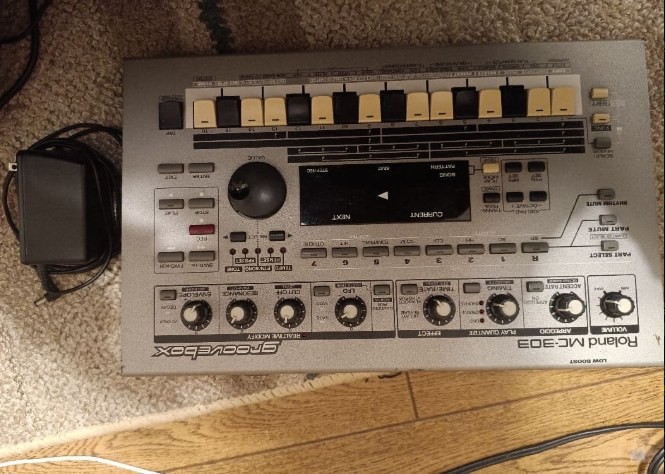
The MC-303 has a built-in frustration, and it comes from being first. Roland packed 448 sounds into a self-contained, retro-styled synth/sequencer combo aimed at dance-music producers. Then it gave the box no space for user patches. Not a reduced bank. None. Every sound is a factory sound, and every sound you make has to be rebuilt from scratch the next time you power up. The follow-up MC-505 fixed that. The 303 shipped anyway.
What it did have was a big sound set. The 448 on-board sounds and 12 drum kits were the point. This was Roland's first Groovebox, and the name stuck to everything that followed. The 8-part multitimbrality meant you could run a bass part, a lead, a pad, and a drum kit at the same time. That is enough to sketch a full dance track without a computer or a rack of modules, with just the box and a pair of headphones. For 1996, that was the whole pitch.
Roland's UK dealer network treated it as a flagship debut. It appeared on the company's 1996 "hot new products" tour, alongside the VS-880 and the VG-8 Guitar System. The machine was made in Japan, at least according to the units that still circulate with that stamped on the back plate.
Documentation is the real problem. No Roland manual or service documentation for the 303 has surfaced in this archive, and the surviving record leans almost entirely on period press coverage. That coverage is consistent, but it's thin. It establishes what the machine was and when it arrived, and it doesn't say what's inside.
Key Features
448 On-Board Sounds and 12 Drum Kits
This is the headline, and it's the number that made the 303 a genre tool rather than a curiosity. 448 sounds is a lot of raw material for a self-contained box in 1996, and the drum kits cover the territory the machine was built for. The catch, and it's a real one, is that the sounds are fixed. Roland gave you the palette and no canvas. You could tweak in performance, but you couldn't save a patch — the MC-505 would later correct this with user patch memory, and the fact that Roland bothered tells you how loudly owners complained.
Sound on Sound (April 1998, p.160), looking back on the machine more than eighteen months after launch, is the source for these figures: 448 sounds, 12 drum kits, 8-part multitimbral, no user patch space. The same retrospective described the 303 as pioneering.
8-Part Multitimbrality
Eight simultaneous parts is what separates a Groovebox from a drum machine. It's enough for a full arrangement skeleton - kick, snare, hats, bass, lead, pad, and two more parts to spare - and it made the 303 usable as a standalone sketchpad. The MC-505 kept the same 8-part figure.
Self-Contained, Retro-Styled Format
The 303 is a synth and a sequencer in one chassis, styled after the drum machines that dance producers had been chasing for years. It established the Groovebox category as a product line rather than a one-off experiment. Roland followed it with the better-specified MC-505 and, later, the MC-307.
Historical Context
The MC-303 arrived in 1996, reviewed by Sound on Sound in August of that year and appearing on Roland's UK dealer tour of hot new products the same autumn. It was the company's first Groovebox, a term Roland coined for a self-contained synth/sequencer aimed at dance-music producers who wanted to work without a studio.
The MC-505 followed with the user patch memory the 303 lacked, and the MC-307 came after that. Dealer advertising kept the original visible well past launch. An ad in Sound on Sound (November 1998, p.99) still listed the 303 at £499, with the MC-505 at £949. By 1998 the 303 was the entry point to the Groovebox line, not the flagship.
Third-party support showed up too. A Video Owners Manual for the machine was advertised in Sound on Sound (December 1997, p.153), which is the kind of product that only exists when a piece of gear has enough confused new owners to justify it.
Collectibility & Value
Prices for the MC-303 sit in a modest range on the current market. Recent eBay listings run from around $207 for a unit with adapter to $437 for one advertised in exceptional condition, with several examples clustered in the $237-$240 band. That's not a collector's premium. It's a working-musician price, provided you can live without saving a patch.
The bigger issue for buyers is documentation. No Roland manual or service documentation for the 303 has surfaced in this archive, so troubleshooting and repair rely on community knowledge rather than official sources. The Video Owners Manual advertised in 1997 is the closest thing to a period reference, and it's a video, not a service guide.
eBay Listings


As an eBay Partner, we earn from qualifying purchases. This helps support our independent vintage technology research.