Casio VL-1 (1979–1984)
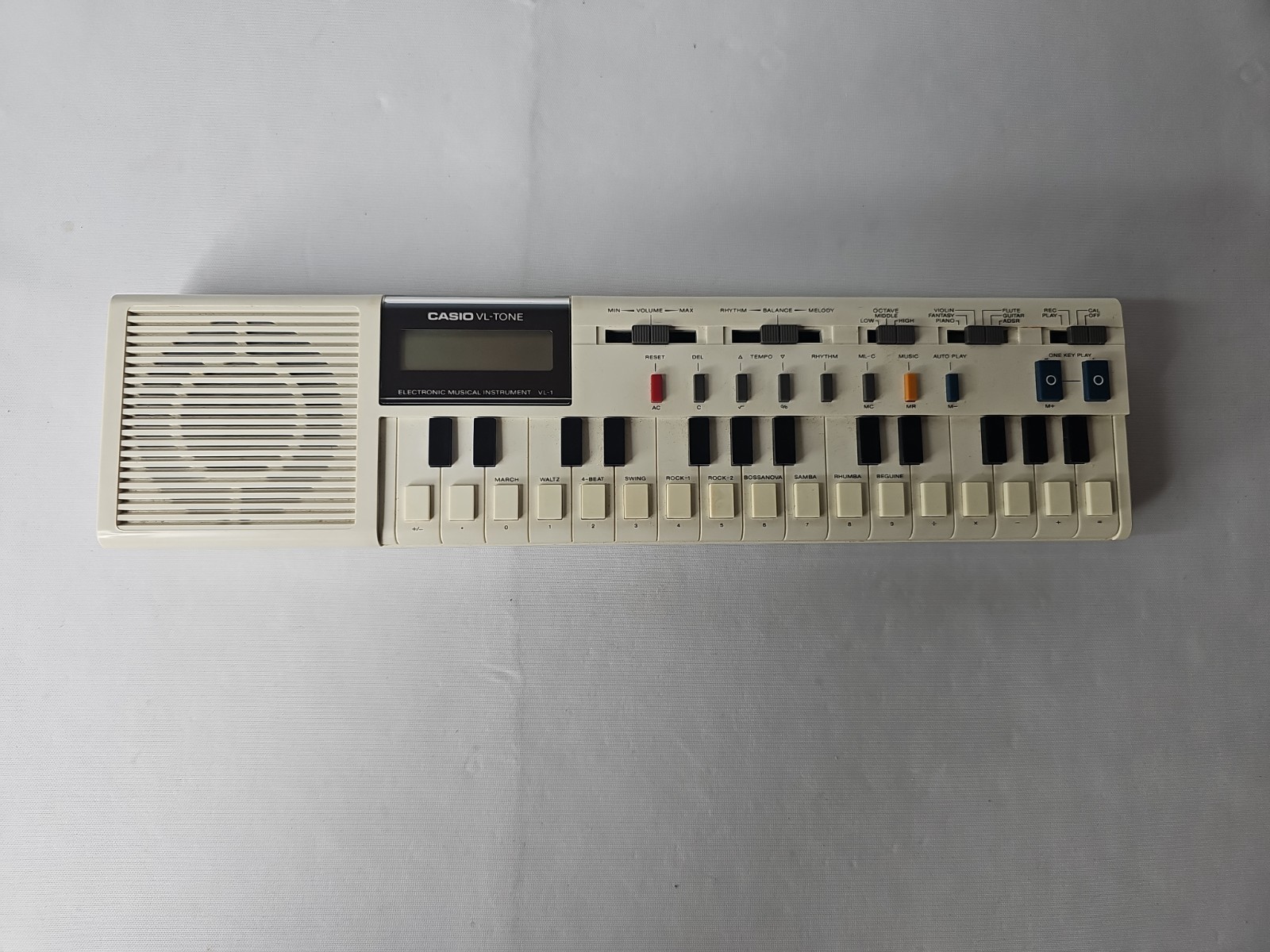
In 1979, Casio shipped what was essentially a four-function calculator with a keyboard glued to it. They called it the VL-Tone and priced it at the cost of a dinner for two. It had a speaker the size of a quarter, four waveforms, eight preset rhythms, and a 100-note memory. By any reasonable standard it should have been a novelty toy.
Three years later, a West German band called Trio used it to make "Da Da Da." The song went to #1 in Germany and top-five in Austria, and has since soundtracked approximately every Volkswagen commercial made in North America. The VL-1 became the first consumer synthesizer many people ever touched, and the first instrument whose limitations became its sound. Everyone from Stereolab to Daft Punk has a VL-1 sample in a track somewhere.
Specifications
| Manufacturer | Casio (Japan) |
| Production Years | 1979–1984 |
| Form factor | Pocket calculator + 29-key mini-keyboard |
| Polyphony | Monophonic (one note at a time) |
| Synthesis | Square/sawtooth-ish waveforms from LSI digital generator |
| Presets | 5: Piano, Fantasy, Violin, Flute, Guitar + one user-programmable ADSR |
| Rhythm patterns | 10 preset patterns (march, waltz, rock, etc.) |
| Memory | 100-note sequencer (non-volatile only if batteries fresh) |
| Calculator | Yes, fully functional four-function |
| Power | 4 × AA batteries or 6V DC adapter |
| Output | Built-in 1-inch speaker + 3.5mm mono line out |
| Dimensions | 230 × 90 × 30 mm |
| Weight | 340 g with batteries |
| Launch price | Approx. $69 US / ¥14,500 |
Why musicians actually use it
The VL-1's sound isn't "realistic" by any definition. It is consistent - the same cheap digital weirdness every time, no drift, no tuning, no warm-up. For producers after a tinny, compressed, 1980s toy-synth sound, it's faster than emulating it in software, because the real thing is the sound.
The rhythm section has a cult following of its own. The "Rock" pattern appears on dozens of indie records. The preset drum patterns have a quantized stiffness that no modern drum machine quite replicates, because modern drum machines are trying to sound good.
Known quirks and what to check
- Battery leakage. The most common VL-1 killer. Check the battery compartment — any green corrosion on contacts likely extends into the PCB traces. Repairable but tedious.
- Membrane keypad. The calculator buttons use a rubber membrane that hardens with age. If specific calculator keys don't respond, that's usually it.
- Speaker. The tiny built-in speaker often develops a rattle. Line out works around it; replacements are easy to solder in.
- Memory retention. The 100-note sequencer is volatile — any power interruption wipes it. Original behavior, not a fault.
- LSI chip. If the synth engine itself dies, it's unfixable — the digital IC is custom Casio silicon and unobtainable. Calculator-only VL-1s show up on eBay and are worth nothing.
Market context
As of 2026, working VL-1s sell for $80-$180, depending on condition and whether the original plastic case and manual are included. Boxed examples with strap and AC adapter occasionally cross $250. Broken units (synth not functional) sell for $20-$40 as calculator-only curiosities or parts donors. A handful of limited-edition colorways (pink Japanese domestic release, early black export) fetch premiums.
Further reading
- Casio VL-1 — Wikipedia
- VintageSynth explorer entry — context and audio clips
- Casio synth catalog — the PT, CZ, and HT lines that came after
eBay Listings


As an eBay Partner, we earn from qualifying purchases. This helps support our independent vintage technology research.
eBay Listings
As an eBay Partner, we earn from qualifying purchases. This helps support our independent vintage technology research.