Oberheim OB-Xa (1981–1984): The Programmable Powerhouse That Defined 1980s Sonic Grandeur
A rare blend of lush analog warmth, live-performance practicality, and preset programmability that made it the go-to polyphonic synth for arena rock, synth-pop, and Prince’s purple revolution.
Overview
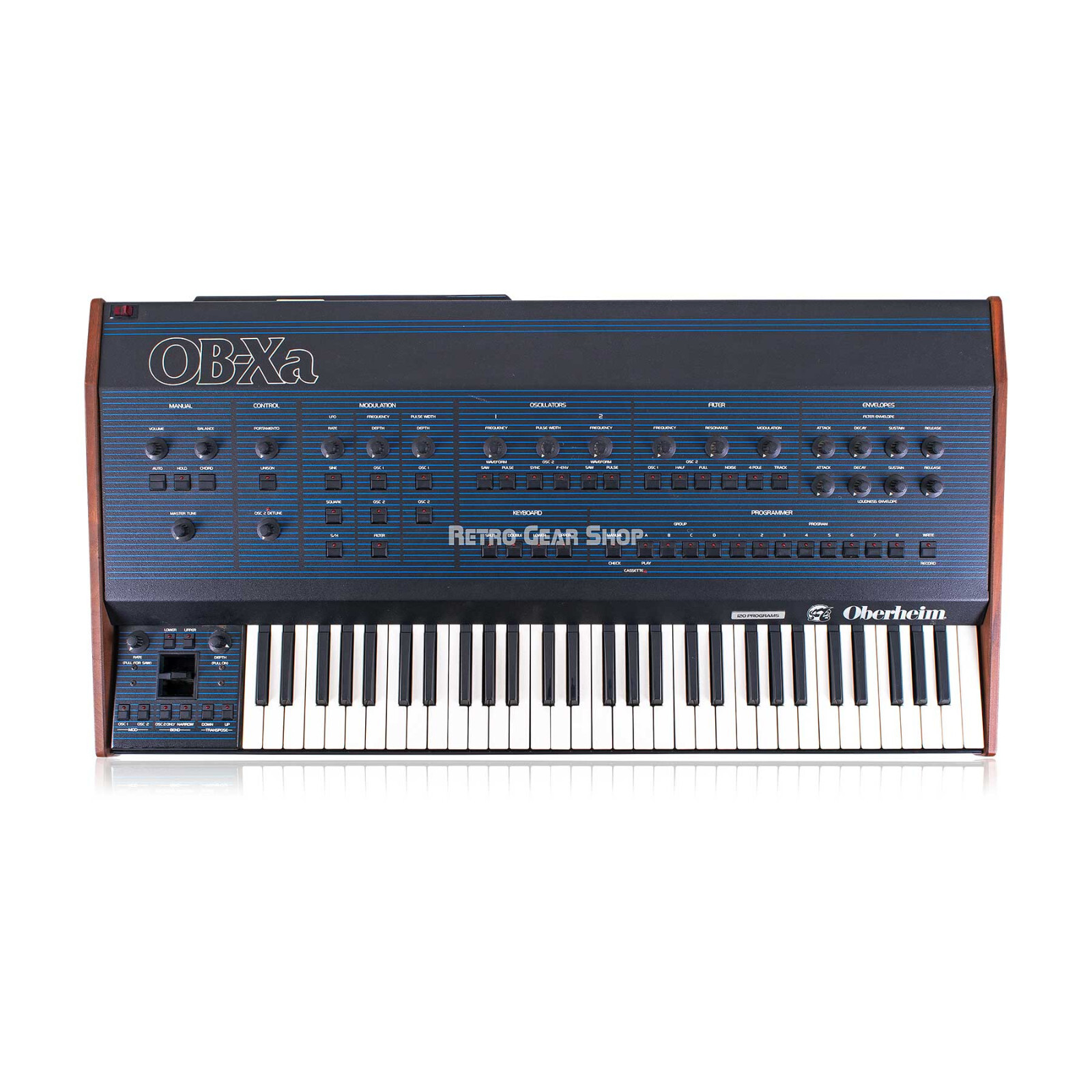
The Oberheim OB-Xa wasn’t just another analog synthesizer—it was a statement. Released in 1981 at the precise moment when rock acts were trading in their banks of monosynths for something more orchestral, the OB-Xa delivered a sonic depth and reliability that few contemporaries could match. With its 4- or 8-voice polyphony, dual oscillators per voice, and that unmistakably warm CEM 3320 filter, it became the secret weapon behind some of the decade’s most iconic recordings. Think of the soaring brass pads on Dire Straits’ “Private Investigations,” the punchy stabs in Van Halen’s “Jump,” or Prince’s entire 1999 album—that’s the OB-Xa flexing its harmonic muscle.
Unlike its legendary but temperamental predecessor, the Oberheim OB-X, the OB-Xa was designed for the road. It retained the rich, full-bodied Oberheim sound but wrapped it in a more stable, serviceable chassis with programmable presets—a godsend for live musicians who couldn’t afford to tweak knobs between songs. At a time when most polyphonic synths either lacked memory or were prohibitively expensive, the OB-Xa struck a rare balance: it was both a studio powerhouse and a stage-ready titan. Its 61-key keyboard offered both velocity and aftertouch sensitivity, a luxury in 1981, and its dual ADSR envelopes gave players nuanced control over filter and amplitude shaping.
Specifications
| Voices | 4 or 8 voices (user-configurable) |
| Oscillators per Voice | 2 |
| Waveforms | Sawtooth, Pulse, Triangle, Square |
| Filter | 12 dB/oct or 24 dB/oct low-pass, resonant, with envelope modulation |
| Filter Cutoff Range | 10 Hz - 20 kHz |
| Envelope Generators | 2 ADSR (filter and amplifier) |
| LFO | 1 LFO with triangle, square, sample & hold waveforms, syncable to oscillator 1 |
| Keyboard | 61 keys, velocity and aftertouch sensitive |
| Memory | 32 preset memories, 32 user memories |
| Dimensions | 38.5 x 15.5 x 5.5 inches (97.8 x 39.4 x 14 cm) |
| Weight | 70 lbs (31.8 kg) |
| Power | 115 VAC or 230 VAC, 100 watts |
| Audio Output Level | 10 Vpp maximum |
| Audio Output Impedance | 600 ohms balanced |
| Country of Manufacture | United States |
| Original MSRP (1981) | $5995 |
Key Features
- Programmable Voice Architecture with 64 Memories: The OB-Xa was one of the first truly programmable polyphonic synths that didn’t require a PhD in electronics to use. With 32 factory presets (including the legendary “Piano,” “Brass,” and “Strings”) and 32 user memories, it let musicians save and recall complex patches—revolutionary for live performance. No more frantic knob-twisting during a Van Halen set break.
- CEM 3320 Filter Chip – The Heart of the Sound: Replacing the discrete transistor ladder filters of the OB-X, the CEM 3320 gave the OB-Xa its signature warmth and musical resonance. While some purists argue it lacks the “raw edge” of the OB-X, the CEM chip offered greater consistency across temperature changes and touring conditions. Its 12 dB/oct and 24 dB/oct switchable slopes allowed for everything from silky pads to aggressive, Moog-like leads.
- Dual Oscillators with Sync and Modulation: Each voice featured two oscillators capable of hard sync, pulse-width modulation, and cross-modulation—giving the OB-Xa a rich, evolving character. The ability to sync Oscillator 2 to Oscillator 1 opened up metallic, bell-like tones that Prince exploited to perfection on tracks like “Automatic.”
- Velocity and Aftertouch on a 61-Key Keyboard: In 1981, this was a luxury. Most synths either had one or neither. The OB-Xa gave expressive players full dynamic control, letting them shape volume, filter, or modulation depth based on how hard they struck or pressed into the keys—essential for emotive performances.
- LFO with Sample & Hold and Oscillator Sync: The single LFO may seem sparse by modern standards, but its inclusion of sample & hold (great for random, sequenced textures) and the ability to sync to Oscillator 1 made it incredibly versatile. Try modulating the filter cutoff with a triangle wave for a slow, breathing pad, or crank the square wave for rhythmic tremolo effects.
Historical Context
The OB-Xa arrived at a pivotal moment in synth history. The late 1970s had seen the rise of polyphonic synths like the Yamaha CS-80 and the Oberheim OB-X, but these were often hand-built, unstable, and prohibitively expensive. By 1981, musicians wanted something that could survive a world tour, recall sounds reliably, and still sound massive. The OB-Xa delivered.
It was also a direct competitor to the Roland Jupiter-8, released the same year. While the Jupiter-8 had a slightly cleaner, more “polished” character and superior build quality, the OB-Xa countered with its more aggressive filter, deeper modulation options, and—crucially—preset memory. Roland didn’t add presets to the Jupiter line until the Jupiter-6 in 1983. For artists like Prince and Van Halen, who needed instant recall of complex sounds, the OB-Xa had the edge.
The OB-Xa also bridged the gap between analog warmth and digital convenience. It predated the digital synthesis revolution of the mid-80s (think Yamaha DX7) and remained firmly in the analog camp, but its programmability foreshadowed the future. When it was succeeded by the Oberheim OB-8 in 1983, that instrument refined the OB-Xa’s architecture with improved MIDI implementation and a more intuitive interface—but many players still argue the OB-Xa had a “dirtier,” more characterful sound thanks to its earlier CEM chip revisions.
Collectibility & Value
Today, the Oberheim OB-Xa is a highly sought-after collector’s item, with a desirability rating that borders on “synth royalty.” Only a few thousand were produced between 1981 and 1984, and surviving units in good condition are increasingly rare. As of 2025, a fully restored 8-voice OB-Xa can command between $8,000 and $15,000 on the vintage market—especially if it includes the original case, documentation, and has been serviced by a reputable tech.
However, buyers beware: the OB-Xa is not a plug-and-play relic. Its Achilles’ heel is the CEM 3320 filter chip, which is no longer manufactured and notoriously prone to failure. Many units suffer from “filter dropouts” or complete silence in certain voices due to degraded chips. Additionally, the power supply components—particularly electrolytic capacitors—tend to degrade after 40+ years, leading to instability or blown fuses. A unit that hasn’t been restored is often a $10,000 paperweight.
When shopping for an OB-Xa, prioritize units that have been professionally recapped and tested. Look for consistent voice tracking across all oscillators and smooth filter sweeps. The original Oberheim logo badges are often missing or damaged—replacements exist, but originals add value. And if you hear that rich, chorus-laden brass patch from “Jump” squeal to life under your fingers? You’ve found a keeper.
eBay Listings


As an eBay Partner, we earn from qualifying purchases. This helps support our independent vintage technology research.
Service Manuals & Schematics
- Service Manual — archive.org
- Service Manual — archive.org
- Owner's Manual — archive.org
- Manual — archive.org
- Service Manual (1982) — archive.org
Related Models
- Oberheim Matrix-12 (1985-1988)
- Oberheim OB-8 (1983-1985)
- Oberheim OB-X (1979-1981)
- Yamaha CS-80 (1977-1980)
- ARP 2600C (1978-1981)
- ARP 2600P (1975-1978)
- ARP Avatar (1979-1981)
- ARP Pro Soloist (1972-1977)
- ARP Solus (1975-1976)
- Korg Mono/Poly (1981-1984)