Oberheim OB-8 (1983–1985): The Analog Swan Song That Sang Through MIDI
The OB-8 was a six-voice analog synth with digital control, and it was Oberheim's last fully analog polyphonic synth.
Overview
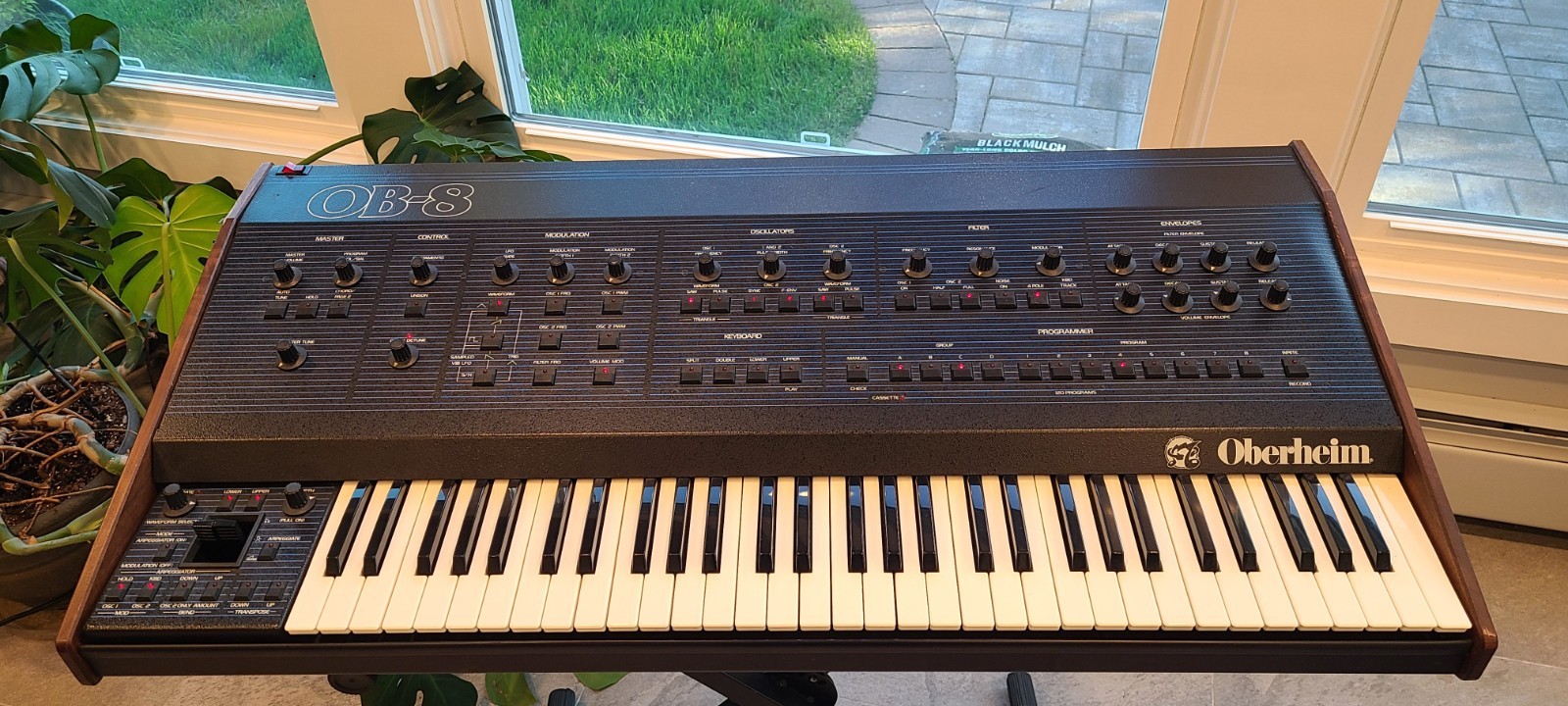
The Oberheim OB-8 came out in the early 1980s, when analog was being questioned, digital was on the rise, and players wanted instruments that sounded rich and behaved reliably. It was released between 1983 and 1985. It was Oberheim's last step in the OB-series lineage before the company moved toward digital and hybrid designs. It wasn't the flashiest synth of its era, and it wasn't the cheapest, but it sounded unmistakably Oberheim: lush, complex, and able to do shimmering pads and snarling basslines. It had six voices of true polyphony, dual analog oscillators per voice, and a filter section that could purr or scream. Studios from London to Los Angeles used it.
Artists like Depeche Mode and Vangelis gravitated toward its 61-key keyboard with full velocity and aftertouch sensitivity, which was a rarity at the time. It also stored and recalled 64 presets (32 factory, 32 user). That sounds modest today, but in 1983 programmable memory on a high-end analog synth was still a luxury. The modulation wheel and pitch bend controlled deeply responsive parameters. The MIDI implementation was solid for its time and let the OB-8 fit into the emerging digital studio.
Specifications
| Brand | Oberheim |
| Model | OB-8 |
| Category | Analog Synthesizer |
| Years Produced | 1983–1985 |
| Country of Manufacture | United States |
| Voice Count | 6 |
| Oscillators per Voice | 2 |
| Waveforms | Sawtooth, Square/Pulse, Triangle, Pulse Width Modulation |
| Filter Type | 12 dB/oct or 24 dB/oct resonant low-pass, 12 dB/oct high-pass |
| Filter Cutoff Range | 10 Hz – 20 kHz |
| Filter Resonance | Up to self-oscillation |
| Envelope Generators | 2 ADSR envelopes |
| LFO Waveforms | Sine, Triangle, Square, Sawtooth, Sample and Hold |
| LFO Rate Range | 0.1 Hz – 100 Hz |
| Keyboard | 61 keys, velocity and aftertouch sensitive |
| Memory | 64 user-programmable presets (32 factory, 32 user) |
| MIDI | MIDI In, Out, Thru |
| Pitch Bend Wheel | Yes |
| Modulation Wheel | Yes |
| Dimensions | 37.5 x 13.5 x 5 inches (95.3 x 34.3 x 12.7 cm) |
| Weight | 45 lbs (20.4 kg) |
| Power Requirements | 100–120 VAC, 60 Hz, 60 watts |
| Original MSRP (1983) | $3,995 |
Key Features
- Hybrid Voice Architecture: The OB-8 used a clever blend of discrete oscillators and Curtis CEM3340 integrated circuits—a design choice that balanced the raw, organic instability of pure analog with the tuning stability demanded by professional studios. This wasn’t just engineering compromise; it was a sonic sweet spot. The CEM3340 chips delivered the fat, singing oscillators Oberheim was known for, while keeping the synth from drifting out of tune during a three-hour session.
- Full MIDI Implementation: Unlike its predecessor, the OB-Xa, which had limited MIDI functionality, the OB-8 featured full MIDI in, out, and thru with patch change support and parameter control. This made it one of the first American analog synths to truly embrace MIDI as a performance and integration tool, not just an afterthought. You could switch presets from a sequencer, sync LFOs, and even control filter sweeps remotely—revolutionary in 1983.
- Enhanced Modulation Matrix: With two ADSR envelopes and a versatile LFO offering five waveforms—including sample and hold—the OB-8 gave sound designers deep control over movement and texture. The LFO could modulate pitch, filter cutoff, and pulse width simultaneously, enabling complex, evolving timbres that stood out in dense mixes. The Mk II revision smoothed out earlier firmware quirks, making crossfading between waveforms seamless and modulation routing more intuitive.
- Keyboard Expressiveness: The 61-note keyboard wasn’t just velocity-sensitive; it supported aftertouch, allowing real-time control over vibrato, filter sweeps, or volume swells by pressing harder on a key. This made the OB-8 not just a sound module, but a true performance instrument—something you could play, not just program.
Historical Context
The OB-8 arrived while analog was under pressure. Digital synths like the Yamaha DX7 were flooding the market with clean FM tones and rock-solid tuning, while analog makers struggled with reliability and price. Oberheim was riding high from the success of the OB-Xa and knew it couldn't ignore the shift. The OB-8 was the answer: an analog synth that kept the warm voice architecture of its predecessors and added digital control via MIDI.
The OB-Xa was its direct predecessor, but it suffered from inconsistent voice chips and spotty MIDI. The OB-8 fixed those issues and added programmable memory as standard. After it came the Xpander and the Matrix-12, both more complex, digitally controlled analog synths with expanded modulation and multitimbrality. The OB-8 was the last of the "classic" Oberheim polysynths: simpler, more immediate, and sonically cohesive. It competed directly with the Roland Jupiter-8 and the Sequential Circuits Prophet-10. The OB-8 offered superior MIDI and a slightly more aggressive tone - less "polished" than the Roland, less "smooth" than the Sequential, and present in a mix.
Collectibility & Value
Today the Oberheim OB-8 is considered uncommon but not rare. Approximately 1,200 units were reportedly produced across both Mk I and Mk II versions. Its current market value (2025) ranges from $3,500 to $5,500 USD, depending on condition, revision, and service history. A fully restored Mk II with stable tuning and replaced membrane switches commands the upper end. Unrestored Mk I units with drifting oscillators may sell for less, but they are restoration projects with high payoff.
There are three common failure points. First, the CEM3340 oscillator chips degrade over time, leading to tuning drift or complete voice dropout. Replacing them with modern equivalents or NOS parts is often necessary. Second, the membrane switches on the control panel are prone to failure. They can be replaced or bypassed with modern tactile switches, but it's a delicate mod. Third, the power supply capacitors degrade after 40 years, risking damage to the entire synth if not recapped. A unit that's been professionally serviced, especially with a fresh power supply and voice board calibration, is worth the premium. Mk II models are the ones to look for, with improved firmware and smoother operation. Test all six voices, MIDI functionality, and aftertouch before buying.
eBay Listings



As an eBay Partner, we earn from qualifying purchases. This helps support our independent vintage technology research.
Related Models
- Oberheim D-50
- Oberheim Matrix-12 (1985-1988)
- Oberheim OB-X (1979-1981)
- Oberheim OB-X8 (2022-)
- Oberheim OB-Xa (1981-1984)
- Akai Ax73 (1986)
- E-mu Vintage Keys
- E-mu Vintage Pro
- Gates Kurzweil K2000
- Gates Kurzweil K2500