Novation Bass Station (1993)
At $400 in 1993, it was a no-frills ticket to raw, digitally synchronized analog synthesis from a company just finding its legs.
Overview
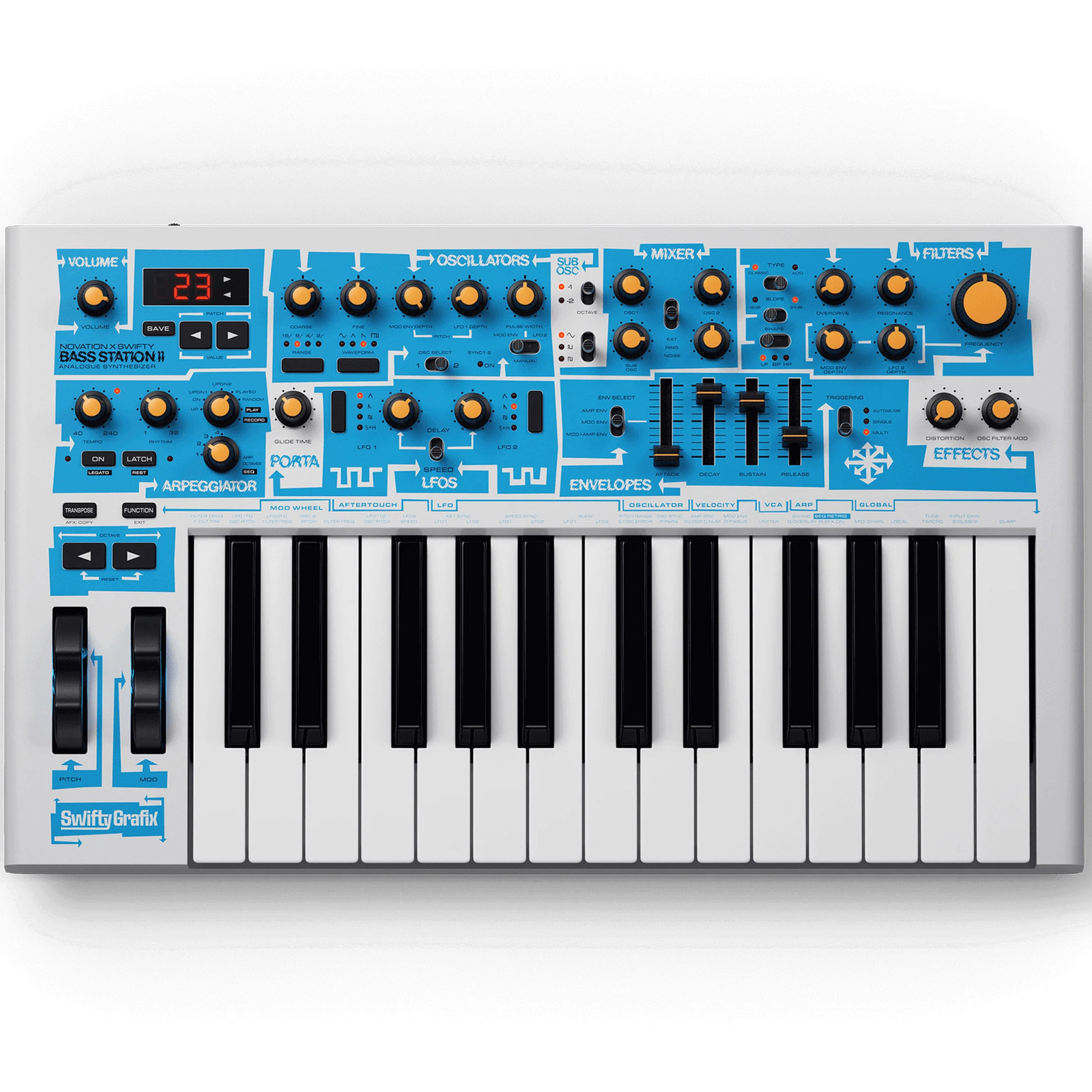
The Novation Bass Station arrived in 1993 not as a polished flagship, but as a scrappy, focused instrument from a fledgling British company testing its voice. It wasn’t trying to be a workstation or a digital multitool—just a compact, 25-key analog monosynth built to deliver punch and presence. Housed in a repurposed MM10 shell, its industrial plastic case suggests function-first engineering, not boutique flair. Yet inside, it channels a lineage: the same analog filter architecture derived from the OSCar and Wasp, stripped of its high-pass capability and locked into a low-pass configuration that bites hard when driven. It’s a dual-oscillator machine, both DCOs digitally controlled for stability, feeding that aggressive filter and a pair of digital envelopes generated by the CPU. The result? A synth that’s analog in character but digitally disciplined in timing—a hybrid approach that gave it reliability without fully sacrificing the warmth players sought.
Despite its limited I/O—no audio input, no expression pedal, no USB, no battery power—it carved a niche. MIDI implementation was present and functional, making it a viable slave or bass engine in a larger setup. The absence of internal modulation routing for filter resonance—despite MIDI and CV control—was a noted limitation, forcing players to modulate externally if they wanted that squelch to evolve. Still, its strength wasn’t flexibility; it was attitude. Described as “raw, punchy, and unmistakably analogue,” the Bass Station didn’t emulate vintage warmth so much as it weaponized it, delivering leads and basslines with a modern edge that cut through 1990s mixes. It wasn’t subtle, and it wasn’t trying to be.
Specifications
| Manufacturer | Novation |
| Product type | Analog monosynth |
| Number of Keys | 25 |
| Key Weight | Synth |
| Key Size | Full |
| Touch Sensitive | yes |
| Aftertouch | no |
| Polyphony | 1 (Monophonic) |
| Sounds Editable | yes |
| MIDI | yes |
| USB | no |
| AC Power | yes |
| Batteries | no |
| Speakers | no |
| Audio Out | yes |
| Audio In | no |
| Sustain Pedal | yes |
| Soft Pedal | no |
| Expression Pedal | no |
| Oscillators | 2 DCOs |
| Filter Type | Analog low-pass filter (based on OSCar/Wasp design, high-pass mode removed) |
Key Features
Dual DCO Architecture with Digital Synchronization
The Bass Station relies on two identical Digitally Controlled Oscillators, a design choice that prioritizes tuning stability over the free drift of pure analog VCOs. This “digitally synchronized analog” approach made it reliable in live settings and studio environments where consistency mattered. The digital core ensures the oscillators lock tightly to internal timing, reducing tuning drift but sacrificing some of the organic wobble prized in vintage synths. Still, when layered and detuned slightly, they produce a thick, assertive tone that forms the backbone of the synth’s character.
Analog Low-Pass Filter (OSCar/Wasp Heritage)
At the heart of the Bass Station’s voice is its analog low-pass filter, a direct descendant of the circuitry found in the Electronic Music Studios (EMS) OSCar and Wasp synths. Chris Huggett, the designer behind those British classics, brought that same aggressive filter topology to Novation’s first major product. However, the implementation is simplified: the high-pass mode present on the OSCar was removed, leaving only the low-pass configuration. Even so, the filter delivers pronounced resonance and a snarling, self-oscillating character when pushed. It responds to external CV and MIDI, but critically, it cannot be modulated by the synth’s internal LFO or envelopes—a design constraint that limits on-board movement but encourages external modulation via sequencers or effects.
Digitally Generated Envelopes
Unlike fully analog envelope generators, the Bass Station’s envelopes are generated by the CPU, making them digital in origin. This contributes to the synth’s precise timing and reliability, but The envelopes are functional—capable of shaping amplitude and filter cutoff—but lack the smooth, rounded curves of analog designs. They serve the synth’s utilitarian purpose: fast, punchy bass and leads with immediate response. The trade-off is character for consistency, a reflection of the engineering priorities of a young company aiming for affordability and stability.
25-Key Velocity-Sensitive Keyboard with Sustain
The keyboard spans 25 full-sized synth-weight keys, offering velocity sensitivity for dynamic expression but no aftertouch. This makes it expressive enough for punchy staccato basslines or swelling leads, but limits deeper articulation. The inclusion of a sustain pedal input adds basic performance control, aligning with standard keyboard practice. It was never intended as a stage piano, but as a dedicated sound module with keys, built for quick access and immediate playability.
Historical Context
The original Novation Bass Station was the seminal product that laid the foundation for Novation as a British synth manufacturer. It marked Chris Huggett’s first collaboration with the fledgling company, bringing his pedigree from EMS to a new generation of affordable instruments. Launched in 1993, it predated the more widely known Bass Station Rack, establishing the name and sonic identity in a compact keyboard format. At the time, Novation was practically just beginning, and the Bass Station served as both a statement of intent and a proof of concept. Before the company expanded into workstations, controllers, and digital synths, this was their opening salvo: a no-compromise analog monosynth built to deliver character on a budget.
eBay Listings



As an eBay Partner, we earn from qualifying purchases. This helps support our independent vintage technology research.
Related Models
- ARP Explorer 2900
- ARP Odyssey Model 2800 (1972)
- ARP 2823 (1978-1981)
- ARP Explorer I (1974)
- ARP Rhodes Chroma
- Akai Ax73
- Akai AX60
- Akai AX80
- Akai VX90
- Alesis Andromeda A6