Moog Taurus I (1975–1981): The Foot-Operated Colossus That Rumbled Beneath Rock’s Golden Age
A 13-note pedalboard powerhouse that let keyboardists stomp out seismic analog basslines while keeping their hands free for solos, chords, and cosmic exploration.
The Moog Taurus I isn’t just a synthesizer—it’s a seismic event disguised as a floor unit. Born in 1975 at the peak of analog synthesis and progressive rock’s theatrical zenith, the Taurus I solved a very specific problem: how do you play deep, growling, Moog-quality bass lines without sacrificing your hands to a keyboard? The answer? Your feet. This wasn’t just clever engineering; it was a performance revelation. Suddenly, keyboardists could lay down subterranean bass foundations with their boots while unleashing arpeggios and solos with their fingers. It was like giving a musician an extra limb—only this one weighed 35 pounds and could shake the foundations of a stadium.
And shake they did. The Taurus I became a secret weapon for bands like Genesis (especially during the Peter Gabriel and early Phil Collins eras) and Yes, where complex, layered arrangements demanded more than one player could physically deliver. Tony Banks famously used the Taurus to thicken his sound, letting his left hand rest while his left foot pounded out ominous, resonant fifths and octaves. The Taurus I didn’t just fill out the low end—it redefined what was possible in live keyboard performance. It was the missing link between the organist’s traditional bass pedalboard and the emerging world of analog synthesis, and it did so with the unmistakable sonic signature of the Moog ladder filter: warm, fat, and capable of sounding like a dinosaur’s mating call or a tectonic plate shifting.
Specifications
| Type | Analog monophonic bass synthesizer |
| Keyboard/Pedalboard | 13-note foot-operated keyboard (C to C) |
| Oscillators | 1 voltage-controlled oscillator (VCO) |
| Waveforms | Sine, triangle, pulse (variable width) |
| Filter | Moog ladder filter (24dB/octave low-pass) |
| Envelope | ADSR envelope generator |
| Control Inputs | 1/4" CV and Gate inputs for external control |
| Audio Output | 1/4" unbalanced |
| Power | 120V AC, 60 Hz (US standard) |
| Dimensions | 36.5 x 14.5 x 6 inches (92.7 x 36.8 x 15.2 cm) |
| Weight | 35 lbs (15.9 kg) |
| Construction | Wooden cabinet with metal grille, rubber foot pedals |
| Country of Manufacture | United States |
| Original MSRP | $1395 (1975) |
Key Features
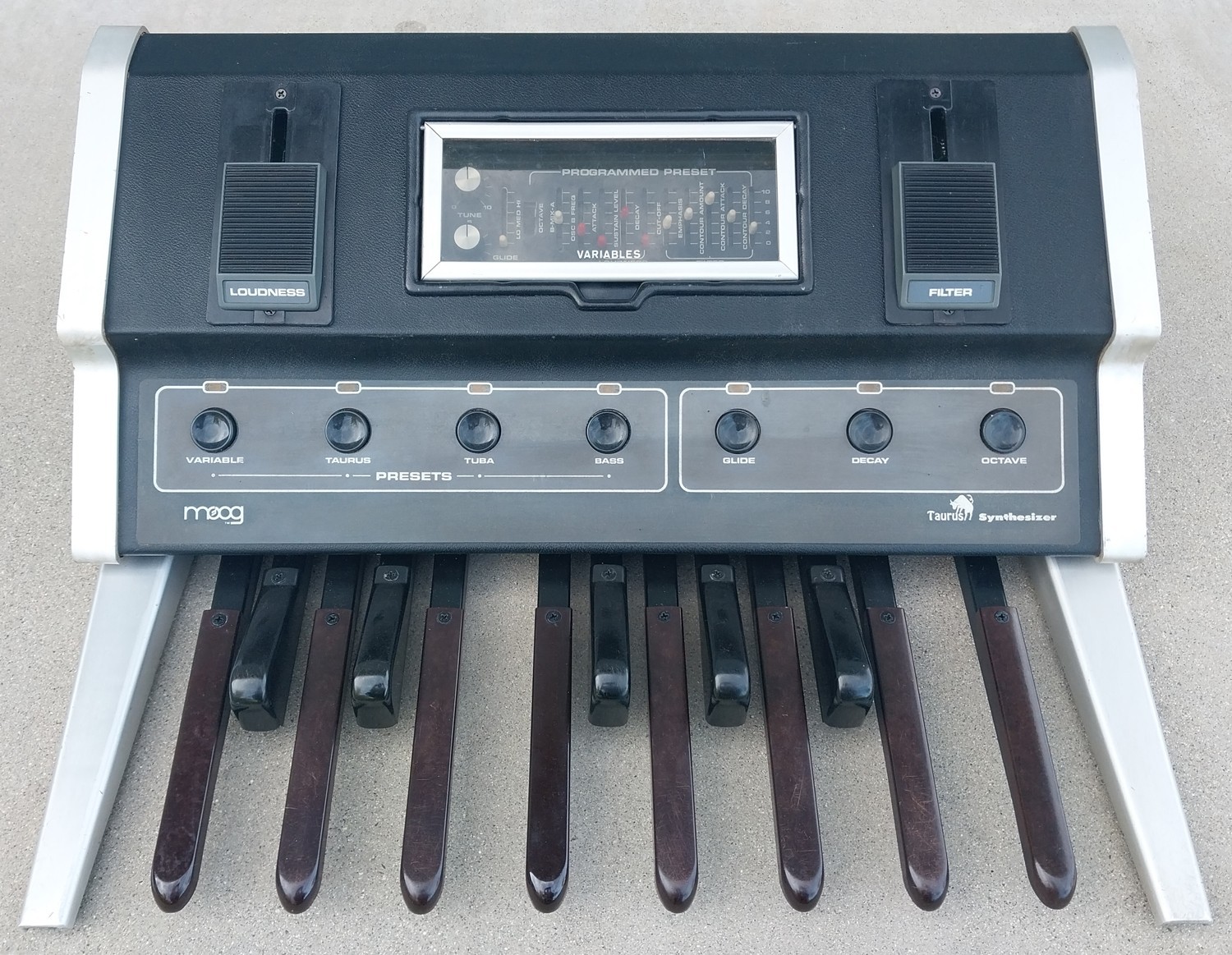
- Foot-Operated Pedalboard Design: The 13-note (C to C) rubber-topped pedalboard wasn’t just a gimmick—it was a performance breakthrough. Modeled after organ pedalboards but tuned for synth bass, it allowed seamless integration into live rigs. You could hold a chord with your left hand on a Minimoog while your foot played a walking bassline on the Taurus. Try doing that with two hands.
- Moog Ladder Filter (24dB/octave low-pass): This is why the Taurus I sounds like Moog. That legendary filter imparts a warmth and resonance that’s impossible to fake digitally. Even at full resonance, the filter remains musical—snarling but never brittle. When you hit a low C and sweep the filter, it feels like opening a portal to the Earth’s core.
- Monophonic Analog Architecture with ADSR Envelope: Despite having only one VCO, the Taurus I delivers immense character thanks to its full ADSR envelope. You can shape notes from soft, swelling drones to sharp, percussive stabs—essential for mimicking synth bass parts from studio recordings in a live setting.
- CV/Gate Inputs for External Control: A nod to modular purists, the 1/4" CV and Gate inputs let you drive the Taurus I from a sequencer or another synth. Want your ARP 2600 to trigger Taurus bass? Done. This flexibility made it a favorite in hybrid setups.
- Built Like a Tank: Housed in a solid wooden cabinet with a metal grille and industrial-grade rubber pedals, the Taurus I was built for the road. It wasn’t light—35 pounds will wreck your back—but it survived the rigors of 1970s touring. That said, those rubber pedals are now the Achilles’ heel of surviving units (more on that later).
Historical Context
Before the Taurus I, bass pedals were either mechanical (like those on a Hammond organ) or rudimentary electronic add-ons with limited tonal range. Moog didn’t invent the concept of foot-played keyboards, but they were the first to marry it to a full analog synth voice—and do it under their name. Released in 1975, the Taurus I arrived when progressive rock was at its most ambitious. Bands were layering keyboards, experimenting with time signatures, and demanding more from their stage setups. The Taurus I answered that call with a solution that was as elegant as it was heavy—literally.
It stood apart from contemporaries like the Oberheim OB-1, which was a portable, hand-played synth with a built-in sequencer but no pedal interface. The OB-1 was innovative, but it didn’t solve the “hands vs. bass” dilemma the way the Taurus did. Moog wasn’t chasing portability or polyphony—they were chasing depth, both sonic and performative. The Taurus I was succeeded by the Moog Taurus II in 1981, which added a second VCO, preset memory, and a sleeker metal case, but lost some of the raw immediacy of the original. Later, in 2010, Moog revived the line with the Moog Taurus III, a modern reinterpretation with MIDI and expanded control—but at nearly $3,500, it was more tribute than replacement.
The Taurus I also reflected a broader trend: the modular-to-integrated shift in synth design. By the mid-70s, musicians wanted self-contained instruments, not racks of modules. The Taurus I was a complete, dedicated bass synth in one rugged box—no patch cables, no guesswork. It was Moog’s answer to the need for reliability on stage, wrapped in a form factor that was as theatrical as the music it helped create.
Collectibility & Value
Today, the Moog Taurus I is a rare and coveted beast. Fewer than 200 units were reportedly produced during its 1975–1981 run, and many were worked hard on tour. That scarcity, combined with its iconic status in prog and fusion circles, has driven prices into the stratosphere. As of 2025, a working Taurus I in good condition will fetch between $4,000 and $7,000 USD, with pristine, fully serviced units sometimes commanding more. It’s not just a synth—it’s a centerpiece, a conversation starter, a museum-worthy artifact of analog innovation.
But buying one is not for the faint of heart or thin of wallet. The biggest issue? Those rubber foot pedals. Decades of stomping have left many units with broken contacts, cracked rubber, or intermittent triggering. Replacing or repairing them requires specialist knowledge—some techs now 3D-print replacement parts or retrofit modern switches. Beyond the pedals, expect to deal with aging capacitors, degraded wiring, and potential power supply issues, especially if the unit hasn’t been serviced in years. A “cosmetic-only” Taurus might look cool under a stage light, but if it doesn’t play, it’s just a very expensive footrest.
If you’re in the market, insist on a fully functional demo. Check every note across the pedalboard, listen for oscillator stability, and test the filter sweep for smoothness. Original finish and paperwork (like the manual or brochure) add value, but reliability is king. And if you’re lucky enough to own one? Treat it like the relic it is—keep it warm, dust-free, and never, ever let a drummer borrow it for kick drum practice.
eBay Listings

As an eBay Partner, we earn from qualifying purchases. This helps support our independent vintage technology research.