Korg Polysix (1981–1984): The Analog Workhorse That Brought Polyphony to the People
A six-voice analog polyphonic synth with a cult-favorite chorus effect, the Polysix made lush, warm sounds accessible to working musicians when such luxuries were still a rarity.
Overview
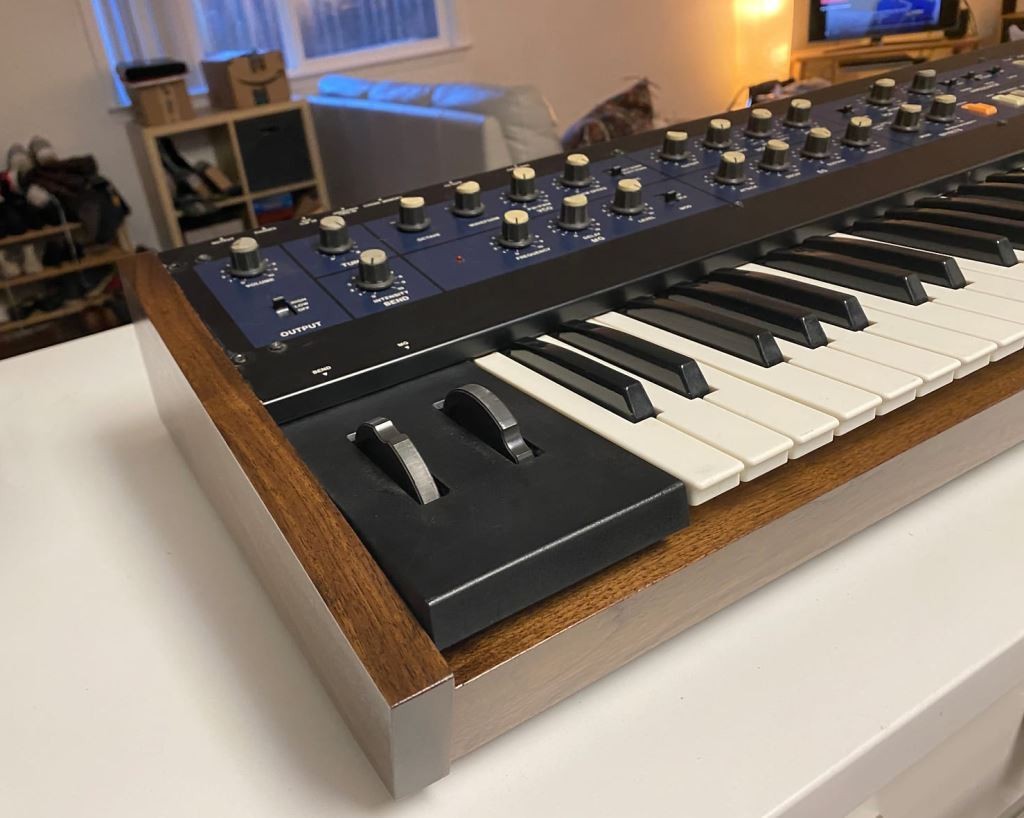
The Korg Polysix wasn’t the first polyphonic analog synthesizer, nor was it the most powerful. But in the early 1980s, when Roland’s Jupiter-8 cost more than a used car and digital synths like the Fairlight CMI were science fiction for most musicians, the Polysix arrived like a breath of fresh, slightly chorused air. Priced at a modest $1,695 in 1981—roughly half the cost of many competing polysynths—it brought genuine analog polyphony within reach of bedroom composers, touring keyboardists, and indie studios. It wasn’t flashy, but it was functional, musical, and, most importantly, affordable. And with its iconic built-in analog chorus, it could conjure pads and strings that sounded like they were recorded in a cathedral, even when played through a practice amp in a damp basement.
The Polysix became a staple in genres ranging from new wave to ambient, used by artists who valued texture over technical fireworks. You can hear its fingerprints on records by Tears for Fears, The Human League, and even in the background washes of early Talk Talk albums. Unlike some of its contemporaries that leaned into digital presets or complex architecture, the Polysix kept things refreshingly straightforward: six voices, one oscillator per voice, a single filter, and a modulation section that, while limited, was more than capable of expressive movement. Its programming interface was entirely knob-per-function—no menu diving, no cryptic button combinations. What you saw was what you got, and that honesty earned it a loyal following.
Specifications
| Voice Architecture | 6 voices, 1 oscillator per voice |
| Polyphony | 6 notes |
| Oscillator Waveforms | Sawtooth, Pulse, Triangle, Square |
| Pulse Width Modulation | Yes, via LFO or envelope |
| Filter Type | Voltage-Controlled Filter (VCF), 24dB/oct low-pass |
| Filter Cutoff Range | 16 Hz – 20 kHz |
| Filter Resonance | Adjustable up to self-oscillation |
| Envelope Generators | ADSR: Attack (10 ms – 10 s), Decay (100 ms – 10 s), Sustain (0% – 100%), Release (100 ms – 10 s) |
| LFO Waveforms | Triangle, Square, Sample & Hold |
| LFO Rate Range | 0.1 Hz – 100 Hz |
| LFO Modulation Targets | Pitch, Pulse Width, Filter Cutoff |
| Keyboard | 61 keys (F to F), non-velocity-sensitive, no aftertouch |
| Arpeggiator | Up, Down, Up/Down, Programmable Hold |
| Memory | 32 user patches, 32 factory patches |
| Audio Outputs | 1x 1/4" unbalanced |
| Audio Input | 1x 1/4" for external signal processing through filter and envelope |
| Headphone Output | 1x 1/4" |
| Control Inputs | Sustain pedal, Expression pedal |
| Chorus Effect | Built-in analog bucket-brigade device (BBD) chorus |
| Dimensions | 980 mm × 348 mm × 110 mm |
| Weight | 13.5 kg |
| Power Supply | AC 120V / 240V, 50/60 Hz |
Key Features
- 6-Voice Polyphony with Single Oscillator Efficiency: While most polyphonic synths of the era used two oscillators per voice (like the Roland Juno-6), the Polysix achieved its six-voice count with just one oscillator per voice. This design choice kept costs down and the unit compact, but Korg compensated with rich modulation options and that legendary chorus, making up for harmonic simplicity with textural depth.
- Analog Bucket-Brigade Chorus (BBD): The Polysix’s chorus isn’t just an effect—it’s the reason people still hunt for this synth. Using analog BBD chips, it delivers a warm, swirling modulation that thickens even the simplest patch into something cinematic. It’s so integral to the sound that many owners leave it on constantly. Turn it off, and the synth feels oddly naked.
- Direct Patch Programming: Every parameter has a dedicated knob. No menus, no data wheels, no cryptic displays. Want to tweak the filter envelope? There’s a knob for that. This immediacy makes sound design intuitive and performance-friendly—critical in an era when real-time control was still a novelty.
- External Audio Processing: The 1/4" audio input lets you route external signals (like a drum machine or another synth) through the Polysix’s filter and envelope. This turns it into a powerful analog processor—perfect for adding movement to static sounds or creating dynamic filter sweeps on the fly.
- Programmable Arpeggiator with Hold: For its time, the arpeggiator was advanced. The “Hold” function lets you latch the pattern while freeing up your hands—ideal for layering parts live. It’s simple, but effective, and adds a rhythmic dimension that many of its peers lacked.
Historical Context
The early 1980s were a turning point for synthesizers. Analog polysynths like the Roland Juno-6 and Sequential Circuits Prophet-5 had proven the market, but they were expensive and often out of reach for all but top-tier acts. Korg, still building its reputation in the professional synth world, saw an opening: deliver polyphony without the premium. The Polysix was their answer—a no-frills, no-compromises (well, few compromises) analog machine that prioritized usability and sonic character over raw specs.
It arrived in 1981, the same year as the Juno-6, and while the two are often compared, they had different philosophies. The Juno offered a second oscillator and better build quality; the Polysix countered with more hands-on control and that magical chorus. Where the Juno felt polished, the Polysix felt alive—slightly unpredictable, a little gritty, but full of soul. It was also a bridge between Korg’s earlier, more experimental synths like the Korg Lambda and the digital shift that would define the mid-80s. Its successor, the Korg Poly-800, would abandon knobs for sliders and begin the move toward cost-reduced, mass-market designs. The Polysix, then, was perhaps Korg’s last truly hands-on analog poly before the digital tide rolled in.
Collectibility & Value
Today, the Polysix is highly desirable among analog synth enthusiasts, particularly those chasing that early-80s pad aesthetic. With a current market value ranging from $800 to $1,500 (2025), it’s not the most expensive vintage synth, but it’s no bargain bin find either. Its rarity is “uncommon”—not rare enough to be mythical, but scarce enough that a fully functional, well-maintained unit commands a premium. Cosmetic condition matters less than functionality; these synths were built tough, and the plastic case can show wear without affecting performance.
However, potential buyers should be cautious. The Polysix is notorious for aging-related issues. The power supply capacitors are prone to degradation, which can lead to noise, hum, or even failure. The audio path also uses electrolytic capacitors that may need replacing after 40+ years. Pots and switches often develop crackles due to oxidation—cleaning helps, but a full service may be necessary. The chorus, while legendary, relies on aging BBD chips that can fail or develop clock noise. A working Polysix with a pristine chorus is the holy grail. If you’re buying, insist on a video demo and check for even voice tuning across the keyboard—some units suffer from slight drift, especially when cold.
eBay Listings



As an eBay Partner, we earn from qualifying purchases. This helps support our independent vintage technology research.
Service Manuals & Schematics
- Service Manual — archive.org
- Owner's Manual — archive.org
- Schematic — archive.org
- Service Manual — archive.org
Related Models
- Korg Mono/Poly (1981-1984)
- Korg MS-20 (1978-1983)
- Yamaha CS-80 (1977-1980)
- ARP 2600C (1978-1981)
- ARP 2600P (1975-1978)
- ARP Avatar (1979-1981)
- ARP Pro Soloist (1972-1977)
- ARP Solus (1975-1976)
- Moog Memorymoog (1982-1985)
- Moog Minimoog Model D (1970-1981)