Korg Mono/Poly (1981–1984): The Analog Bridge Between Monophony and Polyphony
A four-voice analog powerhouse with a chameleon-like voice architecture that delivered lush polyphony, snarling unison leads, and everything in between—before digital took over.
Overview
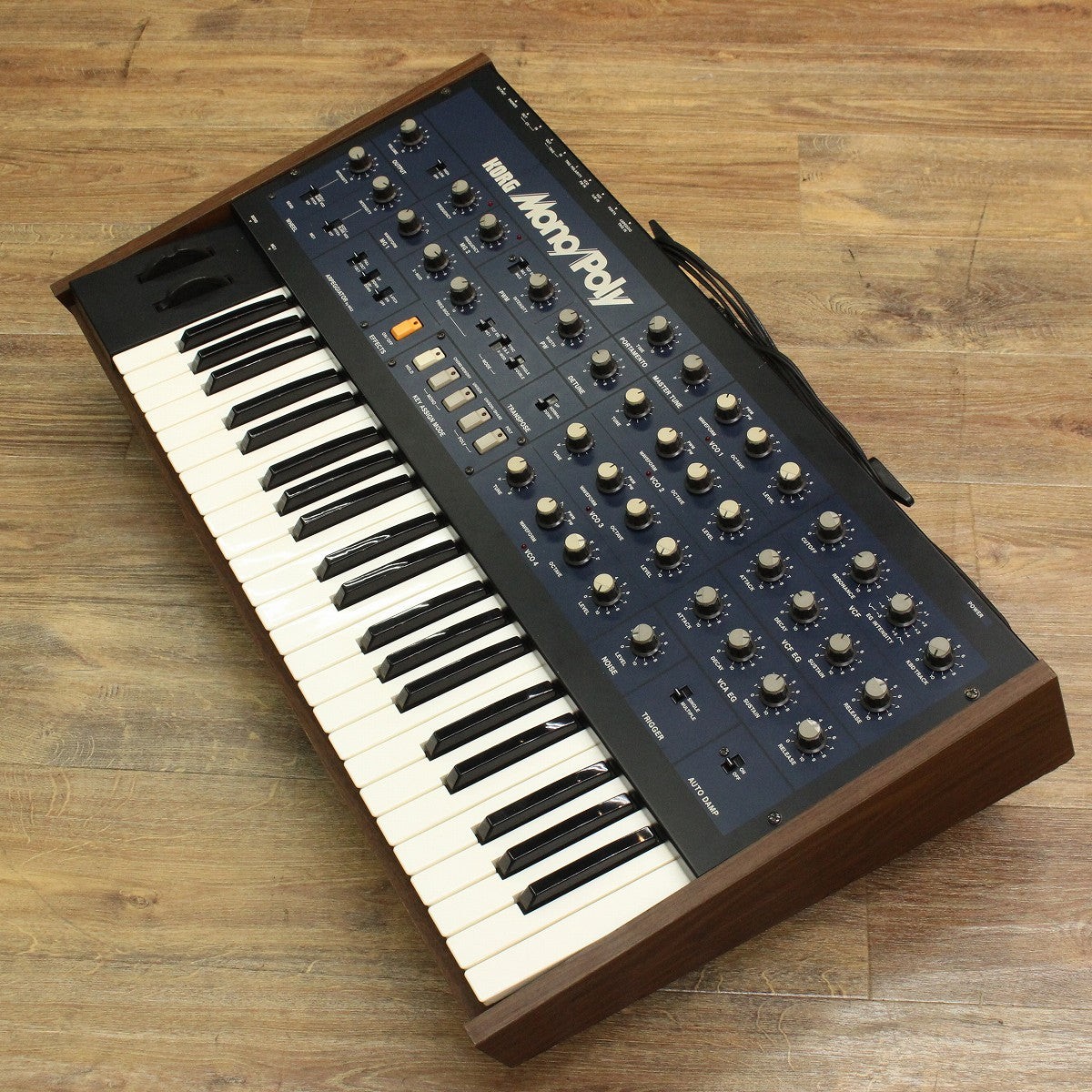
The Korg Mono/Poly wasn’t just another analog synthesizer dropped into the early ’80s synth boom—it was a quiet revolutionary. Priced at $1,395 in 1981 (roughly $4,300 today), it offered something exceedingly rare for its time: true analog polyphony with per-voice voltage-controlled oscillators, filters, and amplifiers, all packed into a sleek, space-gray Japanese chassis. While competitors were either monophonic beasts or prohibitively expensive polyphonic systems, the Mono/Poly carved its niche as the pragmatic dreamer—affordable enough for working musicians, yet sonically rich enough to land on records by Depeche Mode, New Order, and Gary Numan. It didn’t just compete; it filled a gap in the market that almost no one else dared to touch.
What made the Mono/Poly truly special wasn’t just its four-voice architecture, but how it let you use those voices. You could stack all four VCOs into a single, screaming unison lead—thicker than a slab of Chicago deep-dish—or split them into duophonic mode for fat basslines with intervallic movement. Or, if you were feeling civilized, go full 4-voice polyphony for chords that shimmered with warmth and slight imperfection, the kind of organic drift that digital synths would spend the next decade trying (and failing) to emulate. This flexibility made it a favorite among synth-pop pioneers who needed one keyboard to do everything: leads, pads, bass, and atmospheric textures. It was the Swiss Army knife of analog polysynths—before the Swiss Army even made one with a corkscrew.
Specifications
| Synthesis Type | Analog subtractive |
| Oscillators | 4 VCOs per voice, selectable tuning modes (mono/unison, duophonic, 4-voice poly) |
| Waveforms | Sawtooth, square/pulse (variable pulse width), triangle, noise |
| Filter | 1 VCF per voice, 24dB/oct resonant low-pass (based on IR3109 chip) |
| Envelope Generators | 2 ADSR envelopes (one for filter, one for amplifier) |
| LFO | 1 LFO with triangle, square, sample & hold waveforms, with delay |
| Keyboard | 44 keys (F to F), velocity and aftertouch sensitive |
| Aftertouch | Channel aftertouch (not polyphonic) |
| Memory | 32 patch memories |
| Dimensions | 990 mm × 375 mm × 115 mm |
| Weight | 18.5 kg |
| Audio Output Level | 1 Vrms max |
| Audio Output Impedance | 1 kohm |
| Power Requirement | AC 120V / 230V, 50/60 Hz, 25W |
| Country of Manufacture | Japan |
| Original MSRP | $1395 (1981) |
Key Features
- Four-voice architecture with flexible voice assignment: The Mono/Poly’s core brilliance lies in its ability to morph between mono, duophonic, and polyphonic modes. In unison mode, all four VCOs per voice lock into a single note, creating a lead sound so thick it could stop a bullet. Duophonic mode allowed two-note playing with independent voice allocation—perfect for fifth intervals in basslines. And in full polyphony, it delivered genuine four-voice analog chords, each with its own filter and amp envelope. This wasn’t paraphony; this was the real deal.
- Per-voice VCO, VCF, and VCA: Unlike budget polysynths that shared filters or envelopes across voices, the Mono/Poly gave each voice its own complete signal path. That meant every note in a chord could have its own envelope contour and filter response, resulting in a dynamic, expressive sound that felt alive. The IR3109-based filter—a chip also found in the Korg MS-20—added a creamy, slightly aggressive resonance that cut through mixes without turning brittle.
- Velocity and channel aftertouch on a 1981 synth: This was advanced for its time. Most synths in 1981 didn’t even have velocity, let alone aftertouch. The Mono/Poly’s 44-note F-to-F keyboard responded to both, allowing for expressive swells and modulations via aftertouch-triggered LFO or filter sweeps. It wasn’t polyphonic aftertouch (that luxury wouldn’t become common until the Sequential Circuits Prophet-5 Rev 4), but channel aftertouch was still a major step forward in performance expressiveness.
- 32 patch memories with instant recall: In an era when most synths required manual knob-twiddling for every sound change, the Mono/Poly’s 32 memories were a godsend. You could store complex unison patches, modulated pads, or snappy basses and recall them instantly—critical for live performance. The interface was straightforward: numeric keypad, “Write” button, and a single LED to confirm storage. No menus, no scrolling, no nonsense.
Historical Context
The early 1980s were a crossroads for synthesizers. The monosynth era—dominated by the Korg MS-20 and Minimoog—was giving way to polyphony, but true analog polyphonic synths were either rare or ruinously expensive. The Sequential Circuits Prophet-5 had proven it was possible, but at nearly $3,000 in 1981, it was out of reach for most. Enter the Mono/Poly: Korg’s answer to the demand for affordable, expressive polyphony. It didn’t try to match the Prophet-5’s eight voices or full programmability—it offered four voices, a streamlined interface, and a price that made studio owners nod instead of faint.
What the Mono/Poly lacked in sheer voice count, it made up for in character. Its oscillators had a slight instability—some might call it “drift”—that gave chords a living, breathing quality. This wasn’t a flaw; it was texture. In an age before digital perfection, that imperfection was golden. And while Korg would follow up with the budget-friendly Korg Poly-800 in 1983 (which used a cost-reduced architecture with a single shared VCF), the Mono/Poly remained the last of Korg’s fully-featured, per-voice analog polys before the digital tsunami hit. By 1984, the Yamaha DX7 had arrived, and FM synthesis began to eclipse analog warmth. The Mono/Poly, produced until that same year, was one of the last great analog holdouts—a final flourish before the silicon age.
Collectibility & Value
Today, the Korg Mono/Poly is a sought-after gem, rated “high” in desirability and “uncommon” in the wild. In 2025, a fully functional unit in good condition will fetch between $2,500 and $4,000 USD, with mint examples commanding the upper end—especially if they include the original case and documentation. Its value has steadily climbed, not just for nostalgia, but for its irreplaceable sound: that rich, slightly gritty analog tone that modern plugins still struggle to replicate.
But buyer beware: age has not been kind to all units. The most common issues are capacitor leakage and power supply failures—particularly in the AC/DC converter board, which can take out other components if neglected. Sticky keys and worn keybed contacts are also frequent, thanks to the rubber pad contacts under the keys, which degrade over decades. When shopping, insist on a unit that powers on without hum, has responsive aftertouch, and—critically—retains tuning stability across all four voices. A recapped power supply and cleaned key contacts can add hundreds to a synth’s resale value, but they’re often necessary. For the serious collector or working musician, a serviced Mono/Poly isn’t just an investment—it’s a portal to a pivotal moment in synth history.
eBay Listings



As an eBay Partner, we earn from qualifying purchases. This helps support our independent vintage technology research.
Related Models
- Korg MS-20 (1978-1983)
- Korg Polysix (1981-1984)
- Yamaha CS-80 (1977-1980)
- ARP 2600C (1978-1981)
- ARP 2600P (1975-1978)
- ARP Avatar (1979-1981)
- ARP Pro Soloist (1972-1977)
- ARP Solus (1975-1976)
- Moog Memorymoog (1982-1985)
- Moog Minimoog Model D (1970-1981)