E-mu Xtreme Lead-1 (c. 2000–2001)
Sixty-four voices of late-90s dance DNA in a half-rack box that weighs less than a bag of sugar.
Overview
The E-mu Xtreme Lead-1 weighs 2.2 lb and is 8.5 inches wide. It's easy to forget it's on your desk until you switch it on and the room fills with the supersaw and trance-stab sounds that defined turn-of-the-millennium production. This is the desktop module version of the Xtreme Keys-1 keyboard. It belongs to E-mu's "Xtreme" family - a lineup that also included the Xtreme Synth-1 and other variants, all built around the same core engine.
The Xtreme Lead-1 is a ROM-based variant of the XL-1, running on the Proteus 2000 / XL-1 "C" series engine. That means it's not a sample-playback device in the traditional sense. There's no user-loadable RAM and no way to get your own sounds in. What you get is a fixed ROM packed with the same sonic material that made the XL-1 and Proteus 2000 rack units so popular, at a fraction of the price. The "MEGA" ROM samples drive the oscillator layer, and the whole thing is built around 64-voice polyphony with 16-channel multitimbrality. For a budget box aimed at desktop producers, that's a lot of simultaneous sound.
EQ Magazine (September 2000, p.84) covered the broader landscape of the era's synth modules, noting how manufacturers were packing increasingly large ROM banks into compact boxes - exactly the territory the Xtreme Lead-1 occupies. The module was marketed as a budget-friendly alternative to the full-featured XL-1 and Proteus 2000 racks. It gave you the same engine in a smaller, cheaper package.
Key Features
64-Voice Polyphony with 16-Channel Multitimbrality
Sixty-four voices means you can stack thick unison leads, lay down bass, and still have room for drum loops without stealing notes from your main parts. The 16-channel multitimbrality lets you assign different sounds to each MIDI channel, so a full track's worth of parts can come from one half-rack box. In practice, owners report that this makes the Xtreme Lead-1 genuinely useful as a live module, not just a studio toy. You can run a whole set from a sequencer and never run out of polyphony.
Dual Multimode Filters per Voice
Each voice gets two filters - a dual, multimode design offering 24 dB/oct lowpass, bandpass, and highpass responses. That's a meaningful step up from single-filter budget modules. The second filter lets you shape sounds in ways that cheap gear usually can't manage, and the 24 dB/oct slope gives you that classic, aggressive synth character. For leads and basses, the module's stated purpose, this filter setup fits.
Three Envelopes and Two LFOs per Voice
Per voice, you get three envelopes (pitch, filter, and amplitude) plus two LFOs. That's full synthesis architecture, not a preset-only box. The envelopes are snappy enough for the quick-attack dance sounds this module was built for, and the dual LFOs let you add movement to pads and textures. The pitch envelope opens up the classic "dive bomb" and rising-sweep effects that trance and hard dance producers leaned on heavily in this era.
Two DSP Effect Processors
The effects section is built around two fixed-function DSP processors. You don't program them - you select from a list. But the list is good. Reverb (hall, room, plate, and more), chorus/flanger, and delay are all on board, and the delays can be MIDI-synced to your sequencer. The quality is surprisingly good for the price point; these aren't throwaway effects bolted on as an afterthought. The reverbs are usable, the delays are musical, and having two processors means you can run, say, a reverb and a delay simultaneously. The catch is routing. Owners note that you can't easily send dry/wet per part in multitimbral mode, which limits flexibility when you're running multiple sounds at once.
1024 Presets in Four Banks
Out of the box, you get 1024 presets arranged as 256 in each of four banks. They're drawn from the XL-1's soundset, so leads, basses, and beats are well represented. The module was positioned as "lead/beat"-oriented, and the name isn't marketing fluff. The presets skew toward aggressive synth leads, fat basses, and drum loops ready to drop into a track. The soundset is very much of its time - late-90s/early-2000s dance and trance - so if that era's aesthetic isn't your thing, this module won't convert you.
Half-Rack Desktop Form Factor
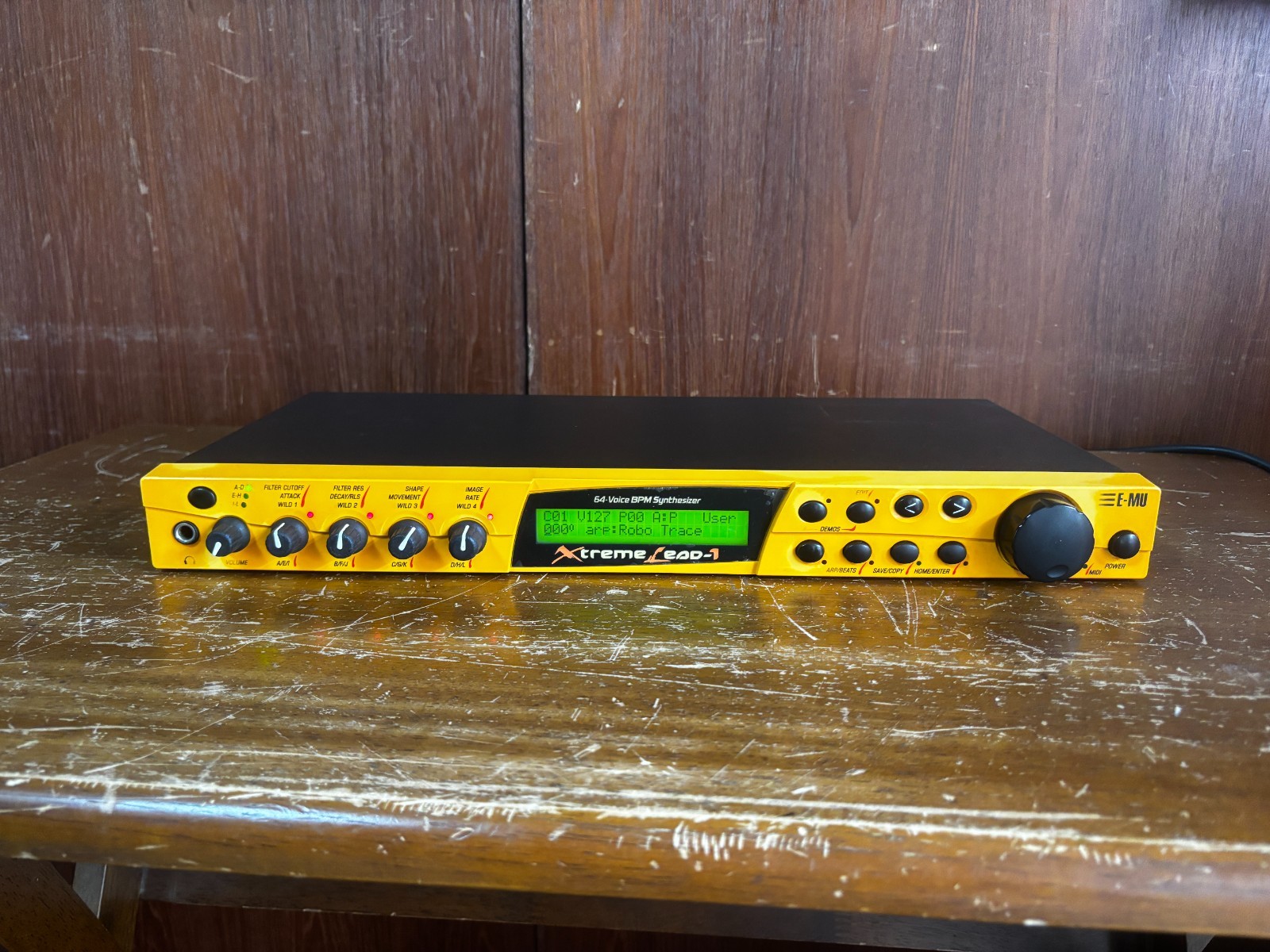
At 8.5" W × 1.75" H × 6.5" D, it's a half-rack-width desktop unit that can sit on a desk or be rackmounted with a half-rack adapter. The front panel has a 2×16-character backlit LCD plus knobs and buttons for editing. Don't expect a full synth front panel. This is a menu-driven system, and owners are unanimous that the interface is tedious. You'll spend a lot of time scrolling through menus to edit sounds. The software editor for Windows made this more bearable, but E-mu no longer provides it for download, so you're stuck with the front panel or old, hard-to-find software.
Connectivity: Analog and Digital
Outputs are unbalanced 1/4" TS main L/R plus a 1/4" stereo headphone jack. On the digital side, you get S/PDIF coaxial in and out at 24-bit resolution, which keeps the signal digital into an interface or mixer. MIDI In, Out, and Thru are standard 5-pin DIN. Power comes from a 12V DC AC adapter, a common failure point (more on that below).
Historical Context
The Xtreme Lead-1 arrived around 2000-2001 as part of E-mu's Xtreme lineup, a family designed to be affordable, compact, and packed with the sounds of the earlier XL-1 and Proteus 2000 series. At the time, E-mu Systems was owned by Creative Technology, the Sound Blaster card maker. That gave the company resources to push out budget-friendly modules while leveraging its existing sound libraries. The Xtreme family was aimed at desktop producers and live musicians who wanted the Proteus/XL-1 sound without the rack-mount price tag.
This is a "lead/beat" module, emphasizing synth leads, basses, and beats, as opposed to the Xtreme Keys-1, which was the keyboard version of the same soundset. It's not a general-purpose workstation.
Collectibility & Value
The Xtreme Lead-1 is not a collector's piece. It typically sells used for $100 - $200 USD in good condition, and it's less desirable than the XL-1 or Proteus 2000, so prices run lower. Collectors tend to bypass it in favor of the bigger rack units. Still, for someone who wants those late-90s/early-2000s dance and trance sounds in a compact, cheap desktop module, it's a usable tool.
The 12V DC adapter is critical. If it fails, the unit won't power up, though third-party replacements are readily available. The CR2032 coin-cell battery backs up memory, and when it dies, presets may not be retained. This is a common issue across all E-mu modules, and the Xtreme series is no exception. Replacement is simple via the bottom panel. Front-panel buttons can wear out after years of use, and the LCD backlight can dim. The headphone jack can loosen over time, and replacement jacks are non-standard and hard to find.
E-mu/Creative no longer supports the unit, and spare parts aren't available from the manufacturer. The Windows editor software is no longer offered for download. There are also rare reports of MIDI sync issues with the delay effects when slaved to certain DAWs. None of these are deal-breakers for a $150 module.
Owners describe the build quality as plasticky. It's a budget unit and feels like one. But the sound engine is the real XL-1/Proteus 2000 architecture, and the 64-voice polyphony plus dual effects are a lot of capability for the money.
eBay Listings


As an eBay Partner, we earn from qualifying purchases. This helps support our independent vintage technology research.