Crumar Orchestrator (1977)
At 37 pounds, it arrives like a crate of vintage wine—dense, promising, and unmistakably Italian.
Overview
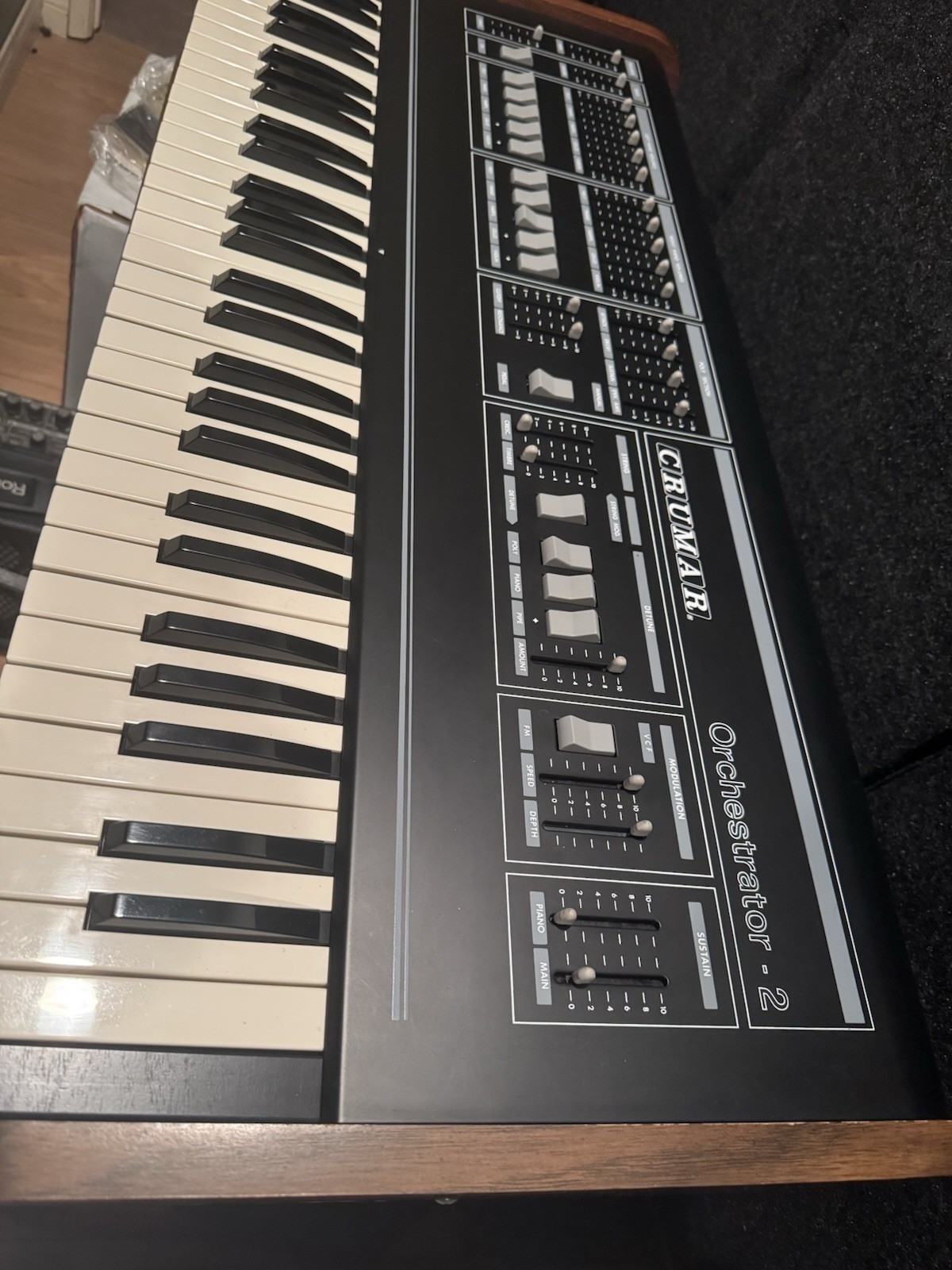
The Crumar Orchestrator—also widely known as the Multiman-S—is a late-'70s analog string synthesizer that occupies a cultish corner of the vintage keyboard world. Built in Italy and released in 1977, it’s a machine designed to emulate orchestral textures with a straightforward, almost utilitarian approach. Owners report it delivers lush, warm string pads and punchy brass sections, all from a chassis that feels industrial in both weight and construction. While not a programmable synth in the modern sense, its fixed architecture channels a specific sonic palette: five independent sections—Brass, Strings, Piano, Bass, and Clavichord—that can be mixed and layered in real time. It’s not flashy, but it’s functional, built for players who wanted instant access to ensemble sounds without diving into patch programming.
Despite its bulk, the Orchestrator was clearly intended for gigging musicians of its era, with a 61-key keyboard and a single volume control that suggests simplicity over nuance. The audio output is routed through a standard 1/4" phone jack, making it stage-ready in the most basic sense. Collectors note its shared-oscillator-per-octave design, a cost-saving and space-efficient method common in string machines of the time, which contributes to its characteristic chorused, slightly detuned texture—especially in the strings section. A Moog-style 24dB/octave filter adds a rare touch of tonal shaping for a machine of this class, giving it a slightly more organic and rounded edge compared to its contemporaries.
Specifications
| Manufacturer | Crumar |
| Product type | analog synthesizer |
| Also known as | Multiman-S Synthesiser |
| Keyboard | 61 -key |
| Polyphony | 49 notes |
| Sounds | five independent sections: Brass, Strings, Piano, Bass, and Clavichord |
| Controls | volume control |
| Connections | Audio Output Connections: 1/4" Phone |
| Weight | 37 lbs. |
Shared Oscillator Architecture
Rather than assigning a dedicated oscillator to each key, the Orchestrator uses a shared oscillator per octave—a design choice that defines its sonic character. This method, common in string machines like the ARP Solina or Logan String Melody, generates a natural chorus effect due to slight tuning inconsistencies across notes. It’s not true polyphony in the modern sense, but it creates a rich, ensemble-like texture that feels alive and slightly unstable. This architecture keeps the circuitry compact and reliable, though it limits the instrument’s ability to play perfectly in tune across wide intervals. Owners accept this as part of the charm: the Orchestrator wasn’t built for clinical precision, but for atmosphere.
Moog-Style 24dB/Octave Filter
One of the Orchestrator’s more surprising features is its inclusion of a Moog-style 24dB/octave low-pass filter. This is unusual for a preset string machine, most of which offer fixed tonal shaping. The presence of such a filter suggests Crumar aimed higher than mere imitation—they wanted warmth, presence, and the ability to sculpt the sound. While not as flexible as a full modular filter section, it allows players to roll off harsh highs or emphasize body in the strings and brass. This filter contributes significantly to the unit’s reputation for a smooth, almost velvety output, especially when paired with external effects.
Five Independent Sound Sections
The heart of the Orchestrator lies in its five selectable and mixable sections: Brass, Strings, Piano, Bass, and Clavichord. These aren’t samples or digital emulations, but analog circuits tuned to mimic the character of each instrument. The strings are the most celebrated—wide, sweeping, and slightly nasal in the upper register. The brass section cuts through with a bold, slightly reedy tone, while the piano offers a hollow, electric-organ-like approximation. The bass is thick and fundamental-heavy, useful for anchoring arrangements, and the clavichord delivers a bright, percussive pluck. These sections can be blended freely, allowing for hybrid textures that predate modern layering synths. It’s a simple system, but effective for film scores, ambient beds, or vintage pop arrangements.
Historical Context
The Crumar Orchestrator emerged in 1977, a period when string machines were in high demand for studio and stage use. Italian-made and distributed globally, it competed with American and Japanese offerings by emphasizing build quality and sonic character over features. Its initial production run reportedly ended in 1986, placing it at the tail end of the analog ensemble era. A later variant, the Orchestrator 2, is associated with the MULTIMAN-S3 designation in service documentation, suggesting an evolution of the platform, though details remain scarce. Unlike some of its contemporaries, the Orchestrator never achieved mass-market penetration, but it found loyal users who valued its distinctive voice.
Collectibility & Value
Today, the Orchestrator trades in the secondary market between $900 and $1,195, depending on condition and provenance. A spare chassis back piece recently sold for $82, indicating that repair parts are scarce and valued. Owners report mixed reliability, with one documented repair video highlighting the complexity of servicing its analog circuitry. Despite its age, it remains functional in many surviving units, and its sound continues to attract players—Jonny Greenwood of Radiohead is noted as a fan. One user recalled paying just $80 for theirs years ago, underscoring how its value has appreciated among niche collectors. It’s not a synth for everyone, but for those chasing a specific vintage Italian warmth, it delivers.
eBay Listings
As an eBay Partner, we earn from qualifying purchases. This helps support our independent vintage technology research.
Related Models
- Crumar Compac-string
- Crumar DS-2
- ARP Explorer 2900
- ARP Odyssey Model 2800 (1972)
- ARP 2823 (1978-1981)
- ARP Explorer I (1974)
- ARP Rhodes Chroma
- Akai Ax73
- Akai AX60
- Akai AX80