Casio CZ-3000 (1986)
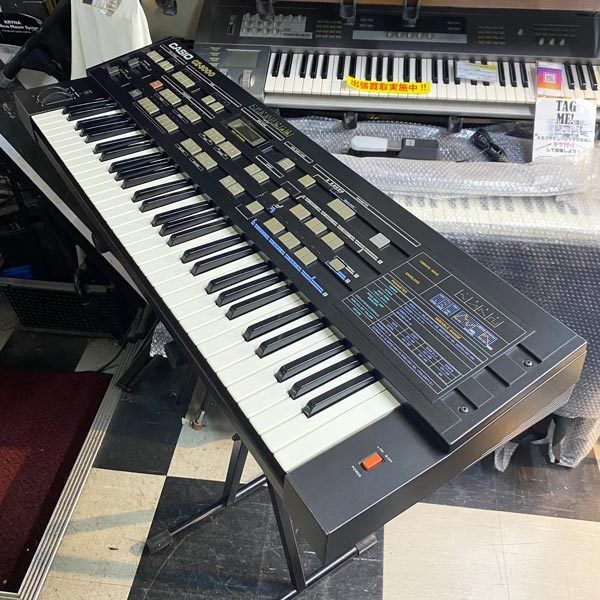
At 1025 mm wide, it sprawls across the desk like a command console from a forgotten digital age.
Overview
The Casio CZ-3000 is a totally digital synthesizer released in 1986 by Casio, representing one of the final entries in the company’s influential CZ series. Unlike the preset-heavy home keyboards dominating the early '80s, the CZ-3000 was built for sound creation, aimed squarely at musicians who wanted to design and modify their own patches rather than rely on factory defaults. It stands as a full-sized evolution of the line that began with the pint-sized CZ-101—the first MIDI-equipped synth many bedroom musicians could afford—and expands the series further into the professional market. While not as feature-packed as the flagship CZ-5000, the CZ-3000 shares much of its architecture, differing primarily in the absence of the on-board sequencer.
Despite its digital core and plastic build, the CZ-3000 delivers a characterful sound often described as bold, thick, and rich in harmonic movement—qualities that have earned the entire CZ line a reputation as one of electronic music’s best-kept secrets. Phase distortion synthesis, the engine under the hood, offered a more intuitive programming experience than Yamaha’s FM synths, with clear envelope stages and a logical layout that made sound design accessible without sacrificing depth.
Specifications
| Manufacturer | Casio |
| Model | CZ-3000 |
| Type | totally digital synthesizer |
| Production Year | 1986 |
| Number of Keys | 61 |
| Key Weight | Synth |
| Key Size | Full |
| Touch Sensitive | no |
| Aftertouch | no |
| Polyphony | 16 |
| Sound Generation | Phase Distortion |
| Sounds Editable | yes |
| MIDI | yes |
| AC Power | yes |
| Batteries | yes |
| Audio Out | yes |
| Sustain Pedal | yes |
| Expression Pedal | yes |
| Dimensions | 1025 (W) x 341 (D) x 125 (H) mm |
| Oscillators | 2 per voice |
| Envelopes | 8-stage envelopes |
| Filter | DCW (Digitally Controlled Wave) filter |
Key Features
Phase Distortion Synthesis with Two DDS Oscillators
At the heart of the CZ-3000 lies Casio’s phase distortion synthesis, a method distinct from FM that manipulates the phase of digital waveforms to create complex, evolving timbres. Each voice employs two Direct Digital Synthesis (DDS) oscillators oscillators with 8 waveforms), capable of generating eight basic waveforms that can be dynamically reshaped through phase modulation. This approach, implemented under LSI (large scale integrated circuit) control control), allowed for rich textures—from glassy pads to snappy digital basses—that felt more immediate to program than Yamaha’s FM systems. The result was a synth that, while digital, avoided sterility, offering a sonic character that many users describe as bold and full of thickness.
8-Stage Envelopes for Precise Shaping
One of the CZ-3000’s standout features is its 8-stage envelopes, a level of control uncommon in synths at its price point. Unlike traditional ADSR envelopes, these multi-stage contours allow for intricate shaping of amplitude, filter, and pitch over time, enabling everything from plucked transients to slowly swelling atmospheres. Combined with the DCW (Digitally Controlled Wave) filter filter)—which modulates waveform structure rather than frequency in the analog sense—the envelopes give the CZ-3000 a unique ability to generate movement within a sound. The interface, while menu-driven and requiring button combinations, is noted for its logical parameter layout, making deep editing feasible without external software.
Full 61-Key Keyboard with Expression Support
Unlike the mini-keys of the CZ-101, the CZ-3000 features a full 61-key synth-action keyboard, providing a more playable and professional feel. While the keys are not touch-sensitive or aftertouch-capable, the inclusion of both sustain and expression pedal inputs adds performance flexibility. The expression pedal can control volume or other parameters in real time, enhancing live playability. The synth can run on AC power or batteries, a rare feature for a full-sized instrument, offering portability for field use or mobile setups.
Historical Context
The CZ-3000 arrived in 1986 as one of the final models in the CZ series, which had launched in 1984 with the groundbreaking CZ-101. That first model broke price barriers by delivering MIDI and programmable synthesis to a mass market previously limited to preset keyboards. Over the next two years, the line expanded to include the full-sized CZ-1000, the rack-mount CZ-1, and the high-end CZ-5000. The CZ-3000 positioned itself as a premium, performance-ready instrument—lacking the CZ-5000’s sequencer but lacking the CZ-5000’s sequencer but otherwise sharing much of its architecture. Marketed under slogans like “Synthesize the Sounds of the Future,” it targeted serious hobbyists and working musicians who needed a capable, affordable digital synth without the complexity of FM.
Collectibility & Value
CZ synths remain remarkably affordable on the used market, and the CZ-3000 is no exception. Current asking prices vary significantly—listings report $314.96 at Music Go Round and $500 on Facebook Marketplace—reflecting condition and regional demand, though no authoritative consensus exists on average resale value. A known issue affects long-term usability: the synth can clear saved patches when powered off, typically due to a failed backup battery. Replacement is possible, but neglected units may have lost all user memory. While original manuals exist, sourcing exact battery specifications or spare parts is not documented in available sources. Despite its age, the CZ-3000 maintains a cult following among synth enthusiasts for its distinctive sound and hands-on programmability.
eBay Listings
As an eBay Partner, we earn from qualifying purchases. This helps support our independent vintage technology research.
Related Models
- Casio CZ-1 (1984)
- Casio CZ-101 (1984-1988)
- Clavia “Nord Lead 2X” (“2003”)
- Roland JP-8000 (1996-2000)
- Ensoniq SQ-80 (1987-1990)
- Ensoniq TS-10 (1990-1992)
- Ensoniq ESQ-1 (1986-1989)
- Yamaha DX7 (1983-1987)
- Access Virus A (1997-1999)
- Access Virus B (1999-2002)