ARP Soloist (1970–1972)
It starts with a flick of the thumb—18 preset sounds, zero patch cables, and a keyboard that responds to how hard you press, not just which key.
Overview
You don’t program the ARP Soloist. You command it. One moment you're playing a flute patch, the next you're snarling through a fuzz guitar tone—all with a single flip of a toggle switch. When ARP released the Soloist in 1970, it wasn’t trying to compete with the modular beasts of the era like the Moog or its own 2500. Instead, it was built for organ players who needed a compact, expressive lead voice they could slap on top of their Hammond and use immediately. No patch cords, no deep editing, no tuning marathons—just 18 preset sounds, a pressure-sensitive keyboard, and a control scheme that put performance ahead of programming.
The Soloist’s design philosophy was radical for its time: make synthesis accessible. While other synths demanded technical fluency, the Soloist treated presets as instruments. Each toggle switch called up a complete patch—oscillator, filter, envelope settings, and effects—all hardwired and instantly available. The lack of programmability might sound limiting now, but in 1970, switching sounds on the fly without repatching was revolutionary. This wasn’t a synth for tweakers; it was for gigging keyboardists who needed reliability and speed.
Under the hood, the Soloist was monophonic, with a single VCO generating pulse and sawtooth waveforms, routed through a 24 dB/octave low-pass filter and a VCA. But what set it apart was its touch-sensitive keyboard. Long before aftertouch became standard, the Soloist used a pressure bar under the keys to detect how hard a note was pressed. That pressure could modulate pitch, filter brilliance, vibrato, volume, and portamento—collectively marketed as “growl,” “wow,” and “brilliance.” This meant a player could start a note softly and then push into it to add vibrato or a pitch bend, all with one hand. For organists used to Leslie speed controls and drawbars, this was intuitive and expressive.
Still, the Soloist had its limits. It never achieved the same reputation as ARP’s later Odyssey or 2600. Its presets were fixed, its tuning was notoriously unstable, and its build quality left something to be desired. Documentation shows that musicians like Donald Fagen of Steely Dan found the Soloist frustrating in live settings due to constant detuning. It was a transitional instrument—ambitious, innovative, but flawed. ARP knew it. By 1972, they’d already begun work on its successor, the Pro Soloist, which would fix many of these issues and become the definitive version of the concept.
Specifications
| Manufacturer | ARP Instruments, Inc. |
| Production Years | 1970–1972 |
| Original Price | $1,195 (estimated) |
| Synthesizer Type | Monophonic analog preset synthesizer |
| Keyboard | 37 keys (3 octaves) |
| Aftertouch | Pressure-sensitive touch bar under keys |
| Oscillators | 1 VCO (pulse, sawtooth) |
| Filter | 24 dB/octave low-pass (ARP4012) |
| Filter Modulation | Brilliance (filter cutoff) |
| Amplifier | Voltage-controlled amplifier (VCA) |
| Envelope Generators | Single contour generator (attack, decay) |
| LFO | Internal vibrato and wow (portamento) modulation |
| Preset Voices | 18 |
| Effects | Vibrato, portamento ("wow"), growl (pitch modulation) |
| Controls | Toggle switches for presets, octave shift, expression effects |
| Outputs | 1 x 1/4" output |
| Power | External power supply (±15 VDC) |
| Weight | Approx. 18.5 lbs (8.4 kg) |
| Dimensions | 34" x 10" x 4" (86 x 25 x 10 cm) |
| Finish | Black textured vinyl, silver control panel |
Key Features
The Preset Revolution
Before the Soloist, changing sounds on a synth usually meant repatching cables or manually adjusting multiple knobs—a slow, error-prone process on stage. The Soloist eliminated that by hardwiring 18 complete patches into the circuitry. Each preset—names like “Flute,” “Bassoon,” “Fuzz Guitar,” and “Brass”—was a full signal path with oscillator settings, filter response, and envelope behavior baked in. This wasn’t just convenience; it was a philosophical shift. ARP wasn’t selling a modular tool, but a set of ready-to-play instruments. For touring musicians, this meant no soundcheck tweaking, no forgotten knob positions, no tuning drift mid-song. You flipped a switch and played. That immediacy made it a favorite among organists and session players who needed reliable, expressive lead tones without the synth-geek overhead.
Touch-Sensitive Expression
The Soloist’s keyboard wasn’t just velocity-sensitive—it responded to aftertouch, a feature almost unheard of in 1970. The pressure bar under the keys detected how hard a note was held and routed that data to multiple parameters simultaneously. Push harder, and you could add vibrato, brighten the filter, bend the pitch, or swell the volume—all in real time. ARP called these “expression effects,” and they were controlled via dedicated switches that let players assign which parameters responded to pressure. This turned the Soloist into a deeply expressive instrument, capable of mimicking the breath control of a wind player or the attack of a plucked string. It was a precursor to modern MIDI aftertouch, but with a tactile, analog immediacy that still feels organic today.
Organ-Top Form Factor
The Soloist was designed to live on top of a Hammond or electric piano, not sit on its own stand. Its low-profile chassis, 34 inches wide and just 4 inches tall, slid neatly over the back of a B3 or a Rhodes. It even came with a built-in music stand—practical for gigging keyboardists who needed to read charts while playing. This wasn’t an accident. ARP targeted organ players specifically, offering a way to expand their sonic palette without abandoning their primary instrument. The control layout, with toggle switches under the left hand, mirrored the thumb-operated drawbar controls on a Hammond, making it feel familiar. This ergonomic consideration was part of what made the Soloist more than just a synth—it was an extension of an existing workflow.
Historical Context
The ARP Soloist emerged at a time when synthesizers were still seen as laboratory curiosities or avant-garde noise boxes. The Moog modular systems were dominant, but they were expensive, temperamental, and required technical expertise to operate. ARP’s founder, Alan R. Pearlman, had set out to build more stable, musician-friendly instruments, starting with the 2500. But the Soloist was a different kind of mission: not to push the boundaries of synthesis, but to bring it to the working musician.
In 1970, most rock and pop keyboardists were organ players. They didn’t want a modular synth—they wanted a way to get flute or brass sounds quickly and reliably. The Soloist answered that need. It wasn’t programmable, but it didn’t need to be. Its presets were designed to emulate real instruments, and while they were crude by modern standards, they were convincing in a mix. The synth found early adopters in progressive and jazz-rock circles, where players like Billy Preston and Herbie Hancock began incorporating its sounds into live sets.
But the Soloist’s legacy is overshadowed by its successor. The Pro Soloist, released in 1972, fixed many of its tuning and reliability issues and expanded the preset count to 30. As a result, the original Soloist became a footnote—a prototype of a better idea. The Soloist Mk II, an intermediate redesign with digital tuning, never made it to market. ARP simply leapfrogged to the Pro Soloist, which became the definitive version. Still, the original Soloist was the first to prove that preset synths could be expressive and practical, paving the way for instruments like the Yamaha CS-80 and the Roland Jupiter-8.
Collectibility & Value
The ARP Soloist is a rare bird. Few were made, and fewer survived. Its tuning instability and fragile internal components mean most units today require extensive restoration. Service technicians observe that the original VCOs and power supplies are prone to drift and failure, and the pressure-sensitive keyboard mechanism often degrades over time. Capacitors dry out, switches oxidize, and the toggle selectors—used constantly during performances—can become flaky.
Collectors note that original Soloists in working condition are scarce, and prices reflect that. As of 2025, a fully restored Soloist can command between $2,500 and $5,000, depending on provenance and condition. Unrestored units sell for $800 to $1,500, but buyers should assume several hundred dollars in repair costs. The real challenge isn’t just finding one—it’s keeping it in tune. Unlike later ARPs, the Soloist lacks the temperature-stabilized oscillators of the Pro Soloist, so even a well-recapped unit may drift during extended use.
For players seeking the Soloist’s sound, a more practical route is the Pro Soloist or a software recreation like Cherry Audio’s Pro Soloist or Wrongtools’ sample library. These capture the character without the maintenance headaches. But for purists, nothing beats the tactile response of the original pressure bar and the gritty, imperfect tone of 1970s analog circuitry. The Soloist isn’t the easiest synth to own, but for those who value historical significance and raw expressiveness, it’s a piece of performance innovation that still speaks.
eBay Listings



As an eBay Partner, we earn from qualifying purchases. This helps support our independent vintage technology research.
Service Manuals & Schematics
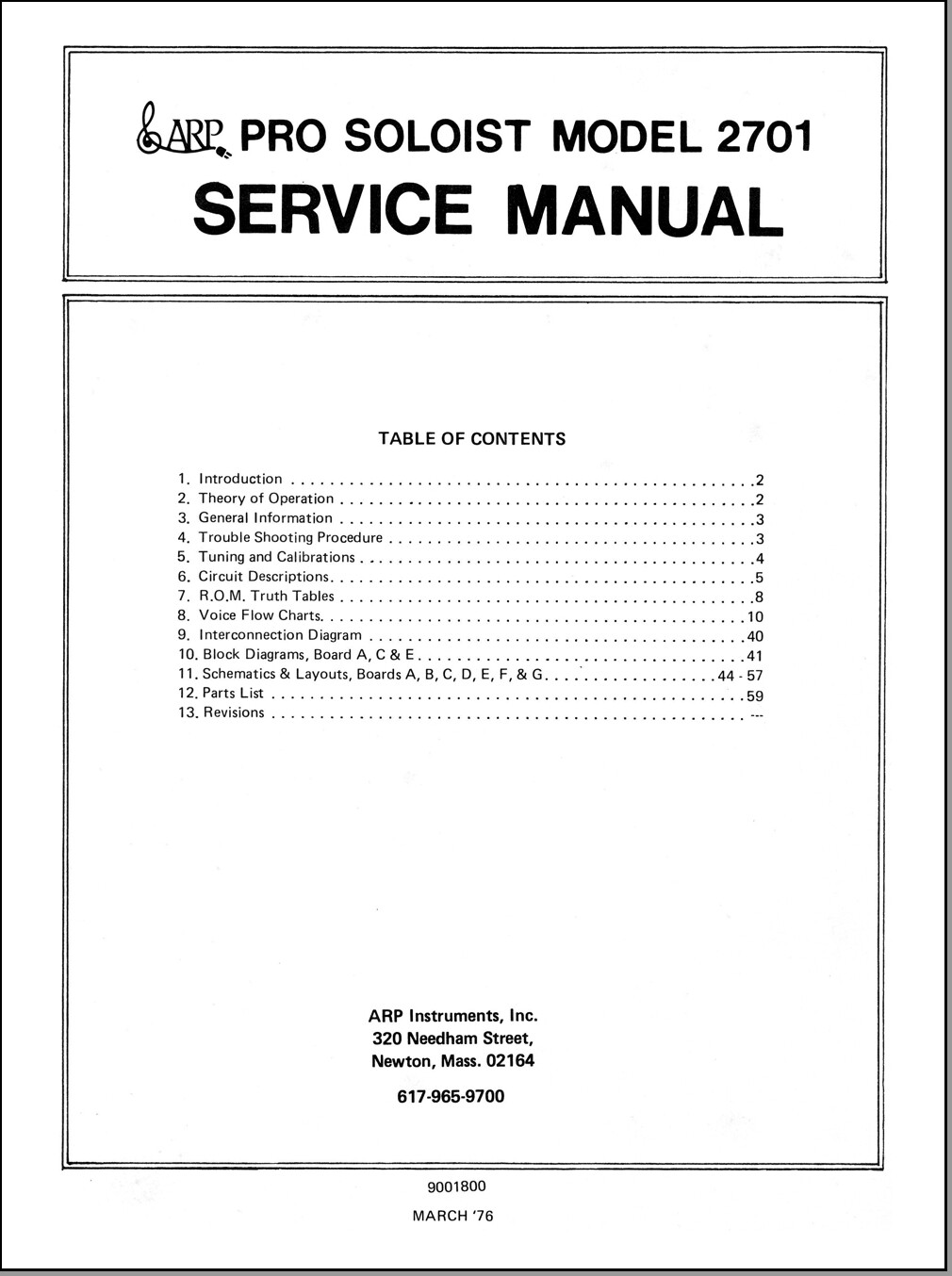
- Service Manual — archive.org
- Service Manual — archive.org
- Service Manual — archive.org
- Service Manual — archive.org
- Service Manual — archive.org