ARP Axxe (1975–1981)
A one-oscillator underdog that punches way above its weight with that unmistakable ARP bite—simple, raw, and still capable of sounds that cut through any mix like a laser.
Overview
Turn it on, twist a few knobs, and within seconds you’re knee-deep in that brash, angular ARP tone—bright, biting, and alive in a way only early analog circuits can be. The Axxe doesn’t pretend to be a powerhouse. It’s not polyphonic, it’s not programmable, and it only has one VCO. But what it lacks in features it makes up for in character. This is the synth ARP built to get their sound into more hands, and it worked—so well that decades later, musicians still seek out its lean, focused voice for leads that scream and basslines that dig in with surgical precision.
Born in 1975, the Axxe was ARP’s answer to the growing demand for accessible, affordable analog synths. While competitors were still wrestling with tuning stability and complex interfaces, ARP took the proven architecture of the Odyssey—already a favorite among pros—and stripped it down to its essentials. One oscillator. One filter. One envelope. No frills. The result? A no-nonsense monosynth that feels like a surgical tool: precise, reliable, and capable of carving out sounds that feel both vintage and urgent.
It’s easy to dismiss a one-VCO synth as underpowered, but the Axxe defies that assumption. Its oscillator delivers both sawtooth and pulse waves simultaneously, and with pulse width modulation available via LFO or ADSR, you get a surprising amount of movement even in static patches. The noise generator adds grit for percussion, and the ability to route external audio through the filter opens up processing possibilities that were rare at this price point. It’s not a multitool—it’s a scalpel.
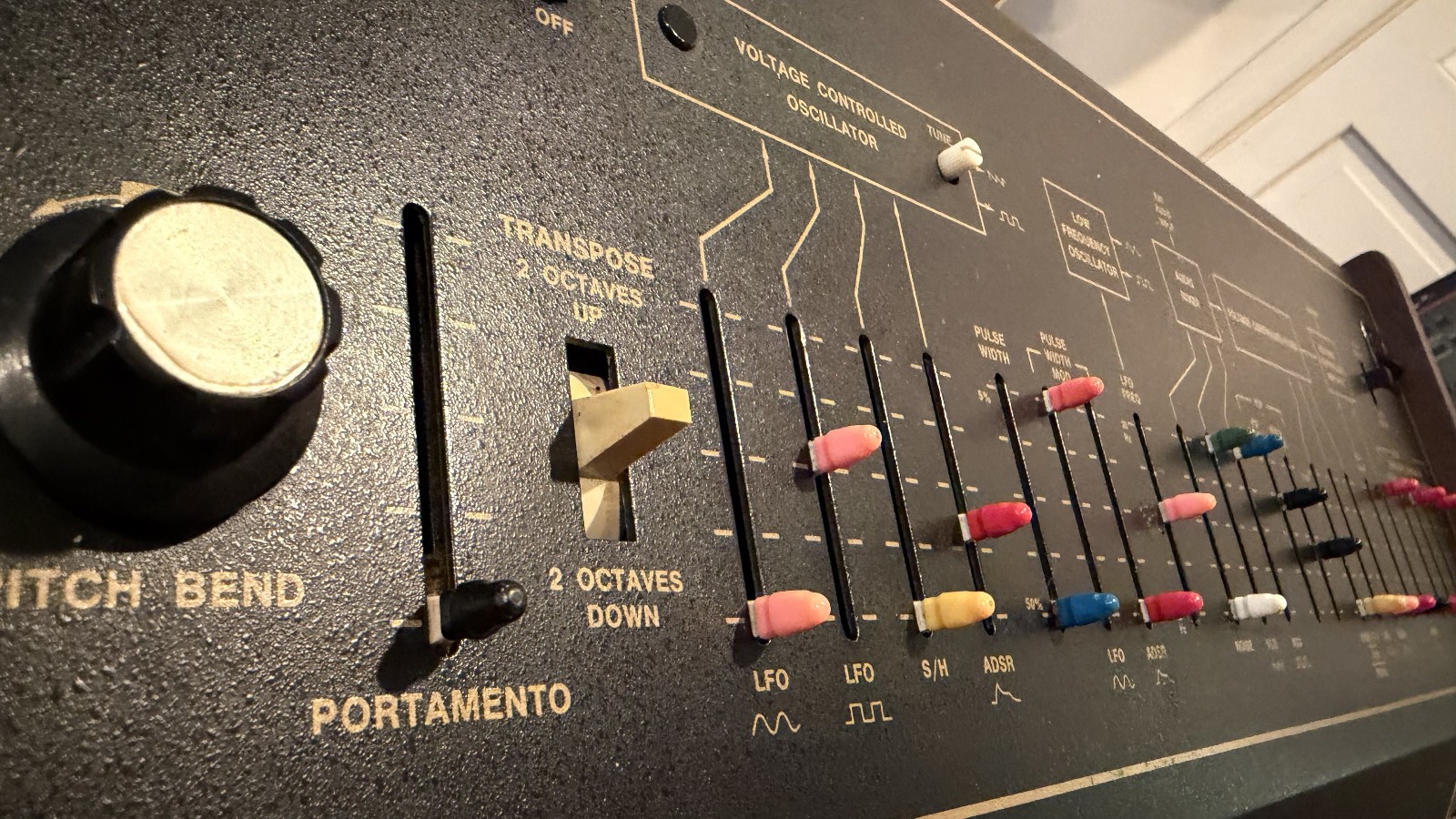
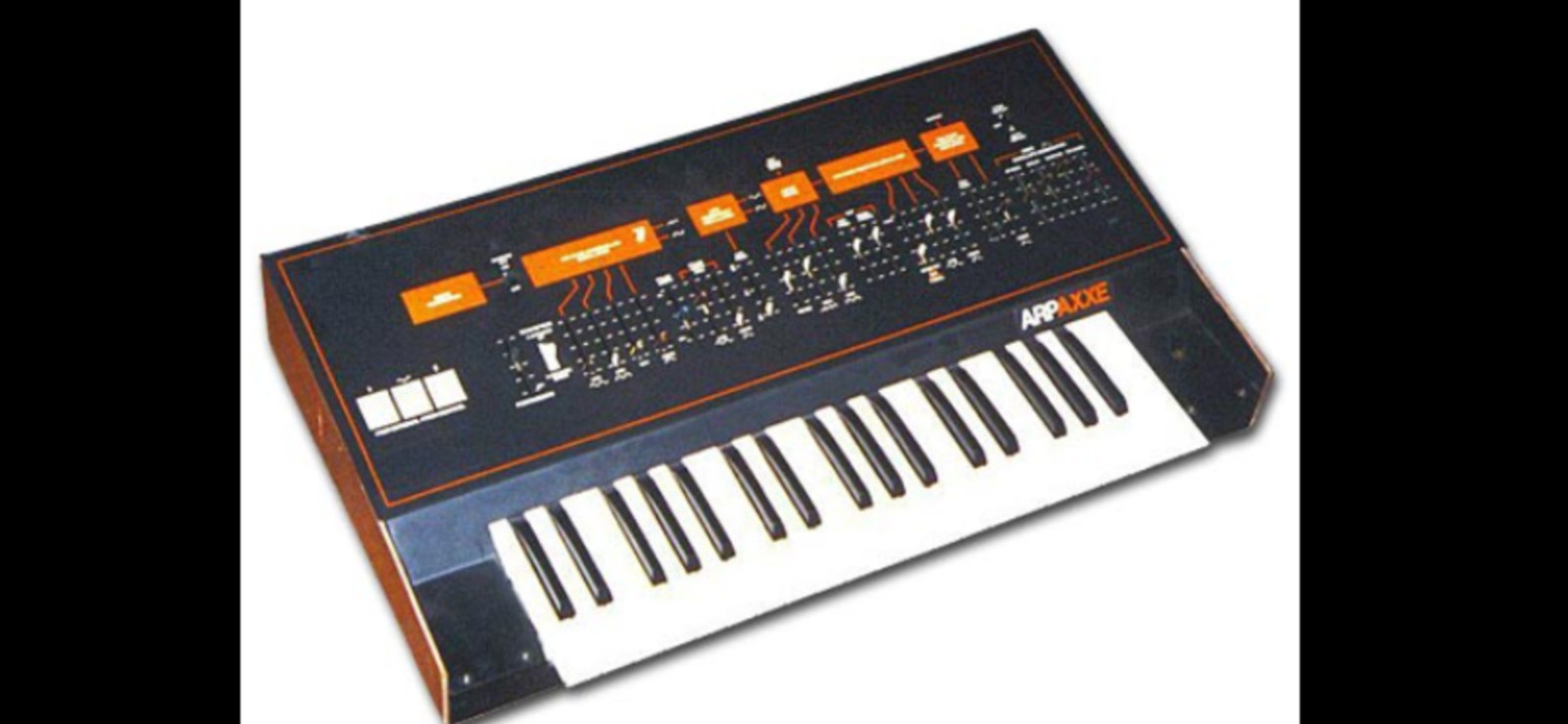
Two versions emerged during its production run. The early MKI, with wooden end cheeks and gold lettering, often came with a pitch-bend knob or a single Proportional Pitch Control (PPC) pad. The later MKII, from around 1978 onward, adopted ARP’s signature black-and-orange livery, leather end cheeks, and—critically—three full PPC pads. These rubber touch-sensitive pads let you modulate pitch, filter, and volume with finger pressure, giving the Axxe an expressiveness that belies its simplicity. Owners consistently report that the MKII feels more dynamic in performance, especially when shaping leads or adding subtle filter sweeps in real time.
Despite its compact size and modest feature set, the Axxe holds its own next to its bigger siblings. It shares the same 24dB/octave low-pass filter as the Odyssey MKIII and later 2600 models—some call it a Moog-style ladder filter, though ARP’s implementation has its own flavor: more aggressive in the high end, with a resonance that sings without collapsing into self-oscillation. It’s not as warm or rounded as a Minimoog, but it doesn’t try to be. The Axxe wants to cut, not cuddle.
Specifications
| Manufacturer | ARP Instruments, Inc. |
| Production Years | 1975–1981 |
| Original Price | $1,295 (1975) |
| Synthesis Type | Analog monophonic |
| Oscillators | 1 VCO (sawtooth, pulse with PWM) |
| Noise Generator | White noise |
| Filter | 24dB/oct low-pass, resonant |
| Filter Modulation | ADSR, LFO, S/H, pedal, keyboard tracking |
| Envelope Generator | 1 ADSR |
| LFO | Sine, square, random (S&H) |
| Modulation Sources | LFO, ADSR, S/H, PPC, external CV |
| Keyboard | 37-note, full-size, synth-action |
| Portamento | Variable glide time |
| Transpose | ±2 octaves via switch |
| Outputs | Audio High, Audio Low |
| Inputs | Audio In, CV In, Gate In, Trigger In, Pedal In (filter) |
| Outputs | CV Out, Gate Out, Trigger Out |
| Control Interface | PPC pads (MKII), pitch-bend knob or single PPC (MKI) |
| Weight | 25 lbs (11.3 kg) |
| Dimensions | 35" × 12" × 4.5" (89 × 30.5 × 11.4 cm) |
Key Features
Proportional Pitch Control (PPC): Expression in Rubber
The PPC pads are the Axxe’s secret weapon. Unlike simple pitch wheels or aftertouch, these rubber pads respond to both pressure and finger position, allowing nuanced control over pitch, filter cutoff, and volume. On the MKII, having all three pads available at once means you can bend a note while simultaneously sweeping the filter and swelling the amplitude—all with one hand. It’s not just expressive; it’s intimate. Players who’ve used both MKI and MKII models consistently report that the full PPC array transforms the Axxe from a basic analog box into a responsive, almost vocal instrument. Early MKIs with only a single PPC or pitch-bend knob feel limiting in comparison, though some owners have retrofitted full pads using salvaged parts or modern reproductions.
External Audio Processing: More Than a Synth
Few synths at this price point offered an audio input with full filter and envelope control, but the Axxe did. Plug in a drum machine, a guitar, or even a microphone, and route it through the 24dB filter with resonance cranked, and suddenly you’ve got a real-time effects processor with analog grit. This feature, inherited from the 2600 and Odyssey, made the Axxe a favorite for experimental musicians and live performers who wanted to manipulate external sounds with the same immediacy as synthesized tones. Pair it with a high-frequency LFO from another synth—like a Korg PS-3100 or Roland SH-101—and you can create vocal-like formant effects that feel alive and unpredictable.
Simplified Signal Path, Maximum Impact
With only one VCO and one envelope, the Axxe forces you to think differently. There’s no oscillator sync, no ring mod, no second filter. But that limitation breeds creativity. The saw and pulse waves can be mixed, and the pulse width can be modulated—either slowly for animation or rapidly for a chorus-like thickening. The LFO can route to pitch, filter, or pulse width, and the sample-and-hold function (driven by noise) adds random stepped modulation that’s perfect for sci-fi textures or unpredictable bass movement. It’s not a sound designer’s dream rig, but it’s a composer’s sketchpad: fast, direct, and full of character.
Historical Context
The mid-1970s were a turning point for synthesizers. What had been lab-bound, modular behemoths were finally becoming portable, performance-ready instruments. ARP was at the forefront, having already established credibility with the 2500, 2600, and Odyssey. But those were expensive, complex, and often intimidating. The Axxe was ARP’s play for accessibility—a way to bring their distinctive sound to students, gigging musicians, and studios on a budget.
It arrived the same year as the ARP Omni, a preset polyphonic synth aimed at keyboardists who wanted strings and brass without patching cables. The Axxe, by contrast, was for those who still wanted hands-on control but couldn’t justify the cost of an Odyssey. It beat Moog’s Micromoog to market by a year, though the Micromoog ultimately gained more traction. Unlike the Prodigy (1979) or Rogue (1981), the Axxe wasn’t built down from scratch—it was carved from a proven design. That gave it instant credibility.
At the time, the idea of a “budget ARP” sounded like an oxymoron. But the Axxe proved that even a simplified version of their architecture could deliver the goods. It wasn’t trying to replace the Odyssey; it was trying to be its younger, scrappier sibling. And in that role, it succeeded. While it never reached the fame of the 2600 or Odyssey, it found a quiet cult following—musicians who valued immediacy over options, and tone over trends.
Collectibility & Value
Today, the Axxe trades in a sweet spot between affordability and authenticity. It’s one of the most accessible ways to own a genuine ARP analog voice, with working units typically selling between $1,800 and $2,800 depending on condition and version. MKII models with full PPC pads command a premium—often $300–$500 more than MKIs—due to their superior expressiveness. Fully restored examples with replaced sliders and recalibrated oscillators can push toward $3,200, especially if they include original packaging or documentation.
But buying an Axxe isn’t just about the price tag—it’s about the long game. These synths were built in an era when reliability wasn’t guaranteed, and decades of use (or neglect) have taken their toll. The most common issues are slider degradation, tuning instability, and failing power supplies. The rubber PPC pads can dry out or lose sensitivity, and the overhanging keyboard design on the MKII is notorious for wobbling or breaking the front panel. Some technicians have reinforced these with custom brackets or replaced the entire chassis support.
Slider tops, especially on MKII units, are a known weak point. The original plastic caps crack and fall off, leaving bare sliders that feel gritty and look worn. Many owners replace them with rubber caps from Synthwood or similar suppliers, which not only restore function but improve the playing experience. The oscillators, while stable when maintained, often require recapping and calibration after years of dormancy. A full service—recap, calibration, slider refurb, PPC cleanup—can run $400–$600, so factor that into any purchase.
When shopping, prioritize units with responsive PPC pads, stable tuning across the keyboard, and intact lettering. Gold-letter MKIs with wooden sides are visually striking but often more fragile. The MKII’s leather cheeks are more durable, though replacements are available if needed. Avoid units with patched-up wiring or non-original power supplies—these are red flags for prior neglect.
Despite its quirks, the Axxe remains a smart buy for collectors and players alike. It’s not a museum piece; it’s a working instrument that still sounds relevant. Its limitations keep it honest, and its voice cuts through modern mixes with zero nostalgia tax. For those who want real analog ARP character without the flagship price, the Axxe isn’t just a compromise—it’s a revelation.
eBay Listings


As an eBay Partner, we earn from qualifying purchases. This helps support our independent vintage technology research.
Service Manuals & Schematics
- Owner's Manual — archive.org
- Service Manual — archive.org
- Service Manual — archive.org
- Service Manual (1977) — archive.org
- Service Manual — archive.org