ARP 4075 Filter ()
A cult-favorite analog filter with a flawed brilliance—bright, raw, and full of character, if you’re willing to fix its infamous ceiling.
Overview
Turn up an ARP Odyssey with a 4075 filter wide open and you might expect a shimmering burst of high-end clarity—something airy, glassy, almost Moog-like in its reach. Instead, you hit a wall. Around 12kHz, the sound just… stops. It’s not a brick wall, but more like a heavy velvet curtain drawn across the top end, muting the brilliance you’d expect from a fully open filter. That’s the 4075’s infamous bandwidth limit, a design flaw baked into its circuitry from the factory. And yet, despite this flaw—or maybe because of it—the 4075 has earned a cult following among synth purists, modders, and boutique builders who prize its raw, organic texture and the unique color it imparts to ARP’s already distinctive voice.
The 4075 wasn’t ARP’s first filter, nor their most revered. That honor usually goes to the earlier 4034 or the white-faced Odyssey’s 4023. But the 4075 arrived at a pivotal time: the late 1970s, when ARP was streamlining production and shifting toward more cost-effective designs. It first appeared in the ARP Odyssey MkII and MkIII, replacing the earlier 4035, and later found its way into the ARP Axxe, Pro Soloist, and Omni. It’s a 24dB/octave four-pole low-pass design, built around a discrete transistor ladder topology similar to Moog’s, but with ARP’s own quirks—particularly in how it handles resonance and high-frequency roll-off. At moderate resonance, it’s smooth and vocal, capable of deep, singing sweeps. Push it harder, and it doesn’t scream like a Minimoog—it snarls, with a slightly gritty, compressed character that some describe as “rubbery” or “oozy.” It’s not as crisp as a Roland Jupiter-8 filter, nor as lush as an Oberheim SEM, but it has a presence all its own.
What’s fascinating is that ARP continued using the 4075 even after the flaw was known. The Vintage Synth Explorer forums from 2007 show users puzzled that the “well-known bandwidth limit error” was still being “featured” in the MkIII Odyssey. The truth is, ARP likely didn’t see it as a fatal flaw—just a characteristic. In an era when most synths were designed to be played live, not scrutinized under a spectrum analyzer, a slightly dark top end might have been considered warm, not deficient. And in context—paired with ARP’s aggressive VCOs and punchy envelopes—it often worked. But as restoration culture grew, so did the demand for fixes. Today, the “4075 mod” is as much a part of the synth’s legacy as the filter itself: a simple resistor swap (replacing four 4.7kΩ resistors with 2.2kΩ) that lifts the ceiling and lets the filter breathe above 14kHz. It’s a ten-minute job with a soldering iron, and one that many owners consider essential.
Specifications
| Manufacturer | ARP Instruments, Inc. |
| Production Years | 1975–1981 (as installed in Odyssey MkII/III, Axxe, Omni, Pro Soloist) |
| Filter Type | 24dB/octave 4-pole low-pass, discrete transistor ladder |
| Resonance | Variable, with self-oscillation capability |
| Frequency Response (unmodded) | Approx. 20Hz–12kHz (cutoff limited by design) |
| Frequency Response (modded) | Approx. 20Hz–16kHz+ |
| Filter Drive | Non-linear, harmonic-rich saturation at high resonance |
| Topology | Integrator cascade (voltage-controlled amplifier stages) |
| Control Voltage Input | 1V/octave compatible |
| Modulation Sources | Keyboard, envelope, LFO (via synth architecture) |
| Output Level | Line-level audio signal |
| Physical Form | PCB-mounted module, approx. 4" x 2.5" |
| Pin Configuration | Compatible with ARP 4035 in many installations |
| Power Requirements | ±15V DC (via host synth power bus) |
| Notable Host Synths | ARP Odyssey MkII & MkIII, ARP Axxe, ARP Omni, ARP Pro Soloist |
| Common Replacements | 4035, 4023 (2-pole), 40235 (DIY drop-in) |
Key Features
The Bandwidth Limit “Flaw”
The 4075’s most discussed trait isn’t a feature—it’s a limitation. Due to incorrect resistor values in the high-frequency compensation network, the filter’s cutoff frequency caps out around 12–14kHz, even when the control voltage suggests it should go higher. This means that when you open the filter fully, you don’t get the airy, open sound typical of other 24dB filters. Instead, it stays relatively dark, which some describe as “muffled” or “veiled.” But this isn’t always a bad thing. In dense mixes, that rolled-off top end can prevent harshness. For basslines and leads with heavy resonance, it adds a kind of controlled saturation that keeps things from getting brittle. Still, for owners chasing authenticity *and* performance, the mod is almost mandatory. And once done, the difference is clear: cymbal-like brightness emerges, and filter sweeps feel more dynamic and complete.
Resonance and Overdrive Character
Where the 4075 truly shines is in its resonance behavior. Unlike some filters that thin out or collapse at high resonance, the 4075 remains robust, even as it approaches self-oscillation. Push it hard, and it doesn’t just whistle—it distorts, generating rich harmonics that add grit and presence. This overdrive isn’t clean; it’s organic, slightly uneven, the kind of imperfection that makes a filter feel alive. It’s particularly effective for percussion sounds, acid lines, and aggressive leads where you want the filter to be a sonic element in itself, not just a tone shaper. Studio Electronics’ modern 4075-based modules highlight this quality, marketing the filter as ideal for “deep drum and percussion sounds” thanks to its ability to generate complex, almost metallic tones when driven.
Drop-In Replacement Culture
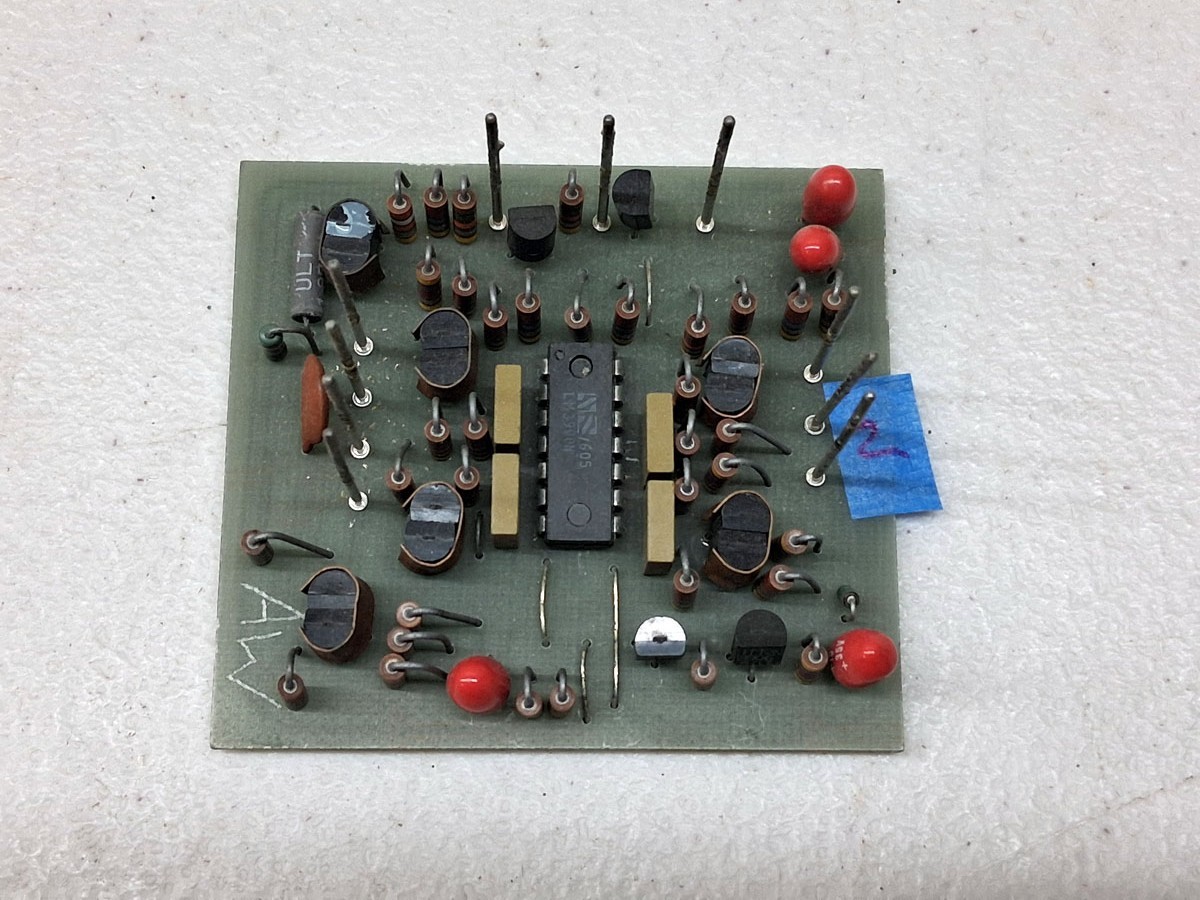
The 4075’s modular design—being a self-contained PCB that plugs into the main synth board—has made it a favorite target for modification. It’s not just the resistor mod. Entire replacement filters are available: the CAE 4035, a faithful recreation of the earlier Odyssey filter, can be swapped in with minimal rewiring. The Arp Tech 40235 is a DIY favorite—a switchable 2-pole/4-pole module that fits in the same space. And boutique builders like STG (Sound Transform Systems) have based entire Eurorack filters on the 4075 design, though often with corrections to the bandwidth issue. This ecosystem of swaps and upgrades speaks to the 4075’s role not just as a component, but as a platform—a starting point for sonic experimentation.
Historical Context
The 4075 emerged during ARP’s transition from boutique innovator to mass-market player. By 1975, the company was under pressure to cut costs and streamline production. The original Odyssey (MkI) used the 4035 filter, a complex, hand-calibrated design that contributed to the synth’s legendary sound but also to its high price and reliability issues. The 4075 was part of a broader shift toward more serviceable, standardized submodules—part of ARP’s attempt to compete with Roland and Korg on price and reliability. It wasn’t a failure; it was a compromise. And in that compromise, it captured a different side of ARP’s identity: less refined, more direct, with a rawness that appealed to players who wanted punch over polish.
It also arrived at a time when filter design was becoming a battleground. Moog owned the ladder, Oberheim had its state-variable, Roland was perfecting the IR3109 chip. ARP’s 4075 was their answer: a homegrown ladder with their own tuning and response. It didn’t dominate the market, but it carved out a niche. Synths like the Omni and Pro Soloist, which used the 4075, weren’t aimed at the pro studio—they were for gigging musicians who needed preset stability and stage reliability. In that context, the filter’s limitations mattered less. What mattered was that it worked, it sounded bold, and it fit the ARP brand: futuristic, slightly aggressive, and unapologetically analog.
Collectibility & Value
The 4075 filter itself isn’t sold as a standalone vintage item—it’s a component, not a product. But its condition and configuration significantly affect the value of the synths that house it. An unmodded 4075 in an Odyssey MkIII isn’t a deal-breaker, but it’s a red flag for serious players. Most technicians and restorers assume the mod will be done, and many sellers advertise “4075 mod performed” as a selling point. A synth with a known unmodded filter might sell for $100–$200 less than an equivalent modded unit, depending on the market.
Failures are generally tied to age, not design. The filter board’s traces are fragile, especially around the resistor pads—several forum users report breaking traces during mod attempts. Electrolytic capacitors on the board can leak or dry out, causing noise or instability. But the filter core itself is robust; transistors and resistors rarely fail unless physically damaged. The real risk isn’t breakdown—it’s misalignment. The 4075 requires calibration to track properly across the keyboard, and a poorly calibrated unit can sound uneven or “lumpy” in sweeps. Buyers should ask if the synth has been recently serviced, and ideally, hear it play across the full range.
For DIYers and modders, the 4075 is a prized candidate. Replacement boards are occasionally available from specialty vendors, and schematics are widely shared online. The mod is so common that some consider an unmodded 4075 a “project synth” opportunity. If you’re after the authentic, unaltered ARP experience, leave it be. But if you want the filter to perform as it should have from the factory, the fix is cheap, fast, and transformative.
eBay Listings

As an eBay Partner, we earn from qualifying purchases. This helps support our independent vintage technology research.