ARP 2600P (1971-1978)
The suitcase that taught a generation how to patch, play, and understand analog synthesis
Overview
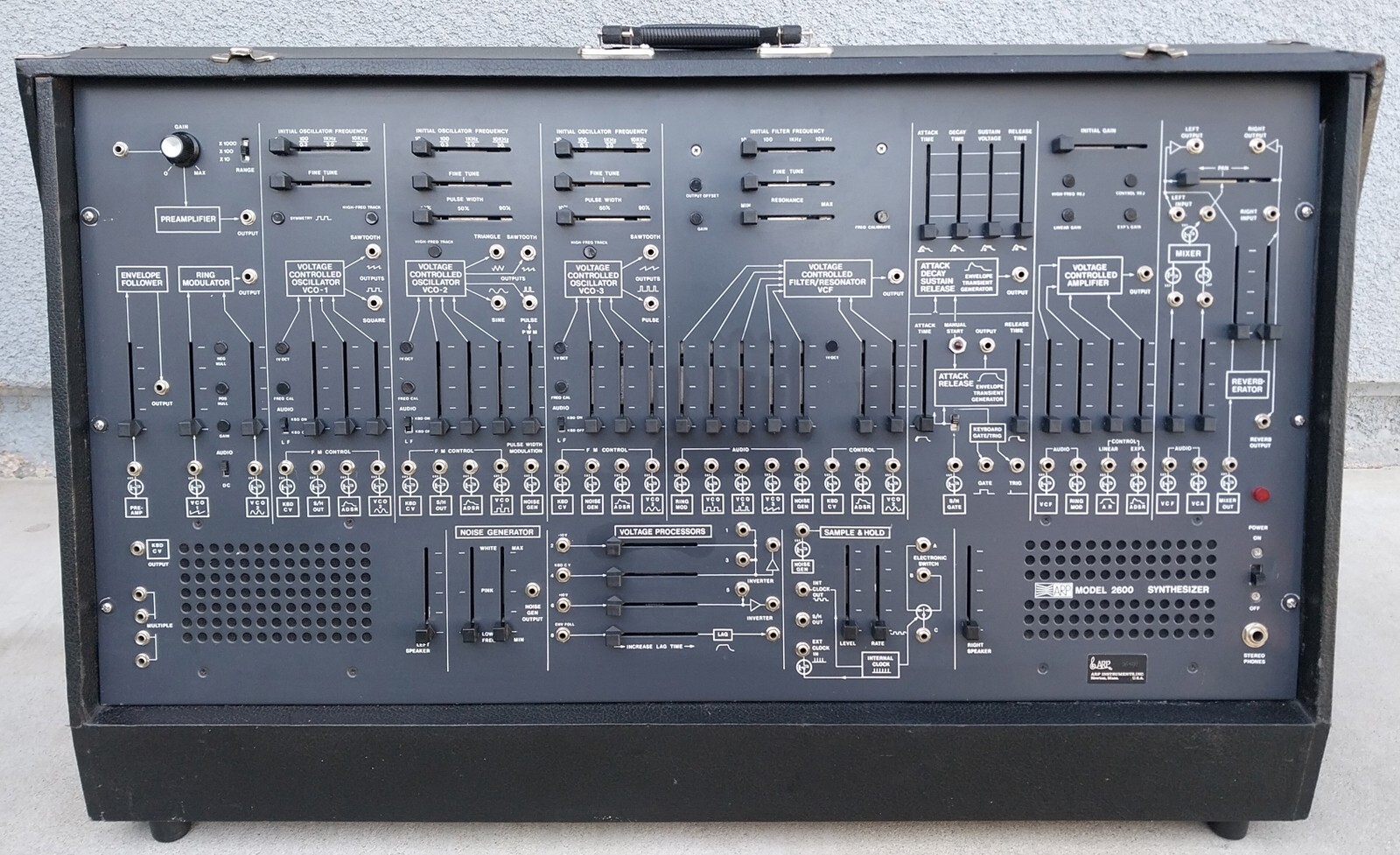
Open the latches on a battleship-gray 2600P and the first thing you notice isn't the sound — it's the weight. This isn't a lightweight gig synth; it's a roadworthy analog laboratory housed in vinyl-covered wood, designed to survive touring while teaching musicians what voltage control actually means. The 2600P emerged late in 1971 as ARP's answer to the modular systems dominating studios, offering pre-wired signal paths that beginners could use immediately while still providing patch points for advanced routing. What made it revolutionary wasn't just the three oscillators or the resonant filter — it was the philosophy that synthesis should be accessible without sacrificing depth.
Early 2600P units carried the same micro-chip voice architecture as the rare Blue Marvin and Gray Meanie predecessors, delivering rich, stable tones that collectors still chase today. By 1972, version 2.0 swapped Teledyne VCO chips for National Semiconductor 4027s, improving reliability while maintaining musical character. Version 3.0 introduced the G-clef logo and taller front panel, becoming the most common variant between 1972 and 1974. The 1974 version 4.0 brought the duophonic 3620 keyboard with its own LFO, expanding performance possibilities beyond the monophonic 3604 controllers used on earlier models.
Built-in speakers and spring reverb weren't just convenience features — they made the 2600P self-sufficient for classroom use, exactly what ARP founder Alan Pearlman intended. The envelope follower could convert microphone input into control voltage, famously creating R2-D2's robotic voice in Star Wars. Ring modulation, sample and hold, noise generators, and dual VCAs with stereo panning gave players textures ranging from haunting flutes to complex electronic storms. This semi-modular approach meant you could start making music immediately while learning to override pre-wired connections as your understanding deepened.
Specifications
| Manufacturer | ARP Instruments, Inc. (Tonus Inc. for early units) |
| Production Years | 1971-1978 (2600P variants) |
| Original Price | Approximately $2,500-3,500 USD (1971-1974, varies by configuration) |
| Current Market Value | $5,000-18,000+ USD (condition and version dependent) |
| Architecture | Analog semi-modular monophonic synthesizer |
| Oscillators | 3 Voltage Controlled Oscillators (VCO), switchable audio/LFO |
| VCO Chips (Early) | Teledyne 4011/4017 (versions 1.0-2.0) |
| VCO Chips (Late) | National Semiconductor 4027/4027-1 (versions 3.0-4.0) |
| Filter Type (1971-1976) | Model 4012 24 dB/oct low-pass (Moog ladder design) |
| Filter Type (1977+) | Model 4072 4-pole low-pass (ARP redesign, limited to ~12kHz) |
| Envelope Generators | 1 ADSR, 1 AR contour generator |
| VCA | 2 Voltage Controlled Amplifiers with stereo panning |
| Modulation | LFO with sample and hold, ring modulator, envelope follower |
| Noise Generator | Low frequency, pink, and white noise options |
| Reverb | Built-in spring reverb |
| Speakers | Built-in stereo speakers (pre-amplifier included) |
| Keyboard (Early) | Model 3604 monophonic (tuning/portamento controls) |
| Keyboard (Late) | Model 3620 duophonic with LFO (1974 onward) |
| Enclosure | Suitcase-style vinyl-covered wood with latching mechanism |
| Panel Color | Battleship gray (versions 1.0-3.0), orange/black (1977+) |
| Patch Points | Multiple 3.5mm jack patch points for signal rerouting |
| Weight | Approximately 35-40 lbs (main cabinet with keyboard) |
| Dimensions | Suitcase enclosure: ~24" W x 18" D x 8" H (varies by version) |
| Total Production | Approximately 3,000 units across all 2600 variants (1971-1980) |
Key Features
The Semi-Modular Philosophy
The 2600P's genius lies in its pre-wired default signal path. Unlike full modular systems requiring extensive patching before any sound emerges, the 2600P routes oscillators through the mixer, filter, and VCA automatically. Beginners could turn it on and play immediately, learning synthesis concepts through the clearly labeled slider controls rather than wrestling with cable management. Yet every section offers patch points — oscillators can be redirected, filters bypassed, envelopes reassigned. This dual approach made it both a teaching instrument and a professional tool, explaining why it appeared in classrooms and on stages simultaneously.
Filter Evolution and Legal Consequences
Early 2600P models used the Model 4012 filter, a design closely matching Moog's patented ladder filter topology. This delivered musical resonance with strong low-end presence and smooth frequency tracking up to approximately 15kHz. In 1976, Moog's legal action forced ARP to redesign their filter circuit, resulting in the Model 4072. The 4072 suffers from a design limitation — frequency response caps at roughly 12kHz, producing a duller, weaker character compared to the 4012. This change affected not only the 2600P but also the Odyssey and later 2601 models. Collectors and technicians consistently note that units with 4012 filters command higher prices and deliver more musically satisfying resonance.
Keyboard Controllers and Performance
Keyboard options define the 2600P's performance capabilities significantly. The Model 3604 provided monophonic operation with tuning and portamento controls beneath the keyboard surface. Version 4.0 introduced the Model 3620 duophonic keyboard, adding a dedicated LFO, latching mechanisms, and two independent pitch CV outputs. This allowed players to hold two notes simultaneously — a rare feature on monophonic synthesizers of this era. The 3620 also transmitted both CVs to the main cabinet through the connecting cable, enabling patch access to KBD CV-1 and KBD CV-2 sockets. Later Korg recreations added aftertouch, but original 3620s lack this feature while maintaining their duophonic advantage.
Historical Context
ARP emerged in the early 1970s as Moog's primary American competitor, both companies pushing synthesizers from laboratory curiosities toward mainstream musical tools. The 2600 launched in 1971 as the successor to the massive 2500 studio system, targeting schools and synthesizer beginners rather than custom studio installations. David Friend and Roger Powell toured the United States demonstrating the instrument, often getting thrown out of music stores that found monophonic synthesizers too difficult to sell. Sam Ash's decision to carry the 2600 late in 1971 provided credibility among retailers and exposed the instrument to New York musicians.
Famous endorsers included Joe Zawinul, Edgar Winter, Pete Townshend, Stevie Wonder, and Herbie Hancock. Edgar Winter's "Frankenstein" became the most famous 2600-based track, constructed from spliced instrumental jams with the synthesizer handling rapid melodies, screaming leads, thunder crashes, and even a bike horn duet. Joe Zawinul performed with two 2600s in Weather Report concerts, changing sounds while playing rapid melodic lines. The instrument appeared across jazz, rock, funk, and soul throughout the 1970s, cementing its place alongside the Minimoog and EMS VCS3 as one of the top three portable analog synthesizers of the era.
Production ran from 1971 until ARP's demise in 1980-1981, with approximately 3,000 units manufactured across all variants. Nine revisions occurred during this lifespan, addressing reliability issues, legal challenges, and cosmetic updates. The 2600P became the definitive version musicians knew — most users didn't realize earlier Blue Marvin or Gray Meanie models had ever existed. Built-in speakers and spring reverb made it self-sufficient for educational use, while the owner's manual became famous as a brilliant teaching resource for analog synthesis generally, not just the 2600 specifically.
Collectibility & Value
Market values for the 2600P range dramatically based on version, condition, and filter type. Fully serviced units with 4012 filters and 3620 keyboards have appeared at $6,000-7,000 USD, while pristine examples with early VCO chips reach $15,000-18,000+ USD. Units in mediocre condition or with 4072 filters drop below $5,000 USD — some technicians suggest buying multiple modern recreations instead of one problematic vintage unit. The fair value depends heavily on what breaks and what gets repaired.
Common failures demand serious attention. Early micro-chip voice paths sounded exceptional but proved highly unreliable — many Blue Marvin and Gray Meanie units failed within months. Version 2.0 and 3.0 improved stability with National Semiconductor chips, though the 4027-1 VCO in version 3.0 introduced noise issues. The 4072 filter represents a permanent sonic limitation rather than a repairable fault — units with this filter simply sound duller regardless of service condition. Capacitor aging affects all analog circuits from this era, requiring comprehensive recapitulation to prevent leakage and component damage. Spring reverb units develop corrosion and contact issues over decades.
Before purchasing, verify the filter model number (4012 vs 4072), check all oscillator tracking across the keyboard range, test the envelope follower's microphone input response, and inspect patch point contacts for corrosion. Keyboard models matter significantly — 3620 duophonic controllers add performance value over monophonic 3604s. Service costs run high due to component density and the need for specialized technicians familiar with ARP's submodule architecture. Phil Cirocco and similar specialists maintain databases of worked units over decades, providing service history documentation that adds confidence to high-value purchases.
Modern alternatives exist for players wanting 2600 character without vintage risks. Korg's 2600 FS recreation offers accurate circuitry with modern components, filter selection switches (4012 or 4072 mode), and improved cable storage. Arturia's software emulation captures the sound at lower cost but lacks the physical patching experience. Eurorack modular systems can approximate 2600 functionality through multiple modules, though the integrated workflow differs. For collectors seeking the original experience, version 3.0 units with 4012 filters represent the sweet spot between availability and sonic character — version 1.0 and 2.0 sound superior but appear rarely at premium prices.
eBay Listings


As an eBay Partner, we earn from qualifying purchases. This helps support our independent vintage technology research.
Related Models
- ARP 2600C (1978-1981)
- ARP Avatar (1979-1981)
- ARP Pro Soloist (1972-1977)
- ARP Solus (1975-1976)
- Yamaha CS-80 (1977-1980)
- Korg Mono/Poly (1981-1984)
- Korg MS-20 (1978-1983)
- Korg Polysix (1981-1984)
- Moog Memorymoog (1982-1985)
- Moog Minimoog Model D (1970-1981)