Roland System 101 (1975–1979)
The first time you patch a square wave into the ring modulator and hear that metallic howl erupt from the speaker, you realize this isn’t just a synth—it’s a laboratory.
Overview
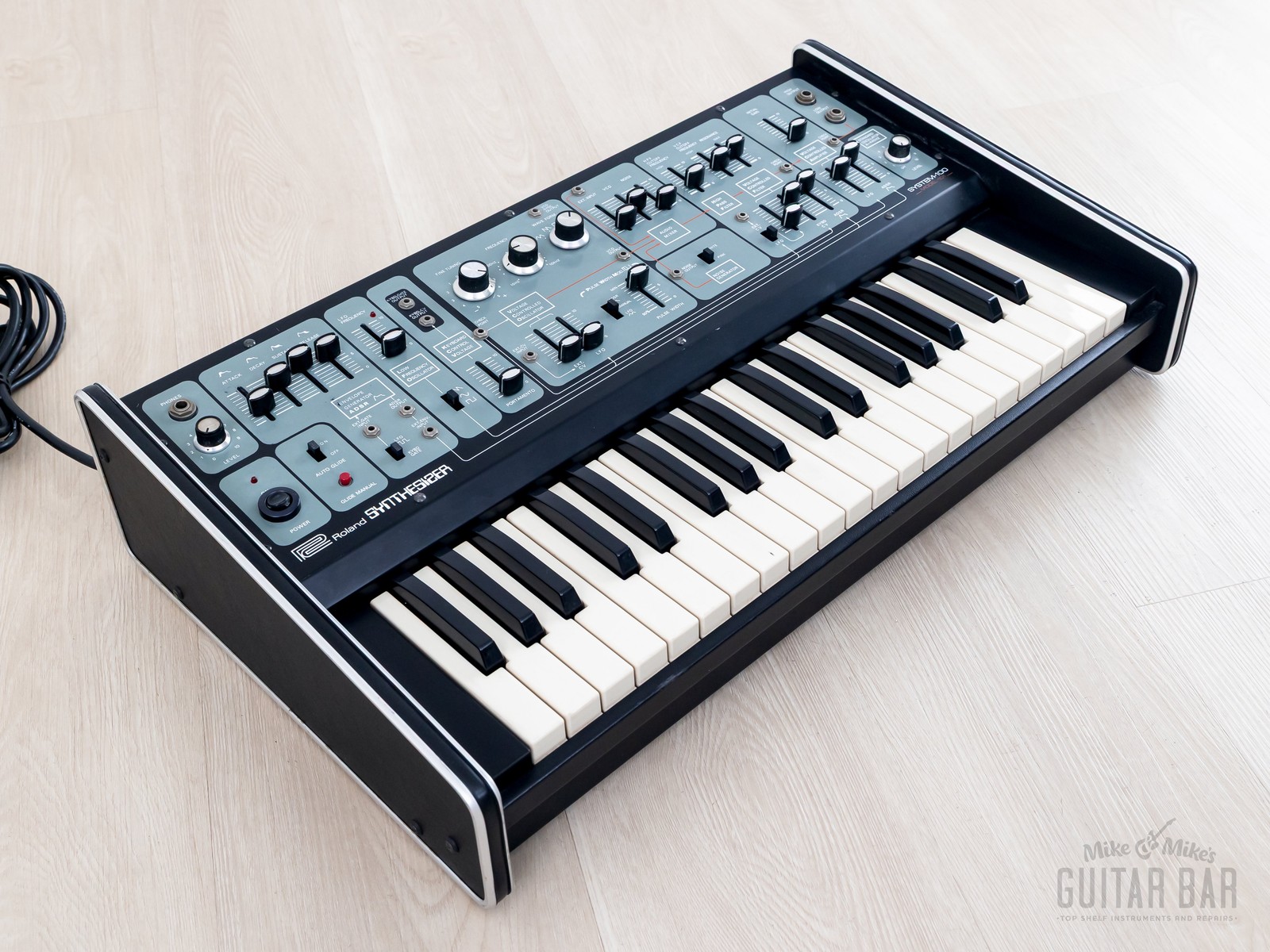
You don’t just play the Roland System 101—you conduct experiments. From the moment you set eyes on its olive-green faceplate studded with patch bays and chunky knobs, it announces itself as something different from the preset-laden synths that would flood the market a few years later. This is a machine built for discovery, the centerpiece of Roland’s first foray into semi-modular synthesis, and the foundation upon which the entire System 100 was built. Released in 1975, the Model 101 wasn’t just a keyboard with some effects bolted on—it was a self-contained analog universe, designed to be rewired, rerouted, and reimagined at will. It’s the synth that taught a generation how voltage control actually works, not through manuals, but through hands-on patching, trial, error, and glorious sonic accidents.
Sitting at the heart of the System 100, the 101 pairs a 37-note keyboard with a full monophonic voice path: VCO, filter, envelope, and mixer, all pre-wired but ready to be dismantled with a single cable. That semi-modular design is key—most functions work straight out of the box, but the moment you plug into the front-panel patch bays, you’re overriding the internal signal flow and entering modular territory. It’s this balance between accessibility and deep synthesis that made the 101 such a pivotal instrument. Unlike the fully modular beasts from Moog or ARP, which demanded technical fluency and deep pockets, the System 101 offered a gentler on-ramp into patching while still delivering the raw, unpredictable character of analog circuits pushed to their limits.
The sound? Thick, organic, and slightly unhinged in the best way. The VCO delivers a rich square wave with smooth pulse-width modulation and a sawtooth that cuts with a slightly nasal growl—nothing like the pristine DCOs that would define Roland’s 1980s synths. The filter section is where things get truly interesting: a dual high-pass/low-pass design that lets you sculpt both the top and bottom end simultaneously, something rare even among modular systems of the era. Crank up the resonance on the low-pass and you get that classic Roland squelch, but with a darker, more resonant character than the later SH series. It doesn’t just scream—it snarls. And when you route external signals through it, like a drum machine or another synth, the 101 transforms into a dynamic processor, capable of turning a simple kick into a sweeping, resonant explosion.
It wasn’t built for the stage. There’s no velocity, no aftertouch, no memory for patches—what you see is what you get, and what you patch is what you hear. But that limitation is also its strength. Without presets or digital recall, every sound is a moment in time, captured through physical interaction. You learn the machine by muscle memory, by the way the knobs resist just slightly as you twist them, by the hum of the power supply when you leave it on too long. It’s a synth that demands presence, not just performance.
Specifications
| Manufacturer | Roland Corporation |
| Production Years | 1975–1979 |
| Original Price | Not available |
| Synthesis Type | Analog semi-modular |
| Keyboard | 37 keys (F–C), monophonic |
| Oscillators | 1 VCO with sawtooth, square, and PWM; white/pink noise generator |
| Filter | Low-pass and high-pass VCF with resonance control |
| Envelope Generator | ADSR with gate/trigger inputs |
| Modulation | LFO with triangle and square waveforms |
| Inputs/Outputs | External audio input, CV/Gate in/out, patch bays for VCO, VCF, VCA, LFO, envelope |
| Effects | Ring modulator (via patching) |
| Power Requirements | ±15V DC |
| Weight | Approx. 10.5 kg (23.1 lbs) |
| Dimensions | 630 × 305 × 115 mm (24.8 × 12 × 4.5 in) |
| Color | Olive green with cream panel |
| Expansion | Designed to integrate with System 100 modules (102, 103, 104, 109) |
Key Features
The Semi-Modular Signal Path
What sets the System 101 apart from both fully integrated synths and pure modulars is its semi-modular architecture. The signal path—from VCO to filter to VCA—is pre-wired internally, so you can play it right out of the case. But the moment you plug a cable into any of the front-panel jacks, you break that internal connection and take full control. This design lowers the barrier to entry while preserving the flexibility of modular synthesis. Want to modulate the filter cutoff with an external sequencer? Patch it. Need to route the LFO to pulse width instead of pitch? Just connect the dots. It’s a teaching tool disguised as a performance instrument, and it’s why so many early electronic musicians cut their teeth on the System 100.
Dual Filter Topology
While most monosynths of the era offered a single low-pass filter, the 101 gives you both high-pass and low-pass sections, each with independent cutoff and resonance controls. This dual-filter setup allows for surgical tone shaping—think of it as a crude but effective graphic EQ with only two bands. You can use the high-pass to strip away mud from a bass patch while using the low-pass to tame harshness, or go extreme and create narrow band-pass effects by cranking both resonances. The filters don’t self-oscillate quite as cleanly as a Moog ladder, but they’ve got a character all their own: a slightly gritty, resonant growl that responds dramatically to modulation. When overdriven, they add a subtle saturation that modern clean filters often lack.
External Sound Processing
Few synths from this era invited external audio input as openly as the 101. With a dedicated “External Sound-In” jack, you can route drum machines, vocals, or other synths directly into the filter and VCA path, turning the 101 into a real-time effects processor. Pair that with the ring modulator (accessible via patching between the VCO and external input) and you’ve got a primitive but powerful sound mangler. Early industrial and experimental artists exploited this feature to devastating effect, using the 101 to transform simple waveforms into metallic clangs and inharmonic shrieks. It’s not subtle, but subtlety wasn’t the point.
Historical Context
The System 101 arrived in 1975, a time when analog synthesis was still the domain of academic studios and wealthy rock stars. Moog and ARP dominated the high end, but their systems were expensive, complex, and often required custom installation. Roland, still a relatively young company, saw an opportunity to bring modular synthesis to a broader audience—not by simplifying it into irrelevance, but by packaging it in a more approachable form. The System 100 was their answer: a modular system that didn’t require a rack full of disparate modules or a degree in electronics to operate.
The 101 competed not just with other synths, but with the very idea of what a synth should be. While Sequential Circuits was developing the Prophet-5 with programmable memory, Roland doubled down on immediacy and hands-on control. There were no presets, no digital brains—just knobs, cables, and volts. It was a philosophical stance as much as a technical one. The 101 wasn’t trying to be the most powerful synth on the market; it was trying to be the most *understandable*. And in that, it succeeded.
It also laid the groundwork for everything Roland would do in synthesis. The SH series, the Jupiter line, even the later Boutique modules—all owe something to the architecture and design language first established in the System 100. The 101’s VCO and filter designs evolved into the circuits that would define the SH-101 and Juno-60, but with a rawness that those later instruments smoothed over. It’s the difference between a hand-built prototype and a mass-produced product: less consistent, perhaps, but full of character.
Collectibility & Value
Finding a working Roland System 101 today is no small feat—and keeping it alive is a commitment. These are 50-year-old analog circuits, and time has not been kind to their electrolytic capacitors, aging transistors, and patch bay contacts. Owners report that power supply issues are common, often requiring recap and voltage regulation repairs. The ±15V rails must be stable, or the synth will drift wildly in pitch or cut out entirely. Service technicians observe that many units were modified in the 1980s for studio integration, so finding one in original condition is rare.
When they do surface, prices reflect their status as vintage grails. A fully restored Model 101 can command upwards of $4,000 on the open market, especially when paired with other System 100 modules like the 102 expander or 104 sequencer. Unrestored units sell for less—$1,800 to $2,500—but come with significant risk. Rusty patch jacks, stiff or noisy pots, and failing keyboards are all common. The 37-note keyboard, while playable, is prone to keybed wear and contact oxidation, leading to missed notes or stuck triggers.
For collectors, the real value lies in completeness and originality. A 101 with its original power supply, patch cables, and documentation is worth a premium. Units that have been retrofitted with MIDI or modern power supplies lose some of their vintage appeal, though such mods can make them more usable in contemporary setups. If you’re buying, power it up and test every function: check for stable tuning over 15 minutes, verify that the filters respond smoothly, and test all patch points for continuity. And if it smells like burnt electronics? Walk away.
Despite the maintenance challenges, the 101 has aged well sonically. Its raw, unfiltered character stands in stark contrast to the clinical precision of modern analogs. It’s not a synth for everyone—its learning curve is steep, its footprint is large, and it demands attention. But for those who want to understand synthesis from the ground up, there are few better starting points.
eBay Listings



As an eBay Partner, we earn from qualifying purchases. This helps support our independent vintage technology research.