ALM mmMidi mkII (2025–)
Four tiny HP that quietly solve the oldest headache in modular: how to get your laptop to talk to your rack without a nest of cables and a PhD in MIDI implementation charts.
Overview
Plug in a USB-C cable from your phone, tap a note in a MIDI app, and watch your VCO track perfectly—no configuration, no menu diving, no hocus-pocus. That’s the mmMidi mkII in its natural habitat: the unglamorous but critical role of translator between the digital world and your analog chaos. It doesn’t make sound. It doesn’t sequence. But without it, half your rack might as well be mute. This is the module you don’t notice until it’s gone, like clean power or a decent ground connection. And when it works this smoothly, you stop thinking about it entirely—which is exactly the point.
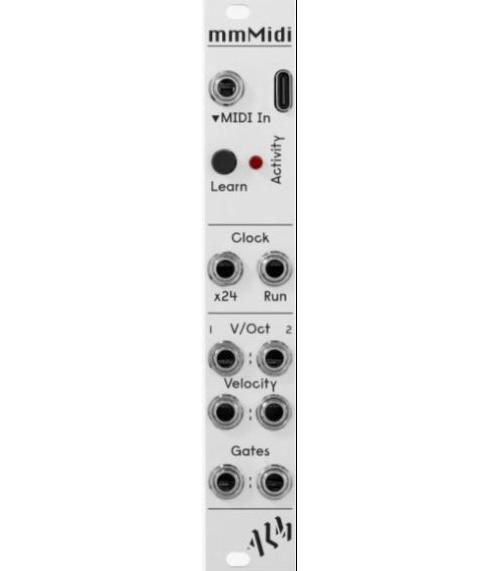
ALM didn’t reinvent the wheel here, but they finally put air in the tires. The original mmMidi was already lean and functional, but the mkII swaps the old USB-B port for USB-C, making it compatible with modern tablets, smartphones, and laptops that ditched legacy ports years ago. That’s not just convenience—it’s relevance. A modular synth in 2025 might be clocked by an iPad running a sequencer, or triggered by a MIDI file on a phone during a live set. The mkII meets that reality head-on, supporting class-compliant USB MIDI so it works with iOS, Android, and desktop systems without drivers or workarounds. And if you’re still rocking a DIN MIDI keyboard or an old DAW interface, it’s got a 5-pin DIN input too, complete with an included adapter to convert standard MIDI cables to the module’s TRS-style connector.
What it does, it does with surgical precision: two full MIDI channels converted to 1V/oct CV, gate, and velocity for each voice. That’s enough to run two monosynths in perfect unison, or a lead and a bass line from the same DAW track. Clock in via MIDI, and it spits out a rock-solid 24 pulses per quarter note (PPQN) clock signal and a run/stop trigger—essentially DIN Sync in modern clothing—so you can lock Pamela’s PRO Workout, a vintage Roland drum machine, or any clock-hungry module to your host tempo. There’s no quantizer onboard, no arpeggiator, no fancy MIDI learn modes. It doesn’t try to be smart. It just translates, fast and cleanly, with latency under 400 microseconds. In a world where some MIDI-CV boxes take 30 seconds to boot and require firmware updates just to recognize channel 3, that simplicity feels like a revelation.
Specifications
| Manufacturer | ALM Busy Circuits |
| Production Years | 2025– |
| Original Price | £170 GBP |
| Power | +12V @ 50mA, -12V @ 0mA |
| Size | 4HP |
| Depth | 38mm |
| MIDI Inputs | DIN MIDI (TRS), USB-C |
| CV Outputs | Dual 1V/Oct (Channel A and B) |
| Gate Outputs | Dual gate (Channel A and B) |
| Velocity Outputs | Dual velocity CV (Channel A and B) |
| Clock Output | 24 PPQN fixed clock |
| Run Output | Run/stop trigger |
| Expander Support | mmT (adds third channel with 8 key-mapped gates) |
| MIDI Response Latency | 200–400 µSec |
| CV Resolution | 12-bit, factory calibrated |
| CV Range | 0–8V |
| Gate Level | +5V |
| Firmware Updates | USB-C drag-and-drop |
| Reverse Power Protection | Yes |
| Warranty | 2 years |
| Country of Manufacture | England |
Key Features
USB-C That Just Works
The mkII’s headline upgrade isn’t flashy, but it’s transformative: USB-C replaces the outdated USB-B port, and it’s implemented as a class-compliant MIDI device. That means plug it into an iPad running GarageBand or a Surface tablet with Ableton, and it appears instantly—no drivers, no settings, no MIDI configuration menus. For live performers, this is a game-changer. No more carrying a powered USB hub or a legacy adapter dongle. The USB connection carries MIDI data only; it doesn’t power the module, so your phone won’t drain, and your rack stays on its own power supply. But the ability to control your modular from a tablet on stage, or even a MIDI keyboard app on your phone during a soundcheck, removes friction that used to kill spontaneity.
Dual-Channel Simplicity
Two MIDI channels, each with full CV, gate, and velocity outputs—no sharing, no toggling. Channel A and B run independently, so you can assign one to a bass oscillator and the other to a lead filter cutoff, or send both to different voices in a polyphonic setup. The velocity outputs are particularly useful for patching into VCA levels or filter modulation, adding dynamics without extra modules. There’s no pitch bend or modulation wheel CV out, which might disappoint some, but that’s by design. The mmMidi mkII doesn’t try to do everything; it does the core job so well that you rarely miss the extras. If you need more, ALM offers the mmT expander, which adds a third channel with eight individual gate outputs mapped to specific keys—perfect for triggering drum modules or sample players from a MIDI keyboard’s lower octaves.
Rock-Solid Clock Conversion
Syncing a modular to a DAW used to require arcane setups involving DIN Sync converters, clock dividers, and prayer. The mmMidi mkII handles it in one step: MIDI clock in, 24 PPQN clock and run signal out. That clock output is precise and jitter-free, capable of locking even the most timing-sensitive digital oscillators or FM patches. The run signal mirrors the MIDI start/stop command, so your sequencers and LFOs reset cleanly on every play command. This isn’t just convenient—it’s essential for any hybrid setup where the DAW is the master clock. And because it outputs standard voltage levels (+5V), it plays nicely with vintage gear that expects DIN Sync, bridging decades of technology in a single module.
Historical Context
The mmMidi mkII exists because the modular world changed faster than its interfaces. Eurorack exploded in popularity just as computers and mobile devices were shedding legacy ports. By the mid-2020s, USB-B was vanishing from laptops, and MIDI DIN ports were becoming rare outside dedicated audio interfaces. Meanwhile, modular users increasingly relied on DAWs, iOS apps, and MIDI controllers that spoke USB natively. The gap was real: a $3,000 rack couldn’t talk to a $10 MIDI app without a tangle of adapters and a USB host module. ALM saw the bottleneck and solved it with surgical precision. The mkII isn’t the first MIDI-CV converter, but it’s one of the first to treat USB-C as a first-class citizen rather than an afterthought. It arrived alongside a wave of similar updates from Intellijel, Doepfer, and others, but ALM’s implementation stands out for its zero-configuration ethos. Competitors often require software setup or mode switching; the mmMidi mkII just works. In an ecosystem full of over-engineered solutions, that simplicity is revolutionary.
Collectibility & Value
As of 2026, the mmMidi mkII is too new to be “vintage,” but it’s already essential infrastructure in modern Eurorack builds. New units sell for around £170 GBP (approximately $215 USD), with no significant markups or scarcity. That price is fair for what it delivers: a no-compromise bridge between worlds. Used units are just beginning to appear, trading for 20–30% less, but given the module’s solid build and lack of moving parts, depreciation should be slow. Failures are rare—documentation shows no widespread issues, and service technicians observe that the most common “problem” is users forgetting to use the included TRS-to-MIDI adapter. The USB-C port is robust, and firmware updates are handled via simple drag-and-drop, minimizing obsolescence risk. For buyers, the only real caution is confirming it’s the mkII version: the original mmMidi lacks USB-C and won’t connect to modern devices without additional hardware. If you’re building or touring with a modular system, this isn’t a luxury—it’s a necessity. Skip it, and you’ll spend more on cables, adapters, and frustration.
eBay Listings
As an eBay Partner, we earn from qualifying purchases. This helps support our independent vintage technology research.