ALM mmMIDI (2019–2025)
Two channels of MIDI-to-CV in 4HP that just works—until your DAW floods it with data and everything glitches out.
Overview
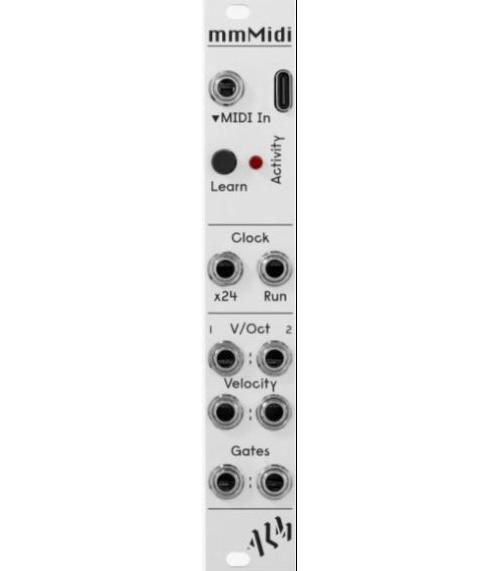
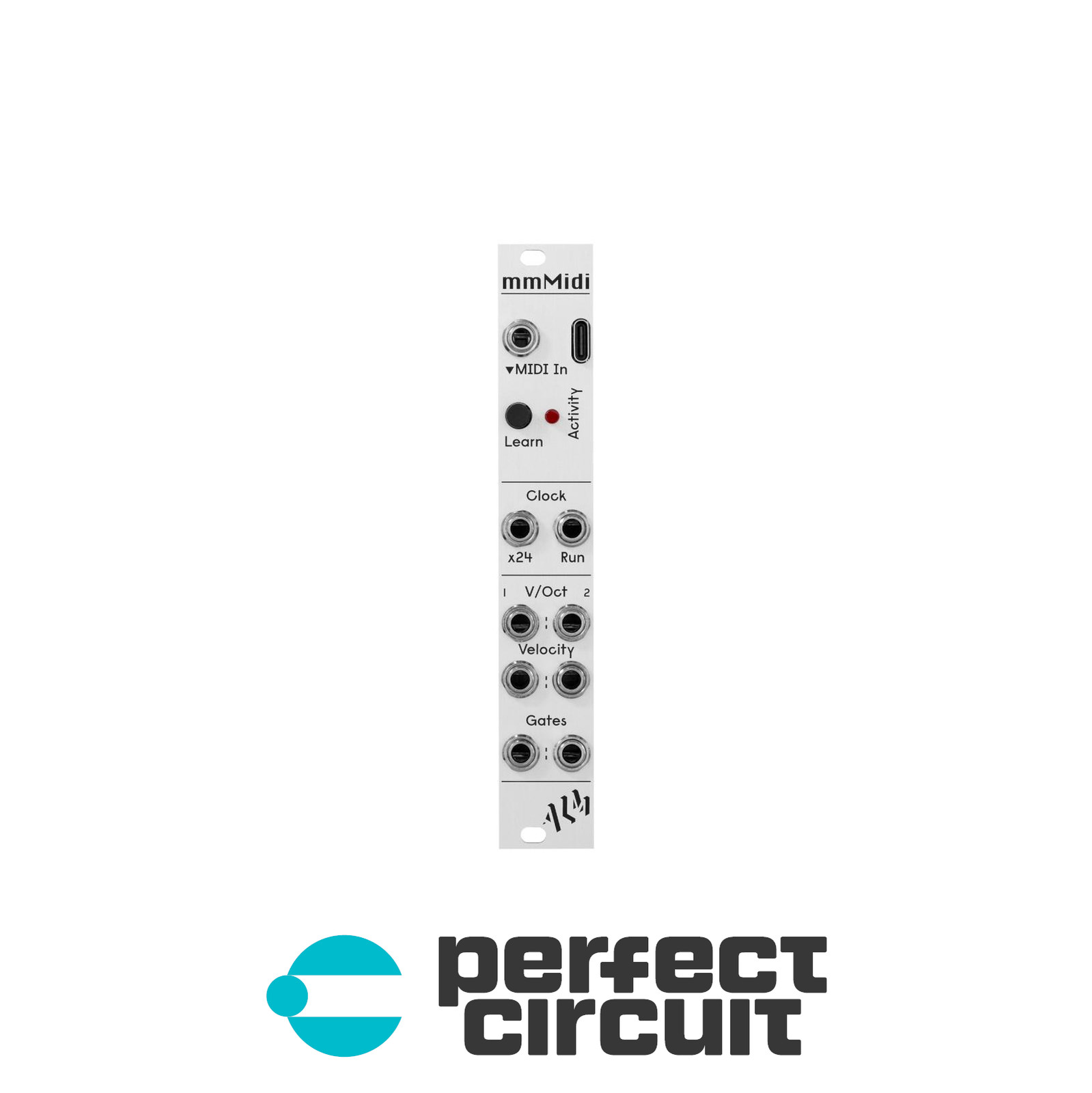
Plug in a MIDI cable, power up, and within seconds you’re playing your Eurorack from a keyboard or DAW—no menus, no screens, no 20-minute calibration ritual. That’s the mmMIDI in a nutshell: a no-nonsense, dual-channel MIDI-to-CV converter that strips away every unnecessary feature to deliver rock-solid tracking and clock sync with the kind of reliability that makes you wonder why every MIDI interface isn’t this simple. It’s the module you reach for when you’re tired of hunting through firmware updates or assigning CCs just to get a gate signal. The original mkI launched in 2019 as a DIN-only unit, and while it lacked USB, its immediacy won over skeptics fast. Then in 2025, ALM quietly rolled out the mkII—same DNA, but now with USB-C support, making it class-compliant with tablets, phones, and laptops without drivers. No firmware update needed, no extra power draw: just plug in and go.
The magic is in the restraint. While other manufacturers pack MIDI converters with arpeggiators, scales, and microtuning options, the mmMIDI does exactly two things: convert two MIDI note channels into 1V/oct CV, velocity, and gate outputs, and translate MIDI clock into a 24ppqn analog clock and run signal. That clock output is specifically tailored to sync Pamela’s PRO Workout, ALM’s own clock powerhouse, making this a natural pairing for anyone running a modular rig anchored by Pam’s intricate timing. There’s no configuration beyond setting MIDI channels via a learn button—no hidden menus, no SysEx dumps unless you’re tweaking the C0 offset (more on that later). It’s the anti-bloatware of the Eurorack world: a utilitarian tool that assumes you know what you’re doing and gets out of your way.
And it works—*most* of the time. Owners report near-instant response, with latency measured between 200 and 400 microseconds, which is tight enough for all but the most timing-sensitive patches. The 12-bit factory-calibrated CV output spans 0–8V, giving you eight full octaves of tracking range, and gates sit at a solid +5V, compatible with virtually every Eurorack input. But this simplicity has trade-offs. Because it accepts *all* MIDI data on its channels, a DAW like Ableton Live that sends pitch bend, aftertouch, or control changes by default can overwhelm the module, resulting in double triggers, stuttering gates, or erratic clock behavior. The fix? Careful MIDI filtering in your software. This isn’t a flaw in the hardware—it’s a consequence of its “dumb” design philosophy. It doesn’t filter; it obeys. That’s great when your MIDI source is clean, but a headache when it’s not.
There’s also the optional mmT expander, a separate module that adds eight assignable key-triggered gate outputs—think of it as turning your MIDI keyboard into a drum rack controller. Press C1, get a kick; D1, a snare. It’s a clever add-on for live performance, especially if you’re using a compact controller like the Keystep, but it’s not stacked directly on the mmMIDI. Instead, it connects via a ribbon cable, consuming another 4HP. So while the base module is skiff-friendly, the full system takes up real estate.
Specifications
| Manufacturer | ALM (Busy Circuits) |
| Production Years | 2019–2025 |
| Model Variant | mkI (DIN MIDI only), mkII (DIN + USB-C) |
| Original Price | $115 USD (mkI), £170 GBP (mkII) |
| Width | 4 HP |
| Depth | 38 mm |
| Power | +12V 50mA, -12V 0mA |
| MIDI Inputs | DIN MIDI (5-pin), USB-C (mkII only) |
| CV Outputs | Dual 1V/oct (0–8V range) |
| Gate Outputs | Dual +5V gate/trigger |
| Velocity Outputs | Dual (0–8V) |
| Clock Outputs | Analog x24 clock, Run (start/stop) |
| Expander Support | mmT (8 key-mapped gate outputs) |
| MIDI Response Latency | 200–400 µs |
| CV Resolution | 12-bit (factory calibrated) |
| Firmware Updates | via SysEx over USB or DIN |
| Weight | Approx. 100g |
| Mounting | Standard Eurorack, reverse power protection |
Key Features
No-Config Operation
The mmMIDI’s biggest selling point is that it requires no setup. Plug in MIDI, assign channels by pressing the learn button and playing a note, and you’re done. No displays, no button-holding sequences, no software editors. This is a deliberate design choice by ALM, who explicitly stated they have no plans to add configuration options beyond MIDI channel assignment. That means no scaling, no offset trimming via front panel, and no filtering of extraneous MIDI data. It’s a trade-off: you gain reliability and speed at the cost of flexibility. For users coming from complex MIDI processors like the Kenton Pro Solo or Expert Sleepers FH-2, this might feel limiting. But for those who just want to play a VCO from a keyboard without diving into menus, it’s liberating.
USB-C on the mkII
The 2025 mkII revision quietly added USB-C MIDI support without increasing power draw or changing the form factor. This wasn’t just a convenience upgrade—it fundamentally expanded the module’s usability. Suddenly, you could plug it directly into an iPad running a MIDI app, a smartphone, or a laptop without a separate MIDI interface. Since it’s class-compliant, no drivers are needed on any major OS. The USB connection carries only data; it doesn’t power the module, so you still need a Eurorack power supply. But the ability to go fully cable-free (with a wireless MIDI controller) makes the mkII a favorite for portable setups. The original mkI remains DIN-only, so if you’re buying used, check which version you’re getting.
Firmware Tweaks for Pitch Offset
One of the few configurable aspects of the mmMIDI is the MIDI note-to-CV offset, which by default maps MIDI note C0 to 0V. For some users, especially those with controllers that can’t play below C1, this makes the lowest octave unreachable. ALM addressed this with a firmware update (available via SysEx) that allows toggling the offset by ±2 octaves via a double-click on the learn button. This isn’t something you’ll find in the manual unless you dig into the ALM firmware page, but it’s a lifesaver for integrating with hardware like the Arturia Keystep or Novation Launchkey, which don’t transmit C0. Service technicians observe that many returns or “faulty unit” reports stem from users unaware of this firmware option—once updated, tracking issues often vanish.
Historical Context
The mmMIDI arrived in late 2019, a time when Eurorack was at peak complexity. Modules were getting smarter, with embedded processors, color screens, and deep firmware layers. In that climate, the mmMIDI felt like a rebellion—a return to the ethos of “one function, done well.” It wasn’t the first MIDI-to-CV converter, nor the most feature-rich, but it was the first to make the process genuinely *simple*. Competitors like the Doepfer MSY2 or Kenton Pro Solo offered more features—scale quantization, multiple outputs, extensive MIDI filtering—but required setup and often suffered from lag or instability. The mmMIDI sidestepped that by being dumb in the best way: it didn’t interpret, it translated.
Its timing was perfect. As more musicians began blending DAWs with modular systems, the need for a reliable, low-latency bridge grew. The mmMIDI filled that gap, especially for users of ALM’s Pamela’s PRO Workout, which had become a clocking staple. The 24ppqn clock output matched Pam’s internal timing standard, making sync rock-solid—when the source was clean. But the module also highlighted a growing tension in the modular world: as software became more dominant, hardware modules had to adapt to messy MIDI streams from DAWs. The mmMIDI’s refusal to filter MIDI data exposed this divide. It worked flawlessly with hardware sequencers like the Elektron Digitakt or Arturia Beatstep Pro, but stumbled with Ableton Live unless carefully configured. That limitation wasn’t accidental—it was philosophical. ALM built the mmMIDI for users who wanted control, not curation.
Collectibility & Value
The mmMIDI isn’t a rare module, but it’s a sought-after one. The mkI (2019–2024) typically sells for $120–$150 used, depending on condition and whether it includes the optional MIDI-TRS adapter. The mkII (2025) commands a premium—around $170–$200—due to its USB-C capability and newer firmware. Prices on Reverb and eBay have remained stable, with no signs of inflation, suggesting strong availability and no cult status—yet. However, collectors note that original mkI units with early firmware (pre-offset fix) are sometimes discounted, as they require a SysEx update to be fully functional with modern controllers.
Common failures are few, but not nonexistent. The most reported issue is MIDI input dropout, usually traced to a failing optocoupler on the DIN input. This is a standard component, and service technicians can replace it in minutes, but it’s a known weak point, especially in units used frequently with unshielded cables. The USB-C port on the mkII has proven robust, with no widespread reports of connector failure. Power issues are rare, thanks to reverse polarity protection, but owners report occasional noise on the CV lines if the module shares a crowded power bus—decoupling caps on the power cable often resolve this.
Buying advice? Always test the clock output. Some users report drift when syncing to DAWs, but this is almost always due to MIDI jitter in the source, not the module. Test with a hardware sequencer first. Also, check the firmware version—anything before 2022 may lack the ±2 octave offset toggle. If you’re buying used, ask the seller to confirm whether they’ve updated it. And if you’re using Ableton, don’t expect it to work out of the box—route MIDI through a dedicated track with only note and clock data enabled, and disable all other MIDI outputs to the module.
eBay Listings

As an eBay Partner, we earn from qualifying purchases. This helps support our independent vintage technology research.