ALM AXON-1 (2010s)
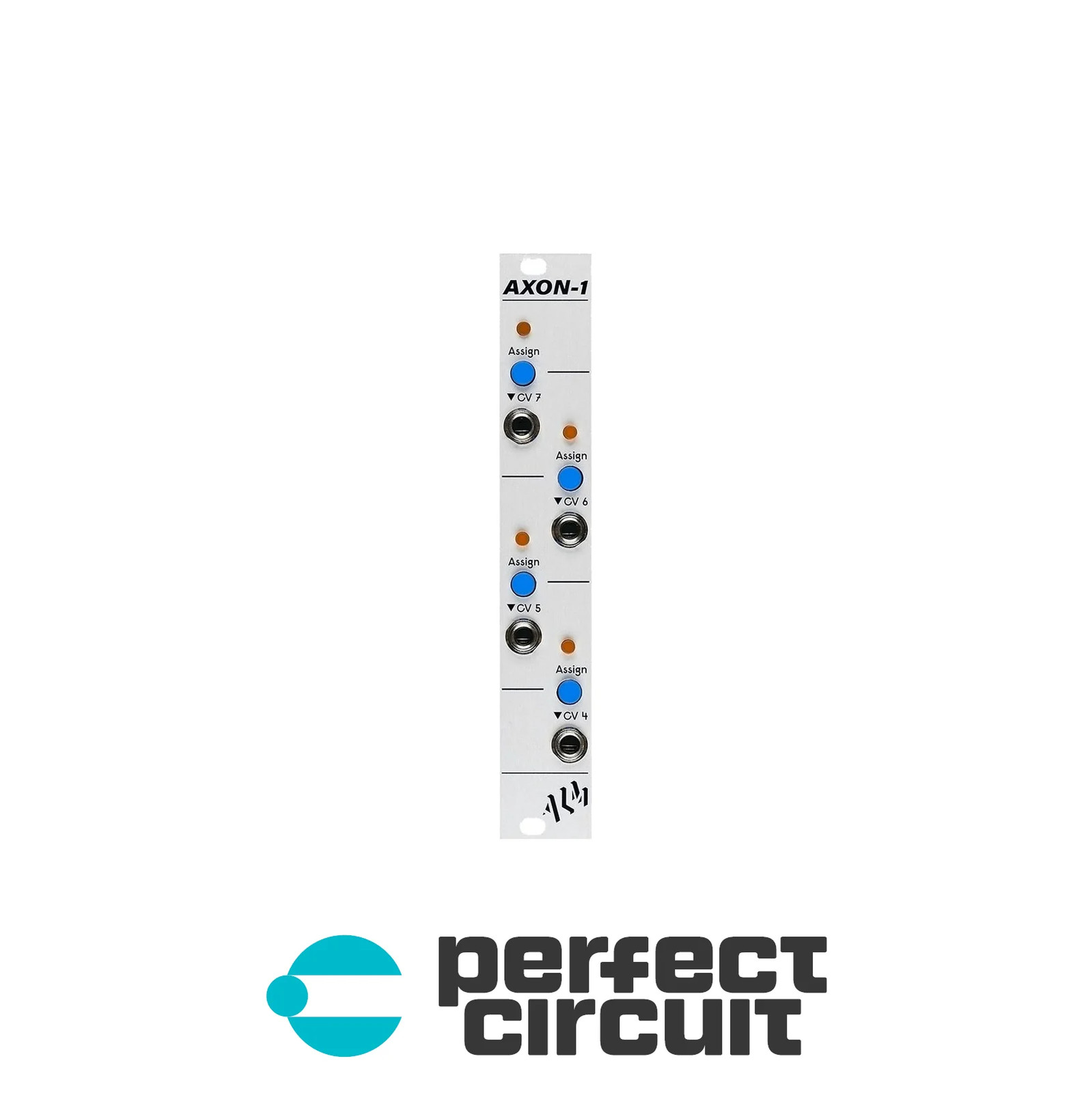
A tiny slab of metal that unlocks the hidden brain of your Squid Salmple—four extra CV inputs that feel like finding a secret level in a game you thought you’d mastered.
Overview
It’s easy to overlook a 4HP expander in a world obsessed with flashy oscillators and kaleidoscopic effects, but the ALM AXON-1 is one of those quiet, unassuming pieces that changes how you use the gear you already love. It doesn’t make sound. It doesn’t process anything. What it does is give you control—four fresh CV inputs that plug directly into the nervous system of the Squid Salmple, letting you modulate parameters with the precision and flexibility that only modular synthesis can offer. If the Squid Salmple is your sampler-brain, the AXON-1 is the extra cortex you didn’t know you needed.
This isn’t just about quantity; it’s about integration. Each of the four inputs behaves exactly like the three built into the Squid Salmple—digitally attenuated, assignable to any parameter, and saved with your presets. That last part is crucial: your modulation routings aren’t lost when you switch banks. They’re part of the patch. That kind of memory-aware modulation was still a luxury in the early 2010s Eurorack scene, and ALM didn’t just offer it—they made it modular, expandable, and dead simple to use. The AXON-1 snaps onto the Squid Salmple’s expansion header, draws power directly from it (no extra cable, no fuss), and disappears into the workflow. It doesn’t demand attention. It just works.
And it’s not just for sampling. The AXON-1 also works with the MFX multi-effects processor and Pamela’s PRO Workout, two other ALM flagships that thrive on deep modulation. On the MFX, those extra CVs can twist reverb decay, morph delay feedback, or warp filter sweeps in real time. On Pamela’s PRO Workout, they become additional modulation destinations for clock division, swing, or pulse width—all saved per preset. That cross-compatibility is part of what makes the AXON-1 more than a niche add-on. It’s a philosophy: ALM builds ecosystems, not just modules.
Specifications
| Manufacturer | ALM Busy Circuits |
| Production Years | 2010s |
| Original Price | $139.99–$145 |
| Width | 4HP |
| Max Depth | 38mm |
| Power | 40mA @ +12V, 0mA @ -12V, 0mA @ +5V |
| Power Connection | Direct from host module (Squid Salmple, MFX, or Pamela’s PRO Workout) |
| CV Inputs | 4 freely assignable |
| Modulation Features | Digital attenuation and offset per input |
| Preset Integration | All assignments and settings saved with host module banks |
| Compatibility | Squid Salmple, MFX, Pamela’s PRO Workout |
| Mounting | Skiff-friendly |
| Country of Origin | England |
Key Features
Digital Control in an Analog World
Most Eurorack expanders from the 2010s were passive—extra jacks, maybe some switching, but no intelligence. The AXON-1 is different. Its digital attenuation and offset aren’t just conveniences; they’re precision tools. You’re not just patching in an LFO or envelope—you’re shaping how that modulation behaves, with fine control over depth and bias, all stored in memory. That means a single LFO can gently wobble one parameter in one preset and violently shred another in the next, without rewiring. It’s a subtle superpower, but one that pays off every time you recall a complex patch and it just… works.
Expansion Without Bloat
At 4HP, the AXON-1 is barely there. It doesn’t eat up valuable rack space, and it doesn’t require a separate power cable—power is drawn directly from the host module via the expansion header. That’s a big deal in a crowded system. No dangling ribbon cables, no extra busboard slots. It’s a clean, elegant solution to a common problem: running out of modulation destinations. And because it’s skiff-friendly, it fits in compact cases or travel rigs without forcing compromises.
One Module, Three Personalities
What makes the AXON-1 truly versatile is its triple compatibility. With the Squid Salmple, it turns a powerful sampler into a fully modulatable sample mangler—think pitch bends synced to envelopes, filter sweeps driven by random voltages, or sample start points modulated by sequencers. On the MFX, it becomes a dynamic effects controller, letting CV shape reverb tails, delay repeats, or distortion intensity in real time. And on Pamela’s PRO Workout, it adds extra modulation targets for rhythmic manipulation—swing depth, clock division, gate length—all recallable per preset. That kind of flexibility is rare in expanders, which are usually built for one host and one purpose.
Historical Context
The early 2010s were a turning point for Eurorack. What had been a niche format for hardcore tinkerers was starting to attract producers, performers, and composers who wanted not just raw sound, but structured, repeatable control. ALM Busy Circuits, a UK-based outfit with a reputation for robust, intelligent design, was at the forefront of that shift. While others focused on sound generation, ALM built tools for organization, sequencing, and modulation—gear that didn’t just make noise, but helped you shape it with intention.
The AXON-1 arrived in that context: not as a headline-grabbing innovation, but as a quiet enabler. It didn’t compete with the flashy synths from Make Noise or Mutable Instruments. Instead, it supported them—giving ALM’s own complex modules the kind of deep, recallable modulation that was still rare outside high-end digital systems. At a time when most modular patches were ephemeral—rewired every session—the AXON-1 helped make Eurorack more performable, more reliable, more like a real instrument. It was part of a broader trend toward hybrid systems, where digital brains controlled analog bodies, and memory wasn’t an afterthought.
Competitors like Intellijel and Doepfer were offering multi-function modulation mixers or digital sequencers, but few were building expanders that integrated so tightly with a host. The AXON-1 wasn’t trying to be universal. It was designed to be invisible—just another part of the module it enhanced. That philosophy set ALM apart: gear that didn’t shout, but listened.
Collectibility & Value
The AXON-1 isn’t a collector’s trophy. You won’t find it framed on Instagram or auctioned for triple retail. But that doesn’t mean it’s not valuable. On the used market, it typically sells for $90–$120, depending on condition and whether it’s bundled with a Squid Salmple or MFX. It’s not rare—ALM produced it steadily through the 2010s—but it’s not common, either. Because it’s an expander, many owners never list it separately. You’ll often see it included in full system sales or traded privately among ALM users.
There are no known failure points. No moving parts, no exposed circuitry, no power regulation to go bad. It’s a passive PCB that piggybacks on the host module, so the only real risk is physical damage—bent pins on the expansion header or a cracked solder joint from rough handling. Even then, repairs are straightforward for anyone with basic soldering skills. The biggest issue isn’t reliability—it’s availability. Since it draws power from the host, you can’t use it with third-party clones or DIY builds unless they replicate the expansion header exactly. That locks it to genuine ALM modules, which is both a strength and a limitation.
If you’re buying one, check that the expansion connector is straight and undamaged. Test it with a compatible host if possible—make sure all four CV inputs respond and that assignments save correctly. Most units on the market are in excellent condition, but avoid any that show signs of board flexing or prior repair. And remember: this isn’t a standalone module. It’s a tool. Its value isn’t in scarcity, but in utility. If you own a Squid Salmple or MFX and find yourself wishing for more modulation, the AXON-1 isn’t a luxury—it’s an upgrade you’ll use every day.
eBay Listings

As an eBay Partner, we earn from qualifying purchases. This helps support our independent vintage technology research.