ALM Jumble Henge (2021–)
A patchbay with a personality: plug in, twist one knob, and watch your mix come alive in stereo dimension and spectral color.
Overview
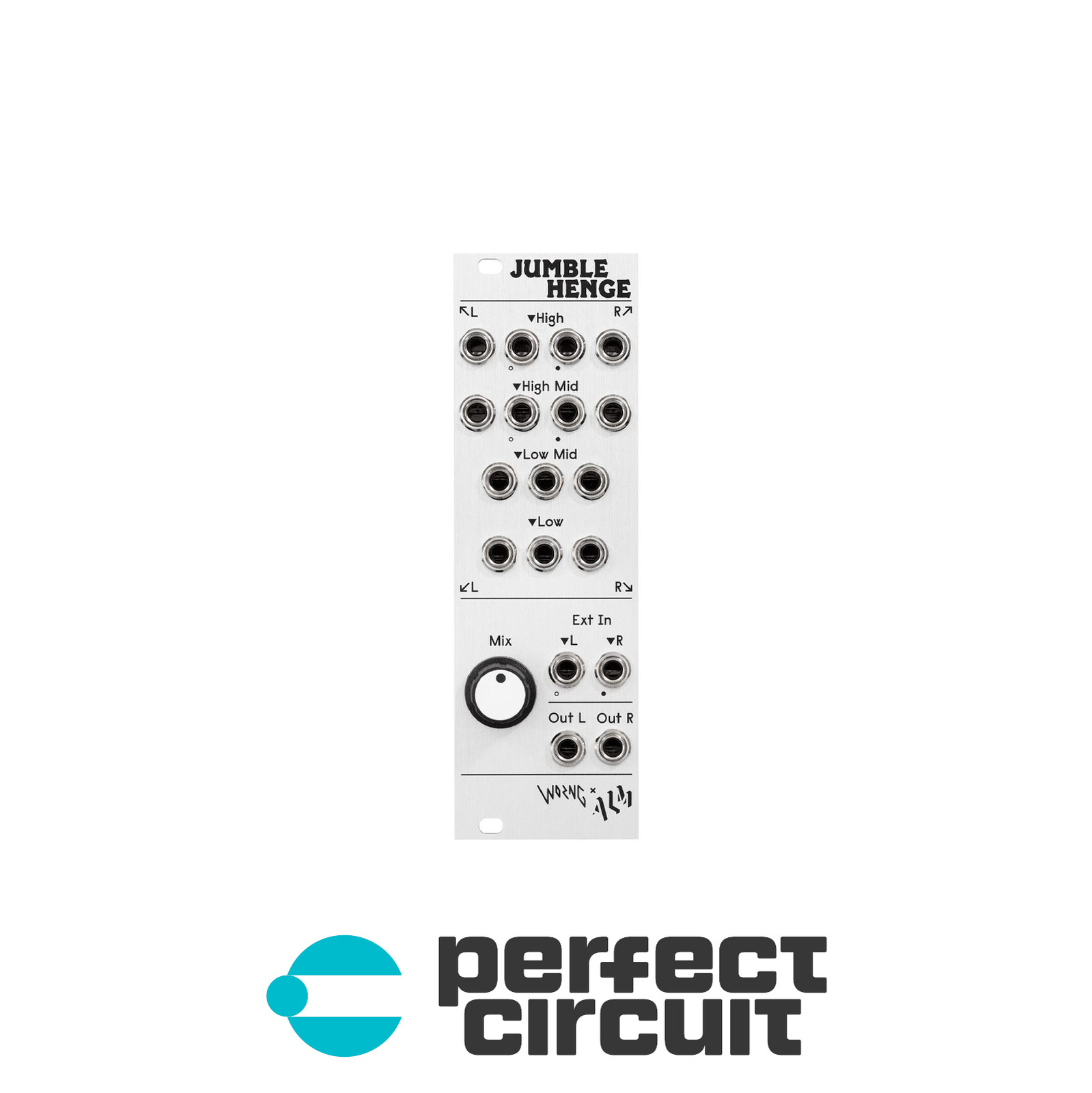
It’s rare for a mixer to feel like an instrument, but the ALM Jumble Henge does exactly that—less a utility, more a sculptor of space and tone. From the moment you patch a signal into one of its 16 inputs, you’re not just routing audio; you’re assigning it a place in a three-dimensional sonic landscape. High and right? Crisp, airy, wide. Low and left? Thick, centered, warm. The magic isn’t in endless knobs or CV inputs—it’s in the fixed, deliberate design. Each input has a pre-tuned analog filter and a fixed pan position, so the character of your mix emerges from where you plug, not how much you tweak. It’s WYSIWYG synthesis: what you patch is what you get, and what you get is instantly musical.
At first glance, it might seem like a stripped-down version of Worng Electronics’ larger SoundStage module—but that’s selling it short. The Jumble Henge isn’t a compromise; it’s a distillation. ALM and Worng didn’t just shrink the footprint from 14HP to a svelte 8HP, they refined the concept into something more immediate, more tactile. There’s no learning curve. No menu diving. No CV spaghetti. Just inputs, a single mix knob, and a stereo output that breathes with life. Turn the mix knob up, and the filters engage, each input responding with a subtle but distinct tonal shift—some band-passed, some high-passed with a gentle resonance, others low-passed into warmth. It’s not aggressive EQ; it’s curation. And because the panning widens as you go up the frequency spectrum—tight and centered in the lows, expansive in the highs—the stereo image feels natural, almost orchestral.
What really sets it apart is how it encourages play. You don’t just mix with it—you perform with it. Patch a drum machine into multiple inputs, sweep a filter across them in sequence, and suddenly your beat is moving through space. Feed a drone into the low-mid and high rows, crank the mix, and you’ve got a slow-motion spectral bloom. It’s a module that rewards experimentation, especially when you start chaining it with others. Use it as a submix bus, send its output to a reverb, then bring that back into another input—feedback loops become spatial events. It’s no surprise that owners report using it alongside the ALM Squid Salmple, whose eight discrete outputs map beautifully onto the Henge’s input grid. But it’s equally at home in a live skiff, where quick, expressive mixing matters more than surgical control.
Specifications
| Manufacturer | ALM Busy Circuits in collaboration with Worng Electronics |
| Production Years | 2021– |
| Original Price | £250 GBP / €250 / $275 USD |
| Module Type | Eurorack stereo spectral mixer |
| HP Size | 8HP |
| Depth | 38mm |
| Power Supply | +12V 70mA / -12V 70mA |
| Inputs | 16 total: 14 with fixed spectral/panning characteristics, 1 clean stereo input (L+R) |
| Outputs | Stereo mix output (L+R) |
| Filter Types | Per-input resonant analog filters: low-pass, band-pass, high-pass (frequency zones pre-assigned) |
| Panning | Fixed per input, equal-power panning, width increases with frequency |
| Control | 1x Mix knob (depth of filtering effect) |
| Filter Zones | 4 rows: Low (low-pass ~1.5kHz), Low Mid (band-pass ~50Hz–2kHz), High Mid (band-pass ~100Hz–7.5kHz), High (high-pass with resonance ~500Hz) |
| Construction | Audiophile-grade COG/NPO capacitors, high-quality OPA audio op-amps |
| Protection | Reverse power protection |
| Manufacturing Location | England |
| Model Number | ALM029 |
Key Features
A Fixed Palette, Not a Blank Canvas
The Jumble Henge’s greatest strength is also its most controversial: it gives you no CV control. No voltage modulation over the mix knob, no assignable parameters, no way to automate a filter sweep across inputs. To some, that’s a dealbreaker. To others, it’s the point. This isn’t a module for remote-controlled precision—it’s for hands-on, real-time shaping. The lack of CV forces you to engage physically, to turn the mix knob like a fader during a performance, to make decisions in the moment. It’s a throwback to the tactile immediacy of vintage mixers, where the mix was a performance in itself. And because each input’s filter and pan are fixed, you’re not lost in options. You’re guided. Plug into the top row, and you know you’re getting brightness and width. Plug into the bottom, and you’re anchoring the center. It’s a design philosophy that values musicality over flexibility—and it works.
Spectral Mixing as Composition
Most mixers treat panning and EQ as separate tasks. The Jumble Henge fuses them. Each input isn’t just panned—it’s filtered in a way that complements its spatial position. This creates a kind of automatic spectral balance. High-frequency content is spread wide, which feels natural to the ear, while low end stays tight and centered, preventing phase issues. The result is a mix that sounds “right” almost by default. But it’s not sterile. The resonant peaks—especially in the high row, with its 500Hz bump—add character, a slight emphasis that can make a voice cut through or a pad shimmer. It’s not a harsh filter; it’s a coloration, like the difference between a Neve and an API console. And because the filters are analog and resonant, they respond musically to input level, adding subtle saturation when driven.
Chaining and Feedback: Where It Gets Wild
While the Jumble Henge excels as a final mix stage, its clean stereo input opens the door to deeper patching. Chain two together, and you’ve got a multi-tiered spectral processor. Send the output of one into the clean input of another, then route individual voices into the second unit’s filtered inputs—suddenly you’re mixing submixes with their own spatial identities. But the real fun starts with feedback. Patch the output back into one or two inputs, dial in the mix knob, and you’ve got a self-oscillating, filtered feedback loop that can range from warm saturation to chaotic stereo distortion. It’s not for every patch, but in the right context—say, feeding a delay return back in—it can turn a simple loop into a living, breathing texture. This is where the module stops being a mixer and starts being a sound design tool.
Historical Context
The Jumble Henge didn’t emerge from a vacuum. It’s a direct descendant of Worng Electronics’ SoundStage, a 14HP module that pioneered the idea of “patch-based” spectral mixing in Eurorack. But where the SoundStage offered more inputs (21) and CV control over mix depth, the Jumble Henge takes a different path—smaller, simpler, more focused. ALM’s collaboration with Worng wasn’t about cloning; it was about reimagining. The design nods to the SP-1200’s iconic mixer section, where each drum sound had a fixed EQ and pan position, creating an instantly recognizable sonic signature. In the same way, the Henge gives your system a voice. It also reflects a broader trend in Eurorack: the move toward curated, opinionated modules. In an ecosystem defined by infinite patchability, there’s growing appreciation for modules that make decisions for you—modules that say “this is how it should sound.” The Jumble Henge is one of the purest expressions of that idea.
It arrived in 2021, a time when Eurorack was bloated with over-engineered, CV-drenched modules. The Henge stood out precisely because it did less. It didn’t try to be everything. It didn’t need a manual to understand. And while it competed with more traditional mixers—like Mutable Instruments’ Vect, or ALM’s own MEGA-TANG—it carved its own niche: not as a replacement for a DAW or a console, but as a creative instrument in its own right. It’s telling that it pairs so well with the Squid Salmple, another ALM module that values immediacy over complexity. Together, they form a self-contained groove box where mixing is part of the performance.
Collectibility & Value
The Jumble Henge isn’t a rare module, but it’s not common either. Built in limited runs in England, it’s been consistently in demand since its 2021 release, and secondary market prices reflect that. New units still sell for around $275–$300, while used ones typically go for $220–$260 depending on condition. There are no known production variants or color options, so pricing is relatively straightforward. The module is solidly built—reverse power protection, high-quality components, no reported batch defects—so failure rates are low. That said, the main wear point is the mix knob, which sees heavy use in performance. A gritty or scratchy pot is the most common complaint, but it’s easily replaced with a standard Alps-style unit.
When buying used, check for clean jack sockets and ensure the stereo output isn’t imbalanced—though there are no known issues with channel drift. Because it’s a passive mixer (no internal gain stages), it won’t overload or distort under normal use, but driving it with hot signals can cause clipping at the output, especially when the mix knob is past noon. This isn’t a flaw—more a characteristic to be aware of. The module doesn’t need recalibration or servicing, and there are no aging components like electrolytic caps that degrade over time. It’s a “buy it, plug it in, forget it” module, which makes it a low-risk acquisition.
For collectors, the Jumble Henge isn’t a trophy piece like a vintage Roland or Moog—it’s a modern classic in the making. Its value lies in its design philosophy, not its scarcity. It’s the kind of module that defines a system, that becomes a centerpiece. And because it’s still in production, it’s accessible. But if production ever stops, expect prices to creep up, especially among players who value tactile, performance-oriented tools over menu-diving complexity.
eBay Listings

As an eBay Partner, we earn from qualifying purchases. This helps support our independent vintage technology research.