ADDAC System ADDAC101 .Wav Player (2000s?)
One of the early Eurorack gateways to digital sampling—quirky, hands-on, and stubborn in all the ways that make modular lovers either adore or abandon it.
Overview
If you’ve ever wanted to drop a snippet of a 1950s radio broadcast or a reversed cello note into your analog patch, the ADDAC101 .Wav Player was one of the first Eurorack modules to let you do it without needing a laptop on stage. It’s not flashy, and it doesn’t pretend to be a full-fledged sampler like some of the beasts that came later—this thing is about immediacy, not endless editing. It introduces the possibilities of digital sampling to the world of analog modulars, as ADDAC System puts it, and that’s no small claim. For a system built on voltage and oscillation, bringing in actual recorded sound felt like smuggling contraband into a purist’s club.
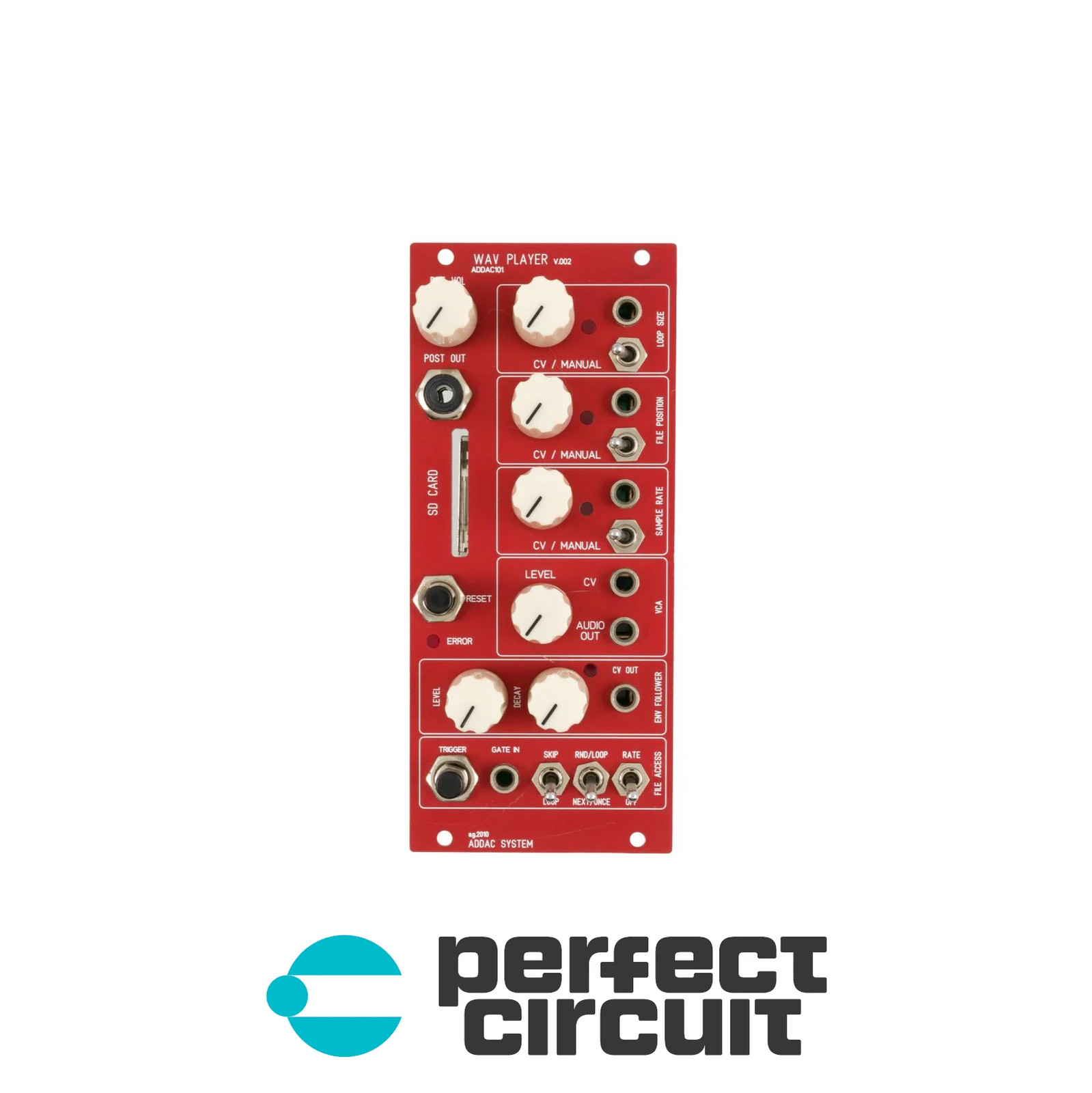
Owners report it’s one of ADDAC’s bestsellers, which says something about its staying power in a world where new modules pop up every week. It’s a dedicated playback box: load 22Khz 16-bit mono samples onto an SD card, pick one, and start tweaking. You’ve got manual control over loop size, position, playback rate, and amplitude—basic but effective. And since it accepts CV inputs, you can modulate any of those parameters from the rest of your system. Want to sweep the playback rate with an LFO? Go ahead. Freeze the loop position with a sequencer step? Sure. It’s simple in concept, but that simplicity means you’re not drowning in menus or submenus.
Still, that simplicity comes with trade-offs. Some users on MOD WIGGLER have griped about the file formatting process, with one admitting, “I’m starting to feel I should’ve just gotten a TipTop One after spending a few hours trying to format mediocre wav-files to no avail…” That’s not a failure of the module itself, necessarily, but it points to a friction point—this isn’t drag-and-drop friendly by modern standards. You’ll need to get your files just right, and if you’re not patient, it’ll test you.
But others defend its charm. One user noted it’s better for playing a sample back directly with no changes, praising the physical switches that let you disconnect CV inputs. That’s a small thing, but in practice, it means you can tweak a sample to oblivion and then—flick—a switch returns it to the original state. No saving presets, no recalling states, just hardware logic doing what hardware does best: being immediate and tactile.
Specifications
| Manufacturer | ADDAC System |
| Product Type | Eurorack module |
| Sample Format | 22Khz 16-bit mono samples |
| Storage Medium | SD Card |
| Controls/Parameters | loop size, position, playback rate, and amplitude |
| Control Methods | manual and through a CV input |
Historical Context
The ADDAC101 arrived during a period when Eurorack was expanding beyond oscillators and filters into more experimental territory. It introduced digital sampling to a largely analog ecosystem, opening doors for sound designers who wanted to blend field recordings, spoken word, or found sounds into their patches. While not the only player in this space—modules like the Nebulae and WaveTrigger offered deeper sampling and manipulation—the ADDAC101 carved out a niche for straightforward, hands-on playback.
It faced direct competition from the TipTop One, a module mentioned by users as a smoother alternative for sample handling. But the ADDAC101 wasn’t trying to be the most powerful; it was trying to be the most accessible. And it must have landed right: the ADDAC111 ULTRA .WAV PLAYER was later introduced as “the long awaited upgrade to our praised ADDAC101 .WAV PLAYER,” a clear nod to the original’s reputation.
Collectibility & Value
Despite the lack of confirmed production years or widespread market data, the ADDAC101 has a footprint in the used market. One listing on Reverb for a used ADDAC101 .WAV Player V001 Gold noted an original price of $399 and a sale price of $359, suggesting it held value reasonably well at retail. Whether it’s sought after today depends on who you ask—some collectors favor its simplicity and physical interface, while others move straight to its successors or more flexible alternatives.
Its collectibility seems tied more to its role as a pioneer than to technical prowess. It’s a module that represents a moment when modular synthesis started to seriously embrace digital media, not just as a gimmick but as a functional tool. If you’re building a historical Eurorack setup or want a no-frills sample player with real switches and knobs, the ADDAC101 still makes sense. But be ready for the file formatting quirks—this isn’t a plug-and-play device by 2020s standards.
eBay Listings
As an eBay Partner, we earn from qualifying purchases. This helps support our independent vintage technology research.