ADDAC 800X High-End Outputs (2014–Present)
When your modular’s hum won’t quit and your mix sounds thin, this little black box with XLR outs and a headphone amp might just be the last output module you’ll ever need.
Overview
It starts with a hiss you didn’t ask for—a low hum under the bassline, a faint buzz in the reverb tail. You’ve checked the cables, flipped the power strip, isolated the case. Nothing kills it. Then you patch in the ADDAC 800X, flip the ground lift, and just like that—the silence. Not empty silence, but clean, resolved audio, like someone wiped a greasy film off your studio monitors. That’s the magic of the 800X: it doesn’t just output your modular signal, it rescues it.
Positioned as a premium utility in the ADDAC 800 Series, the 800X isn’t flashy. No blinking lights, no modulation routing, no CV control. What it does is simple but vital: deliver a noise-free, balanced, professional-grade output from your Eurorack system. It’s the kind of module you don’t realize you need until you’re neck-deep in ground loops and impedance mismatches. And once you’ve used it? You’ll wonder how you ever recorded without it.
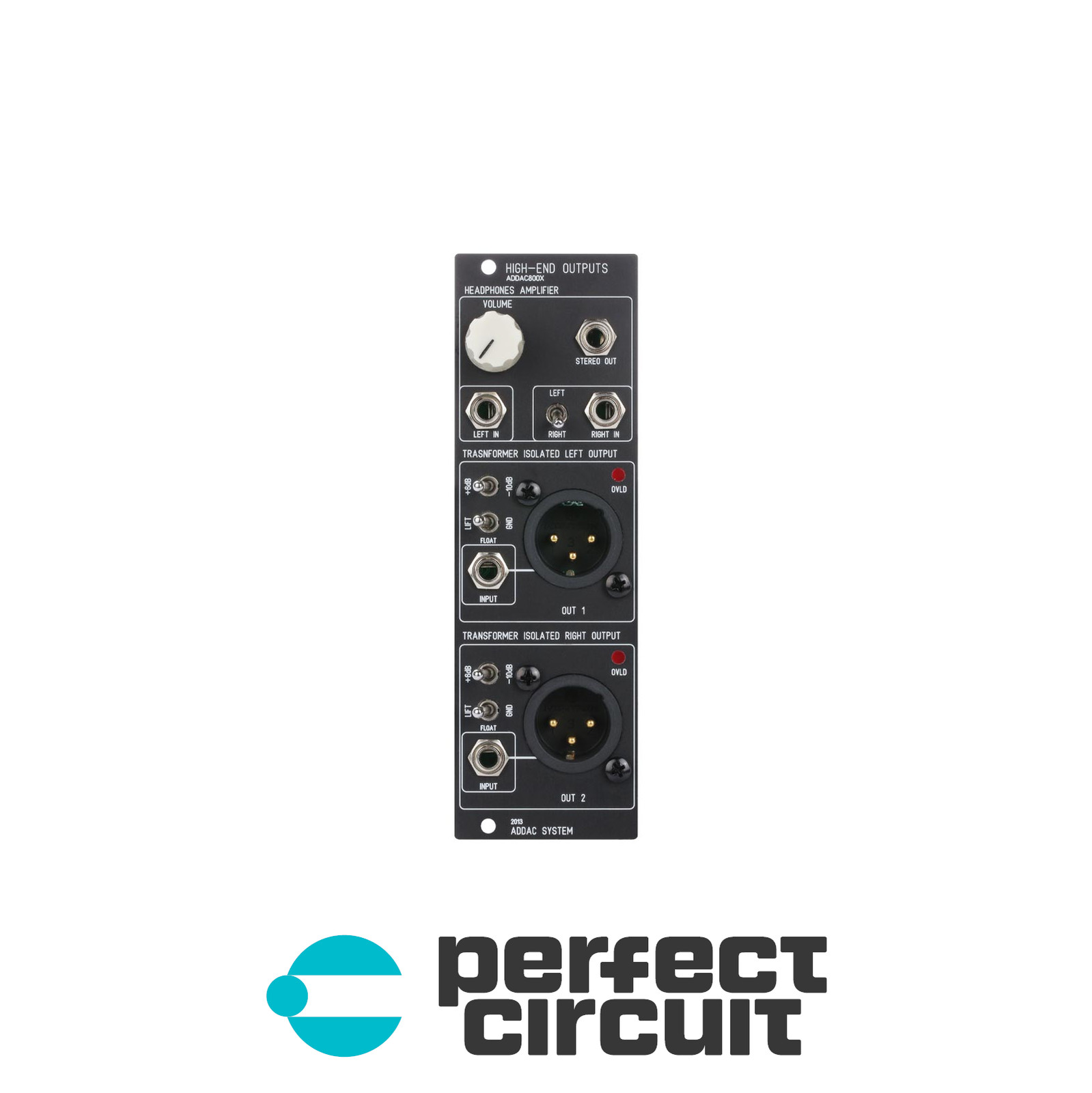
The 800X sits at the high end of modular output solutions—not just in price, but in execution. While many output modules rely on op-amps and basic buffering, the 800X goes full vintage-grade with a pair of nickel-core Hammond 140UEX audio transformers, the same lineage as Jensen transformers used in classic Neve and API gear. These aren’t just for show; they provide true galvanic isolation, breaking ground loops by physically disconnecting input and output circuits via magnetic coupling. That means no shared ground, no sneaky hum paths, no DC offset creeping into your mixer. It’s the kind of solution you’d find in a high-end studio patch bay, now shrunk into 8 HP.
Owners report a subtle but noticeable sonic character—some call it “musical,” others “neutral with weight.” It’s not colored like a tube output, but it’s not sterile either. Compared to solid-state outputs like the Intellijel Stereo Line Out or the Joranalogue Fold6, the 800X has a slightly fuller low end and a smoother top, likely due to the transformer’s natural frequency response. One user noted it “slightly attenuates the high end,” but only when A/B’d directly against a non-transformer module—otherwise, it’s just clean, full-range audio. The consensus? It doesn’t add anything, but it preserves everything.
Specifications
| Manufacturer | ADDAC System |
| Production Years | 2014–Present |
| Original Price | €415 / $499 |
| Format | Eurorack |
| Width | 8 HP |
| Depth | 6.7 cm (2.64 inches) |
| Power Consumption | 100 mA on +12V, 100 mA on -12V |
| Bus Board Connector | 8×2 IDC (Doepfer style) |
| Inputs | Left IN (3.5mm), Right IN (3.5mm) |
| Outputs | OUT 1 (XLR), OUT 2 (XLR), Headphones (6.3mm) |
| Output Type | Transformer-isolated, balanced XLR |
| Transformer | Hammond 140UEX series, 1:1 nickel core |
| Frequency Response | 20 Hz – 20 kHz |
| Headphone Amplifier | OPA2134 operational amplifier |
| Headphone Output | Adjustable volume, stereo |
| Level Switches | +6dB / -10dB per output |
| Ground Lift | 3-way toggle: Lift, Float, Ground |
| Left/Right Mode | Toggle for mono sum or dual input routing |
| Signal LED | Overload indicator per output |
| Panel Color | Black (standard), custom colors available |
Key Features
Transformer-Isolated Outputs
The heart of the 800X is its pair of Hammond audio transformers. Unlike active buffering or basic op-amp outputs, these transformers provide true galvanic isolation—meaning the input and output circuits are physically disconnected. The signal passes magnetically from primary to secondary winding, eliminating any direct electrical path. This kills ground loops dead, a common plague in modular setups where multiple devices share earth references. It also rejects RFI and DC offset, which can skew levels and damage downstream gear. The 1:1 winding ratio ensures no gain loss, and the nickel core delivers extended low-frequency response, crucial for preserving sub-bass in modular systems. While Jensen transformers are often considered the gold standard, the Hammond 140UEX used here is a respected alternative, known for its clarity and shielding—making this not just a functional fix, but a sonic upgrade.
Flexible Output Routing & Ground Control
The 800X doesn’t just spit out a clean signal—it lets you shape how it behaves in your rig. The LEFT/RIGHT toggle determines routing: in the default position, LEFT IN feeds both outputs (mono), while RIGHT IN feeds only OUT 2. Flip the switch, and both inputs are active—LEFT to OUT 1, RIGHT to OUT 2—for true stereo operation. This is useful for splitting a mix bus and a cue send, or routing two separate voices to a multitrack recorder.
Equally important is the 3-way ground switch per output: Lift, Float, and Ground. In Lift mode, the output ground is connected via a 100R resistor and 10nF capacitor, breaking ground loops while maintaining safety. Float completely isolates grounds—ideal for tricky setups but requires caution. Ground ties everything together, useful when isolation isn’t needed. This level of control is rare in Eurorack and puts the 800X on par with pro audio interface design. Users consistently report that trying all three positions often reveals which one eliminates hum in a given setup—no guesswork, just systematic troubleshooting.
Integrated Headphone Amplifier
Beyond the XLR outs, the 800X includes a high-quality headphone amp centered around the OPA2134, a premium audio op-amp known for low distortion, wide bandwidth, and high output drive. It’s not an afterthought—the amp can drive high-impedance headphones (up to 600Ω) with ease, making it suitable for studio monitoring or silent performance prep. The volume knob is smooth and precise, with no audible stepping or channel imbalance. While other modules offer headphone outs, few match the 800X’s combination of isolation, power, and sonic transparency. It’s especially useful for live performers who need to cue a mix without sending it to the PA—patch in your master bus, flip the ground lift, and listen without noise or feedback.
Historical Context
The ADDAC 800X emerged in 2014, right as Eurorack was shifting from boutique curiosity to mainstream studio tool. As more musicians integrated modular systems into professional environments—recording studios, live rigs, broadcast setups—the limitations of basic output modules became glaring. Hum, noise, and impedance mismatches plagued recordings. The 800X answered that with a studio-grade solution: not just an output, but a bridge between the wild, DC-coupled world of modular and the balanced, grounded realm of pro audio.
It arrived alongside similar high-end output modules like the Vermona TAi-4 and the Cwejman Audio Interface, but with a distinct philosophy. While Cwejman’s unit added inputs and more complex routing, the 800X stayed focused: outputs only, but done right. It leaned into vintage topology, betting that transformer isolation—long trusted in high-end consoles and DI boxes—was still the best answer. That decision paid off. In forums and user reviews, the 800X is often compared favorably to these competitors, especially in noise rejection and build quality.
ADDAC, a Portuguese company known for clean design and solid engineering, wasn’t trying to reinvent the wheel. They were applying proven audio principles to a growing problem. The 800X didn’t just fill a gap—it redefined what a “simple” output module could be. It became a benchmark, influencing later designs that adopted transformer isolation as a premium feature rather than a niche option.
Collectibility & Value
The ADDAC 800X isn’t a vintage relic—it’s still in production—but its reputation has solidified it as a modern classic. On the used market, prices range from €320 to €400, depending on condition and whether it includes the optional custom panel. Given its original €415 price, it holds value exceptionally well, especially for a utility module. That speaks to demand: modular users who’ve dealt with noise issues often prioritize this module, and once owned, rarely sell it.
Failure points are minimal. The transformers are passive and robust, with no reported degradation over time. The OPA2134 op-amp in the headphone circuit is a known reliable part, and the toggle switches are high-quality PCB-mounted types. The most common issue reported is power draw—100mA per rail is substantial for a utility module, so users with tightly packed cases may need to check headroom. No firmware, no calibration, no drift. It’s a “set and forget” module.
When buying used, check the headphone amp for channel balance and crackling—though failures here are rare. Also verify the ground lift function by testing all three positions with a known hum-prone setup. Counterfeits aren’t a concern, but ensure the seller isn’t misrepresenting a custom panel as stock. ADDAC offers custom colors (Red, Green, Blue, etc.), but these cost extra and take 4–6 weeks to produce, so a “rare” color at a low price should raise eyebrows.
Maintenance is nearly nonexistent. No tubes to replace, no caps to recoup (unless you’re doing a full case refresh). It’s one of the most reliable modules in the format. If you’re building a studio-grade modular rig, the 800X isn’t a luxury—it’s insurance.
eBay Listings
As an eBay Partner, we earn from qualifying purchases. This helps support our independent vintage technology research.