ADDAC 713 Stereo Discrete Mixer (2022–)
A wolf in sheep’s clothing: a compact stereo mixer that turns from clean summing to full-on sonic annihilation with a twist.
Overview
It sits there so quietly—black panel, modest knobs, eight HP of unassuming real estate in your rack—until you crank it and suddenly your whole system is howling like a Moog in a thunderstorm. The ADDAC 713 Stereo Discrete Mixer doesn’t just blend signals; it transforms them, coloring your mix with the kind of organic, unpredictable saturation that only a fully discrete analog circuit can deliver. Inspired by the legendary Moog CP3 mixer, this is not a transparent utility module. It’s a character machine—one that lives at the intersection of utility and mayhem.
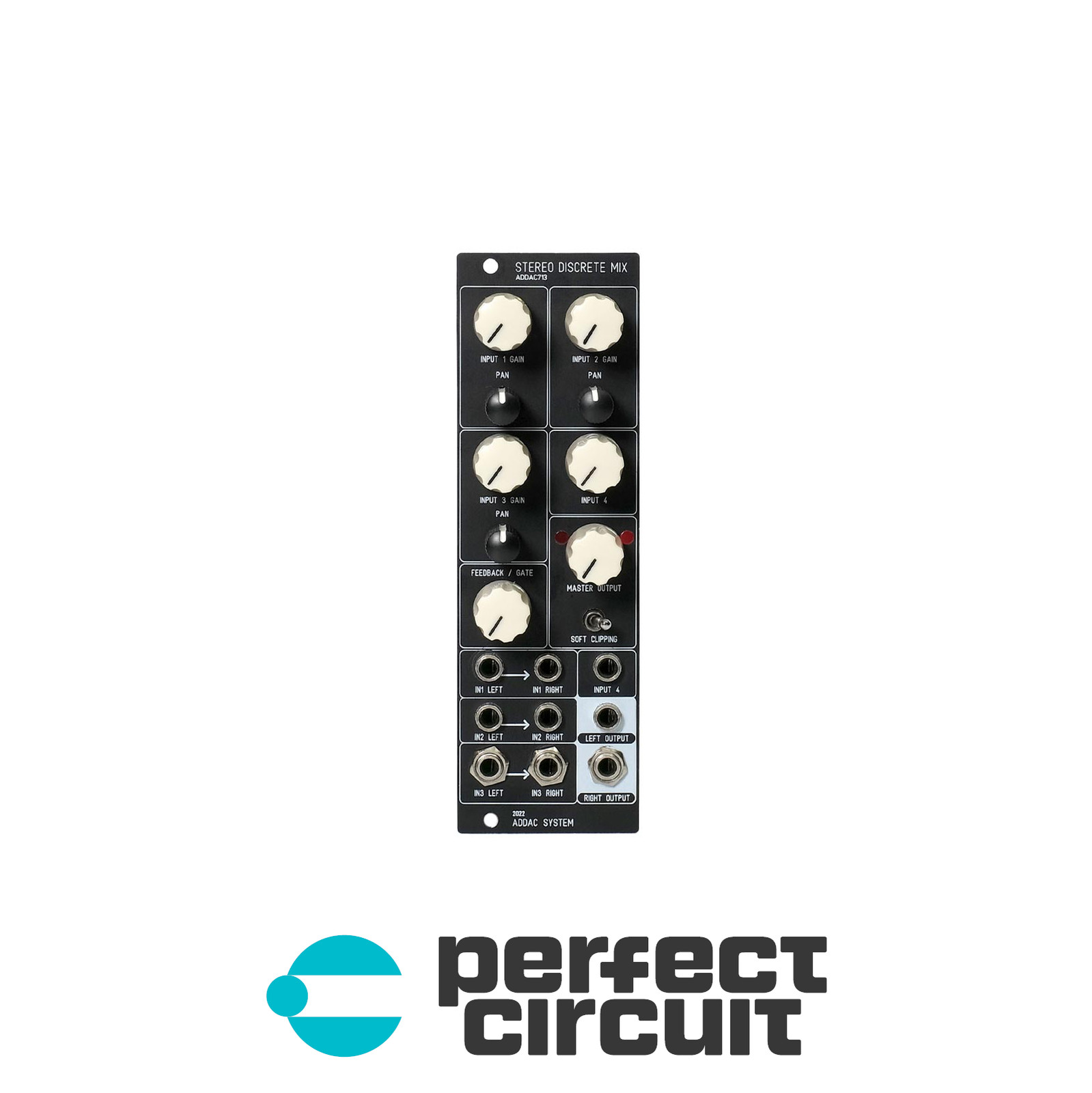
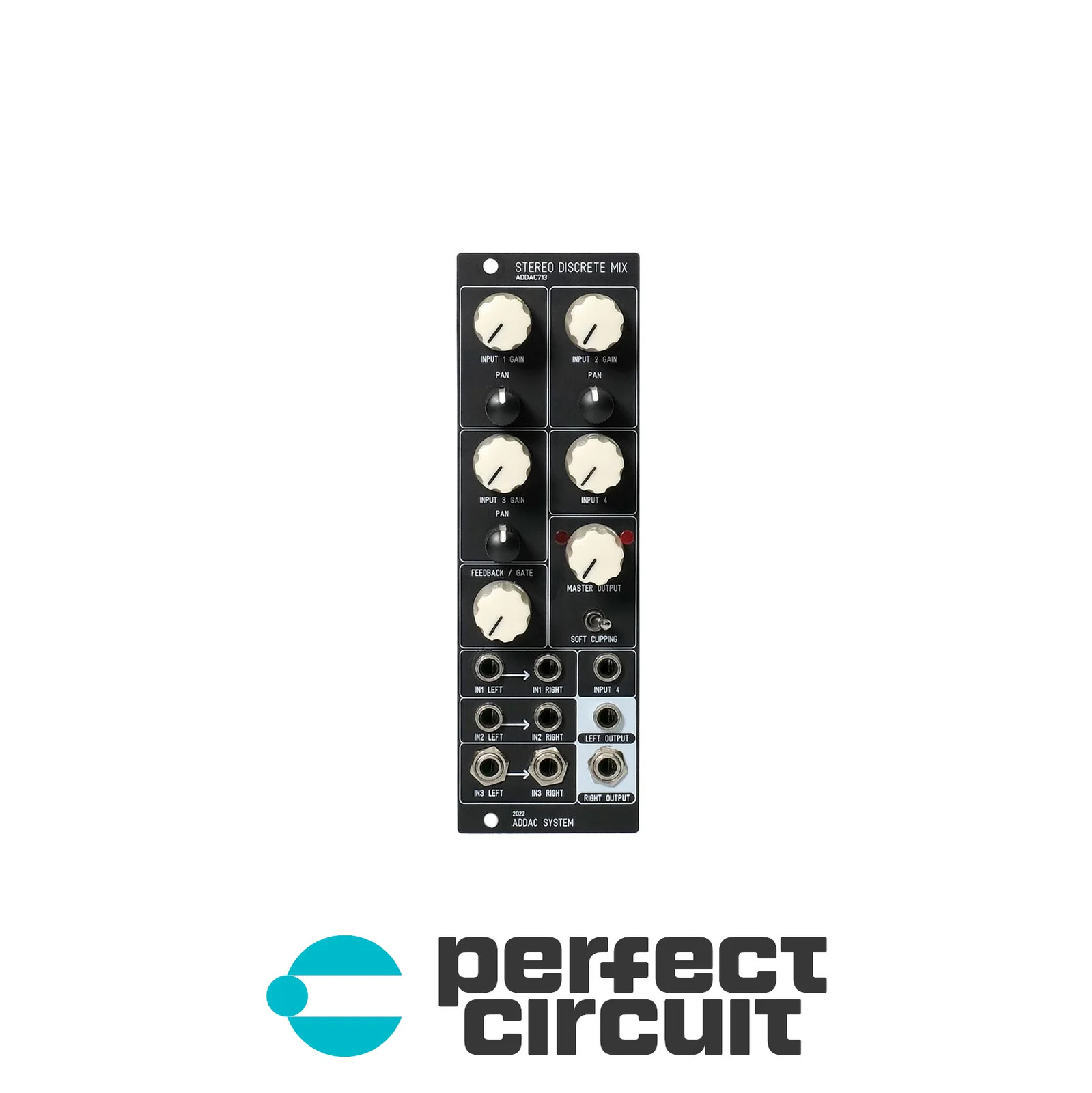
At first glance, it’s built for practicality: three stereo channels with individual gain and pan controls, plus a fourth mono channel, perfect for anchoring kicks or bass in the center. But dig deeper and you realize this module was never meant to stay clean. The real magic lives in the feedback-driven overdrive circuit, which doesn’t just clip—it evolves. Turn the feedback knob clockwise and the mix begins to saturate, then distort, then clip asymmetrically, until at extreme settings it actually gates the signal entirely. That’s not a bug; it’s a feature baked into the design, where increasing feedback shifts the audio bias upward until the waveform gets shoved off the rail, cutting out the sound completely. It’s a brutal, musical, and strangely controllable form of self-destruction.
And yet, for all its aggression, the 713 isn’t a one-trick beast. With gain staging kept in check, it can sum signals with clarity and warmth, making it equally useful as a final output stage or a submixer for drum groups. The soft clipping switch adds another layer of control, offering three positions: soft low-pass (which tames transients and reduces clicks), off (full signal path), and hard low-pass (a more aggressive filter for smoothing out digital harshness). It’s a subtle but meaningful addition, especially when feeding sensitive downstream gear like converters or analog recorders.
What makes the 713 stand out in a market crowded with stereo mixers is its personality. Unlike sterile op-amp-based designs, this one uses discrete transistors throughout, giving it a grittier, more dynamic response. It reacts to input levels like a vintage console—push it and it pushes back, adding harmonics that feel alive rather than digital. It’s particularly beloved in drum and percussion contexts, where the ability to pan stereo sources while driving the mix into saturation creates huge, animated textures. But it’s just as effective as a final stage for a full system, where a touch of feedback can glue a patch together or send it spiraling into noise.
Specifications
| Manufacturer | ADDAC System |
| Production Years | 2022– |
| Original Price | 220€ (assembled), 105€ (DIY kit) |
| Format | Eurorack |
| Width | 8HP |
| Depth | 40mm |
| Current Draw +12V | 80mA |
| Current Draw -12V | 80mA |
| Channels | 3 stereo, 1 mono |
| Inputs | 3 stereo pairs (6 total), 1 mono |
| Outputs | 1 stereo master output |
| Gain Controls | 4 per channel (extreme range) |
| Pan Controls | 3 (for first three stereo channels) |
| Feedback/Gate Knob | 1 (modulates overdrive and signal bias) |
| Master Output Knob | 1 |
| Soft Clipping Switch | 3-position: Soft LPF / Off / Hard LPF |
| Signal Monitoring | 2 LEDs (Left and Right output) |
| Circuit Type | Fully discrete analog (CP3-inspired) |
Key Features
The Feedback That Gates
The feedback knob isn’t just for creating self-oscillation or mild saturation—it’s a performance control that morphs the entire behavior of the mixer. As feedback increases, the circuit doesn’t just clip harder; it shifts the DC bias of the audio signal upward. At maximum, this lifts the waveform so far that it exceeds the voltage rail, effectively cutting off the output. This “gate effect” is unpredictable but musically useful, especially when modulated dynamically. Patch in an LFO or envelope to the feedback CV input (yes, it’s normalled but can be overridden) and you can create rhythmic gating, stuttering, or even rhythmic distortion sweeps that feel organic and alive. It’s not a clean effect, but it’s deeply expressive—perfect for industrial, noise, or experimental genres where control is secondary to character.
Stereo Flexibility with a Mono Anchor
The channel layout is smartly asymmetrical: three stereo channels for pads, effects, or stereo drum buses, each with dedicated pan, and a fourth mono channel that stays center-anchored—ideal for kick drums, bass oscillators, or any element you don’t want drifting. This makes the 713 especially useful as a drum submixer, where you can place hi-hats, snares, and percussion in the stereo field while keeping low-end weight locked down. The pan controls are smooth and centered, with no dead zone, making precise placement possible. And because each channel’s gain goes well beyond unity, you can overdrive individual sources before they even hit the mix bus, creating layered distortion textures.
Soft Clipping as Anti-Click Armor
The three-position soft clipping switch is a small feature with big implications. In “Soft LPF” mode, a gentle low-pass filter engages before the output, smoothing out transients and reducing click artifacts—especially useful when using the mixer to gate or modulate signals. “Hard LPF” applies a steeper roll-off, taming high-frequency harshness from digital oscillators or FM sources. In the center “Off” position, the full bandwidth passes through unimpeded. This isn’t just tone shaping; it’s system protection. Many users report cleaner integration with digital gear or converters when the soft clipping is engaged, avoiding the brittle edge that can come from fast transients in modular systems.
Historical Context
The ADDAC 713 exists because the Moog CP3 mixer never had a proper Eurorack heir—until now. The CP3, a rare and coveted module from Moog’s early modular days, was known for its warm, slightly dirty character and tendency to saturate beautifully under load. When ADDAC released the 703 Discrete Mixer (a mono version of this circuit), it filled a gap for users seeking that CP3 vibe in a modern format. The 713 expands that concept into stereo, responding to the growing demand for spatial processing in modular systems. By 2022, when the 713 launched, Eurorack had matured past basic voice-building into complex, layered systems where stereo imaging and mix character mattered. Competitors like Manhattan Analog’s DTM offered faithful CP3 clones, but ADDAC took a different path—inspired by the original, but evolved for contemporary use, with panning, stereo inputs, and expanded overdrive behavior.
It arrived during a wave of renewed interest in discrete analog circuits, as users tired of pristine digital mixers sought gear with grit and response. The 713 wasn’t the first stereo mixer with overdrive, but it was among the first to make distortion a central, modulatable feature rather than an afterthought. Its closest peers—like the Happy Nerding 4x St Mix or the Befaco Summer—offer different flavors of coloration, but none replicate the 713’s unique bias-shift gating trick. It’s a module that feels both nostalgic and forward-thinking, rooted in vintage topology but unafraid to warp it into new sonic territory.
Collectibility & Value
The ADDAC 713 is still relatively new, but it’s already developed a cult following, especially among noise, industrial, and experimental modular users. As of 2026, used units are scarce and prices remain close to new—typically €200–€250 depending on condition and region. The DIY kit (€105) is more common on the used market, but requires intermediate soldering skills, as it’s an SMD-assist kit with pre-soldered surface-mount components and through-hole parts to finish. Because the circuit is fully discrete and not microprocessor-controlled, failure points are minimal—no firmware, no digital brains to die. That said, the feedback circuit’s sensitivity means poor gain staging can lead to constant clipping, which some users report makes the module feel “always dirty” if not dialed in carefully.
Owners note that the module demands respect in patching: overloading inputs or cranking the master without adjusting channel gains can lead to harsh distortion or even DC offset issues. It’s not a set-and-forget mixer. But for those who embrace its quirks, it’s a revelation. When buying used, check that the feedback knob sweeps smoothly without crackling, and that the LEDs respond symmetrically to signal. Also verify the soft clipping switch clicks cleanly between positions—some early units had flaky switches, though no widespread failures have been reported.
Given its unique behavior and the enduring appeal of CP3-style circuits, the 713 is likely to hold value well. It’s not a beginner’s mixer, but for those who want character over cleanliness, it’s becoming a modern classic. And because ADDAC doesn’t overproduce, scarcity keeps demand steady. If you see one in good condition under €220, grab it—especially if you work with drums, noise, or any music that benefits from a little analog savagery.
eBay Listings

As an eBay Partner, we earn from qualifying purchases. This helps support our independent vintage technology research.