ADDAC 701 VCO (2019–)
A compact analog VCO that punches way above its weight—stable, rich, and loaded with features, but don’t expect miracles from its tuning over long sessions.
Overview
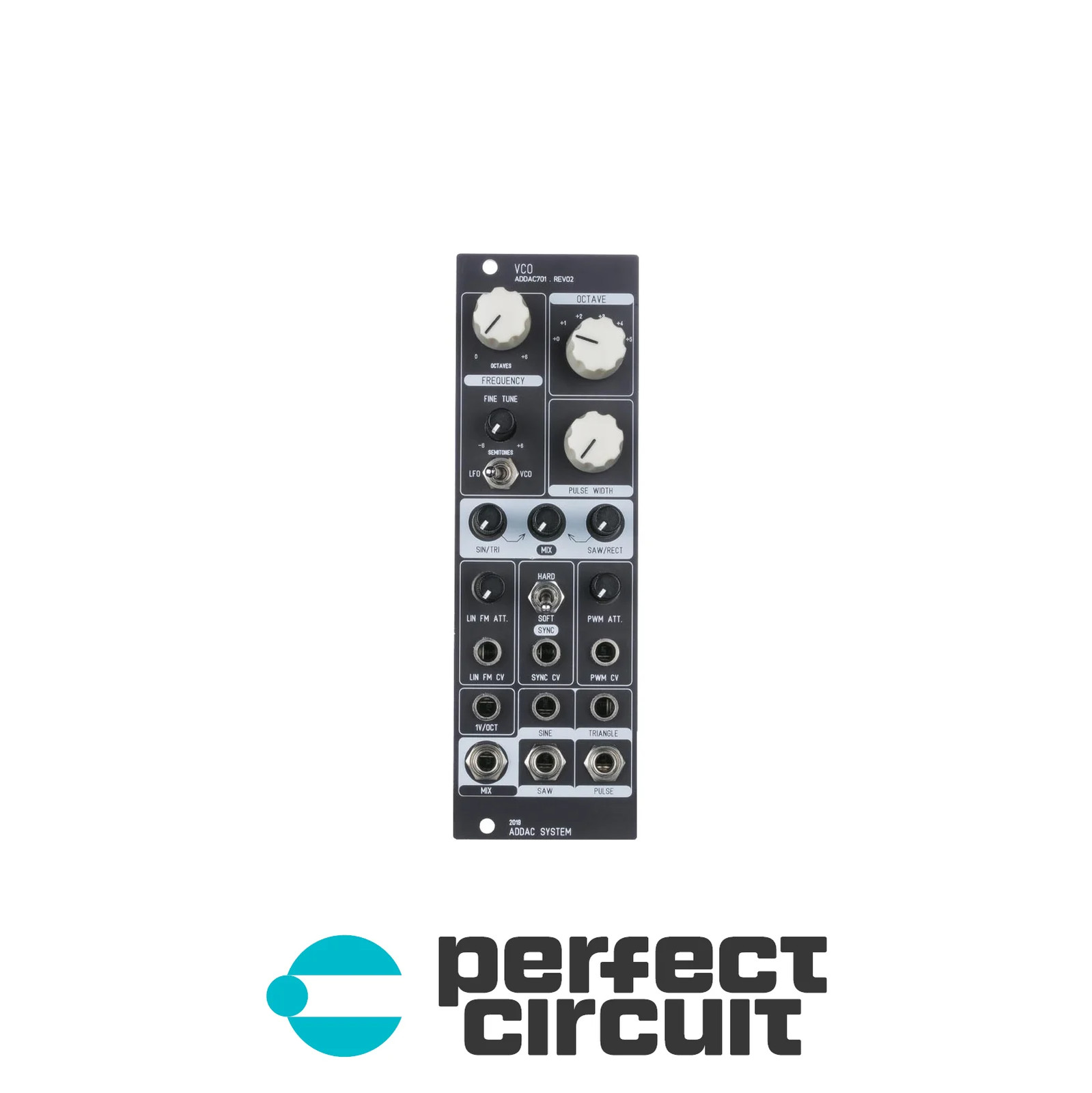
Plug in the ADDAC 701 VCO Rev 2 and you immediately notice how densely packed it feels—not physically, though at 8 HP it’s impressively lean, but sonically. This isn’t a minimalist oscillator that gives you one clean tone and calls it a day. It’s a full-featured analog voice generator with enough routing, mixing, and modulation options to justify its place in even a crowded rack. The first time you sweep through its six-octave frequency knob, backed by an octave switch that doubles the range, you get a sense of its precision. It tracks cleanly, thanks to the modern CoolAudio version of the CEM3340 chip, and the manual fine-tune knob offers a full 12 semitones of adjustment—plenty for microtonal tweaks or dialing in a detuned second oscillator.
But where the 701 really stands out is in its flexibility. It’s not just a VCO; it can switch into LFO mode, which expands its utility beyond tone generation into modulation territory. That switch isn’t just a frequency limiter—it reconfigures the core behavior, letting you use the same module for slow sweeps or fast audio-rate FM without needing to patch in a separate low-frequency source. The inclusion of linear FM with a dedicated attenuator means you can dial in metallic bell tones or subtle harmonic movement without overdriving the input, and the soft/hard sync switch gives you real control over how aggressively the waveform resets. Pulse width modulation is also well implemented, with both manual control and CV input plus attenuation, so you can go from a narrow click to a fat square wave and modulate that in real time.
Still, this isn’t some mythical “perfect” oscillator. Owners report that while pitch stability is vastly improved over the original 701, it’s not immune to thermal drift—especially during the first 15 minutes of operation. Some units exhibit more tuning wander than others, and while the module calibrates well out of the box, long sets or temperature shifts in the studio can nudge it slightly off. It’s not a dealbreaker, but it’s the kind of thing you learn to live with in analog gear. And while the waveforms are full-bodied—especially the sawtooth and pulse, which have a satisfying thickness—the sine wave, though clean, isn’t quite surgical enough to serve as a pristine FM carrier in every application. That said, for West Coast-style timbral exploration or East Coast-style leads, it delivers with character.
Specifications
| Manufacturer | ADDAC System |
| Production Years | 2019– |
| Original Price | €170 / $189 |
| Module Type | Analog VCO / LFO |
| Form Factor | Eurorack |
| HP Size | 8 HP |
| Depth | 35 mm (3.5 cm) |
| Current Draw | 60 mA +12V, 60 mA -12V |
| IC Core | CoolAudio V3203 (modern CEM3340 variant) |
| Frequency Control | Knob (6 octave range), Octave Switch (6 positions) |
| Fine Tune Range | ±12 semitones |
| 1V/Octave CV Input | Yes, tracks accurately over 7 octaves |
| FM Input | Linear FM with attenuator |
| Sync Input | Switchable: Soft, Off, Hard |
| Pulse Width Control | Manual knob + CV input with attenuator |
| Waveform Outputs | Sine, Triangle, Sawtooth, Pulse |
| Mix Output | Yes, via 3-knob mixer (SIN/TRI, MIX, SAW/RECT) |
| Mode Switch | LFO / VCO |
| Available As | Assembled module, DIY kit (€121) |
Key Features
The Onboard Waveform Mixer: More Than a Convenience
Most oscillators make you choose a waveform or patch multiple outputs into a separate mixer. The ADDAC 701 flips that script with a dedicated three-knob mixing section that lets you blend sine/triangle, saw/pulse, and then crossfade between those two pairs. It’s not CV-controllable—owners note this as a missed opportunity for dynamic waveshaping—but as a manual sculpting tool, it’s incredibly useful. You can create evolving hybrid waveforms on the fly, like a triangle-saw morph for a plucky lead, or blend sine and pulse to thicken up a sub oscillator tone. The mix output isn’t just a sum; it’s a new, composite waveform that responds differently to filtering and modulation. This kind of integration in an 8 HP module was rare when the 701 Rev 2 launched, and it still feels generous.
CEM3340 DNA with a Modern Twist
The heart of the 701 is the CoolAudio V3203, a modern reissue of the legendary CEM3340—the same chip that powered the Prophet-5, the Oberheim OB series, and countless other classics. ADDAC didn’t just drop it in; they optimized the surrounding circuitry for better temperature compensation and tracking. The result is an oscillator that behaves predictably across voltages and holds pitch more reliably than many boutique 3340 implementations. It doesn’t quite hit the mythical “digital stability” some claim, but for an analog core, it’s impressively consistent—especially over the advertised seven octaves. The triangle-to-sine converter is borrowed from the original 701 design and remains one of the smoother analog conversions in the Eurorack world, avoiding the stepped or buzzy artifacts some sine shapers produce.
LFO Mode: A Legitimate Dual-Personality Module
Switching to LFO mode doesn’t just slow the oscillator down—it reconfigures the range and response for modulation duties. This isn’t a gimmick; it’s a fully functional LFO with the same waveform outputs and CV control options. You can use it to modulate filter cutoff, amplitude, or even another oscillator’s pitch, all while keeping the same module footprint. The octave switch remains active, giving you fine control over modulation speed, and because it’s based on a real analog core, the LFO has subtle imperfections that can add life to a sequence. Some users initially reported tuning discrepancies when switching back to VCO mode after extended LFO use, but ADDAC addressed this in later production runs by changing a capacitor value—so newer units shouldn’t have this issue.
Historical Context
The ADDAC 701 VCO Rev 2 arrived in 2019 at a time when Eurorack was bloated with feature-heavy, expensive oscillators—modules that cost $300+ and offered wavetables, digital synthesis, or complex modulation engines. Against that backdrop, the 701 stood out by doing the opposite: refining the analog fundamentals. It was a direct response to the discontinuation of the original ADDAC 701, which had developed a cult following but suffered from tuning instability and higher pricing. The Rev 2 wasn’t just an update; it was a recommitment to analog purity with smarter engineering. At a time when Behringer was flooding the market with ultra-cheap 3340 clones, ADDAC positioned the 701 Rev 2 as a premium-but-accessible alternative—better built, more stable, and with thoughtful extras like the waveform mixer. It competed not with the digital giants, but with respected analog modules like the Intellijel Dixie II+ and the Doepfer A-110-1, offering similar performance at a lower price and in less space.
The CEM3340 resurgence was also in full swing. After decades of scarcity, CoolAudio’s reissue of the chip made it possible for smaller builders to access that classic sound without relying on NOS parts. ADDAC seized that moment, combining the renewed availability with their own design philosophy: clean layouts, user-focused features, and European build quality. The 701 Rev 2 wasn’t trying to reinvent the oscillator—it was trying to perfect a proven formula.
Collectibility & Value
The ADDAC 701 VCO Rev 2 isn’t a vintage item in the traditional sense—production began in 2019 and continues today—but it’s already earned a reputation as a modern classic. On the used market, prices hover between €140 and €180 depending on condition and region, with the DIY kit fetching around €100–120. That’s a modest depreciation from the original €170 price, suggesting strong owner retention and demand. Units sold as “new old stock” or with custom front panels (available in colors like bronze, red, or silver gray) can command small premiums, especially in Europe where ADDAC has a strong following.
Common issues are few but worth noting. Early production units—particularly those manufactured before mid-2020—may exhibit the LFO/VCO tuning discrepancy mentioned in user forums. ADDAC issued a fix involving a capacitor swap, and service technicians observe that most newer modules ship with this correction already implemented. Thermal drift remains the most frequently cited flaw: the oscillator can go slightly sharp during warm-up, requiring a brief retune. This is typical for analog VCOs, but the 701 is more sensitive than some competitors. Regular recalibration using ADDAC’s published procedure helps, but it’s not a “set and forget” module.
When buying used, check that the waveform outputs are clean and free of crosstalk, and verify that the mix section behaves as expected—no crackling or channel imbalance. The knobs are sturdy, but the PCB layout is dense, so inspect for any signs of botched repairs or overheated components if purchasing a DIY-assembled unit. Overall, failure rates are low, and the module has no known catastrophic weaknesses—no failing ICs, no flaky jacks. It’s a solid build, and the fact that ADDAC still sells replacement panels and full DIY kits suggests long-term support.
eBay Listings

As an eBay Partner, we earn from qualifying purchases. This helps support our independent vintage technology research.