ADDAC 607 Crossover ()
Three-way audio splitting with surgical precision and analog warmth—this is the quiet architect behind some of the most dynamic Eurorack mixes you’ve never heard.
Overview
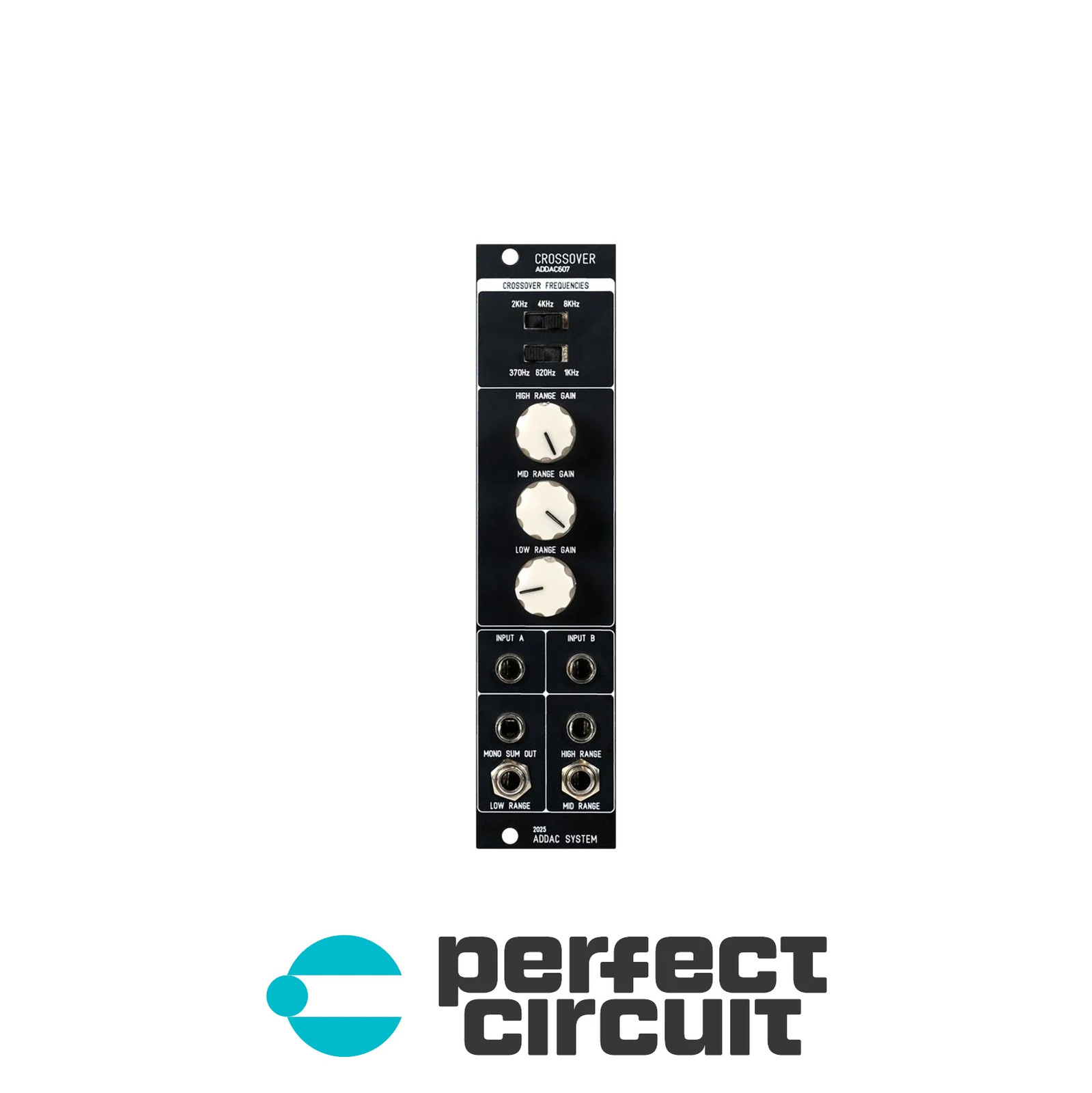
The ADDAC 607 Crossover isn’t flashy, doesn’t modulate, and won’t scream through your speakers—but in a modular rig, it might be one of the smartest six HP you’ll ever patch. It’s an analogue 3-band crossover, designed to split incoming audio into high, mid, and low frequency ranges, each with its own dedicated output. Think of it as a traffic director for sound: send in a full-range signal, and the 607 cleanly routes the lows to a sub synth, the mids to a vocoder, and the highs to a granular processor—all simultaneously, all in analog. It lives in the ADDAC600 Series, a family of utility and processing modules that prioritize clean signal manipulation over flash. This isn’t a filter that shapes tone for musicality; it’s a tool that enables complex routing, effects splitting, or multi-amp setups within the rack. And while it doesn’t resonate or sweep, its role is foundational—like a mixing console’s insert point, but with the flexibility of modular patching.
Built by ADDAC System, known for thoughtful, no-nonsense Eurorack designs, the 607 leans into utility without sacrificing quality. It’s not trying to be a star. It’s the stagehand who ensures the spotlight hits exactly the right place. With two audio inputs, you can blend or switch sources before splitting—handy for live sets or layered processing chains. The sum master output gives you a recombined version of the processed signal, so you can monitor the full picture while still sending isolated bands elsewhere. That kind of flexibility is rare in such a narrow footprint. And despite its technical role, the module feels musical—because ultimately, how you divide frequency space shapes the entire character of a patch.
Specifications
| Type | Analogue 3-band crossover |
| Filter type | 12 dB Sallen-Key filter |
| Controls | Volume controls for high range, mid range and low range |
| Switchable crossover frequencies | 2 kHz, 4 kHz, 8 kHz (high range) and 370 Hz, 620 Hz, 1 kHz (low range) |
| Inputs | Two audio inputs |
| Outputs | Sum master output; Outputs for high range, mid range and low range |
| Power requirement | 60 mA (+12 V) / 60 mA (-12 V) |
| Width | 6 HP |
| Depth | 45 mm |
| Price | €299 |
Key Features
Three-Band Frequency Splitting
At its core, the 607 divides audio into three distinct bands using a pair of switchable crossover points. The low-range crossover offers 370 Hz, 620 Hz, or 1 kHz—perfect for separating sub-bass from punchy mid-bass. The high-range crossover hits 2 kHz, 4 kHz, or 8 kHz, letting you isolate presence, articulation, or sibilance. These aren’t continuously variable, but the stepped options cover most practical needs, from musical tone shaping to technical routing. The result is three clean, non-overlapping (or minimally overlapping) bands, each available at its own output. That makes it ideal for sending different parts of the spectrum to different effects—like distorting the highs, compressing the mids, and leaving the lows pristine.
Sallen-Key Filter Topology
The 607 uses a 12 dB/octave Sallen-Key filter design, known for its stability, low noise, and smooth phase response. Unlike resonant state-variable filters, Sallen-Key circuits here are used purely for clean frequency separation, not tone shaping. That means minimal coloration—what goes in comes out, just sorted. The 12 dB slope is steep enough to prevent bleed but gentle enough to avoid phase artifacts that can plague higher-order designs. It’s a pragmatic choice: effective, reliable, and transparent. This isn’t about character; it’s about clarity.
Independent Level Control Per Band
Each frequency band—high, mid, and low—has its own volume control. That’s more than just convenient; it’s essential for balancing the outputs when routing to different destinations. Maybe your high-frequency processor needs less signal, or your sub oscillator is too dominant. These knobs let you fine-tune each path without touching the source. Combined with the sum master output, you can adjust individual levels while still monitoring the full mix, ensuring your splits don’t throw off the overall balance.
Dual Inputs and Full Signal Access
With two audio inputs, the 607 can handle stereo sources or let you switch between signals on the fly. You’re not limited to one instrument or output. And because it includes a sum master output, you don’t lose access to the original signal—just processed and recombined. That’s crucial for A/B comparisons or feeding a main mix while still processing bands separately. It’s a small detail, but one that shows ADDAC was thinking about real-world use, not just theoretical patching.
eBay Listings
As an eBay Partner, we earn from qualifying purchases. This helps support our independent vintage technology research.