ADDAC 508 Swell Physics (2024)
You’re not patching a module—you’re floating four buoys in an endless ocean, letting wave physics write the sequences for you.
Overview
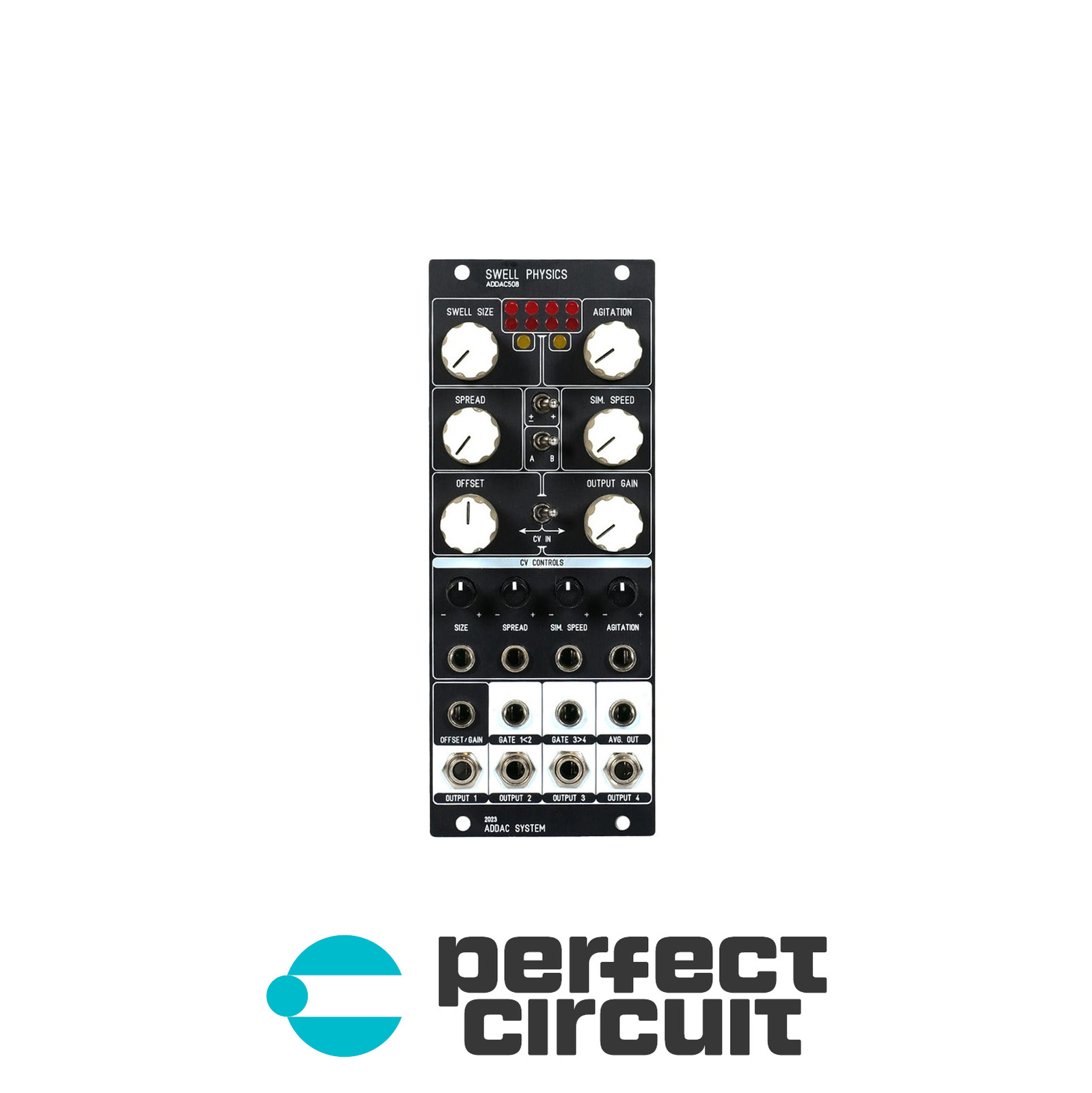
The ADDAC 508 Swell Physics isn’t your usual LFO or random voltage generator. It’s a simulation—specifically, a physics-based model of ocean waves nudging four virtual buoys bobbing in deep water. These buoys don’t just rise and fall; they orbit, drift, and respond to invisible forces like wind and swell, each transmitting its height as a control voltage. That data becomes your modulation source: four independent CV outputs, one averaged CV, and two gate signals—all evolving in real time like a tiny, self-contained sea. It’s another unique modulation source from ADDAC, and if you thought the 503 Marble Physics was out there, this one dives even deeper into the idea of turning physical systems into patchable music.
Available since March 2024, the 508 Swell Physics is part of the ADDAC500 Series, a line clearly uninterested in conventional waveform generation. Instead, it leans into experimental, behavior-driven design. You’re not dialing in a triangle wave or a sample-and-hold pattern—you’re setting up conditions. How far apart are the buoys? How wild is the sea? Is the simulation scrolling like a wave moving across the surface, or evolving in place like a churning swell? These aren’t just parameters; they’re environmental settings. And because every output can be offset, scaled, and modulated via CV inputs with bipolar attenuators, you’re not just observing the ocean—you’re steering the storm.
Specifications
| Manufacturer | ADDAC |
| Width | 10 TE / HP |
| Depth | 45 mm |
| Power consumption | 70mA (+12V) / 40mA (-12V) |
| CV output range | +/-5V or 0V to +10V |
| Number of CV outputs | CV output for each buoy, CV output for averaged signal |
| Number of gate outputs | two gate outputs |
| Number of CV inputs | CV inputs with bipolar attenuator for all parameters |
| Selectable simulation models | Two selectable simulation models (scrolling and evolving) |
Key Features
Gerstner Waves in Motion
At the heart of the 508 Swell Physics is the Gerstner Wave—a mathematical model used in fluid dynamics to describe progressive waves of permanent form on an incompressible fluid of infinite depth. ADDAC uses this as the engine for two-dimensional wave generation, meaning the buoys don’t just bounce up and down; they move in orbital paths, mimicking how real water particles behave under a surface wave. This isn’t approximation—it’s simulation. The result? CV signals that feel organic, never repeating, with a natural push and pull that static LFOs can’t replicate.
Four Buoys, Infinite Modulation
Imagine a small patch of open ocean. Four buoys, equally spaced, anchored to the seabed. As waves roll through, each buoy records its absolute height and transmits it as a voltage. That’s the core concept. Each of the four CV outputs corresponds to one buoy, letting you modulate pitch, filter cutoff, panning, or anything else in your rack with the rise and fall of simulated seas. The fifth CV output delivers the average of all four, useful for extracting a master swell envelope or a smoothed modulation source. Then there are two gate outputs—likely triggered by wave peaks or buoy crossings—adding rhythmic potential to the chaos.
Controllable Chaos
You’re not just watching the ocean—you’re shaping it. The distance between the buoys affects how their signals relate, creating phase differences that evolve over time. The swell parameter sets the minimum and maximum movement, from gentle ripples to stormy heaves. Wind and wave interference introduce complexity, making the CV signals less predictable and more textured. Simulation speed controls how fast the whole system runs, from glacial tides to frantic chop. And with two selectable models—scrolling (waves moving laterally) and evolving (localized turbulence)—you can switch between directional motion and chaotic resonance on the fly.
Full CV Integration
Every major parameter has a CV input with a bipolar attenuator, meaning you can modulate the simulation itself from outside sources. Want the swell to grow as a sequence progresses? Patch in a slow envelope. Need the buoy spacing to shift with a random voltage? Done. The module doesn’t just generate CV—it responds to it, making it a dynamic participant in your patch rather than a static source. The CV outputs also feature offset and gain controls, so you can fine-tune each signal’s range and center point to fit your needs, whether you’re working in 0–5V or ±5V systems.
Historical Context
The ADDAC 508 Swell Physics follows the ADDAC503 Marble Physics, continuing the company’s fascination with translating physical systems into modular synthesis tools. Where the 503 simulated marbles rolling across a virtual plane, the 508 dives into fluid dynamics, using ocean wave mechanics as its foundation. It’s part of the ADDAC500 Series, a collection of experimental modules that prioritize behavior and unpredictability over traditional utility. There’s no mention of competitors or broader market context, but its lineage is clear: this is a module for those who want their modulation to feel alive, not programmed.
Collectibility & Value
The ADDAC 508 Swell Physics is available new at a retail price of $339, as listed by Thomann, the primary source for specifications and pricing. Given its 2024 release date, it’s too new to have a secondary market or collectibility history. No common failures, maintenance issues, or repair notes have been documented. One user review describes it as “Sehr interessante Herangehensweise an eine Art LFO Modul. Verwendet man es z.B. in Verbindung mit einem Noise Modul kann man den Ozean wahrlich hören.” (“A very interesting approach to an LFO module. When used, for example, in combination with a noise module, you can truly hear the ocean.”) That sums it up: this isn’t a workhorse utility module. It’s a sonic weather system.
eBay Listings
As an eBay Partner, we earn from qualifying purchases. This helps support our independent vintage technology research.