ADDAC 306 VC Transitions (2020–)
Five channels of smooth, hands-on voltage morphing—like a crossfader for your CV, not your audio.
Overview
If you’ve ever wanted to sweep your entire patch from “warm pad” to “alien swarm” with one slider, the ADDAC 306 VC Transitions isn’t just useful—it’s quietly brilliant. It doesn’t make sound, it doesn’t sequence, but it orchestrates. Think of it as a master fader for control voltages, letting you glide between two completely different states of your modular system. Slide it one way, and your filter is open, your envelope is snappy, your reverb is drenched. Slide it the other, and everything tightens up, thins out, pulls back. It’s not flashy, but once you’ve used it, you’ll wonder how you lived without it.
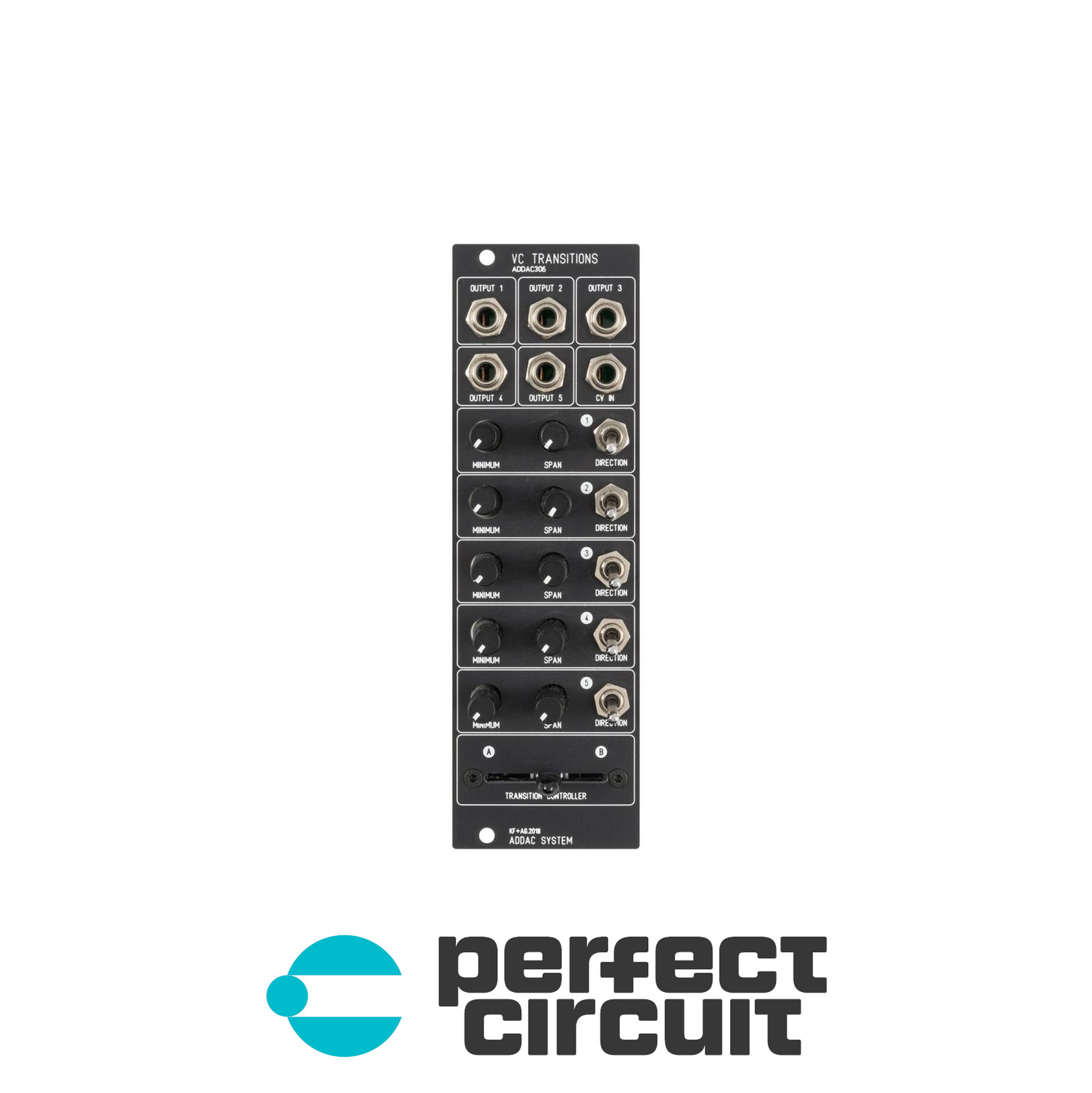
Built as a Eurorack module since May 2020, the 306 is part of ADDAC’s 300 Series, a line focused on utility and control rather than sound generation. It gives you five independent CV channels, each with its own MINIMUM, SPAN, and DIRECTION controls, all governed by a single TRANSITION CONTROLLER slider. That slider is the heart of the module—move it, and all five outputs shift in tandem, each following its own voltage range and direction. You’re not just modulating one parameter; you’re shifting an entire sonic posture. And because each channel’s range is configurable via jumpers on the back—5V or 10V—you can tailor it precisely to the modules you’re controlling, whether they need subtle nudges or full-scale sweeps.
It’s not a complex brain, but it’s a smart muscle. One reviewer called it a “macro controller,” and that fits: it’s the kind of module that lets you stop patching around for dramatic changes and just *perform* them. Another put it simply: “You can find endless uses to this little device.” That’s not hype—it’s the lived experience of people who’ve run cables from its outputs to filter cutoffs, LFO rates, delay feedback, VCA levels, even sequencer clock dividers. It’s the module that turns your rack from a collection of parts into a responsive instrument.
Specifications
| Manufacturer | ADDAC |
| Width | 8 HP |
| Depth | 40 mm |
| Current/Power consumption | 40 mA (+12 V) / 20 mA (-12 V) |
| Number of channels | 5 |
| Controls per channel | MINIMUM, SPAN and DIRECTION controls |
| Common controls | common CV IN and a common TRANSITION CONTROLLER slider |
| Output voltage range (configurable) | maximum range of each channel can be set to either 5 or 10 volts, by 5 jumpers in the back of the module |
| Output polarity | Only positive voltages are generated at the output. |
| Voltage curve of each channel | selectable via switch (minimum to maximum or vice versa) |
| Transition slider controls | the CV curve of all 5 channels simultaneously |
| CV In | for transition controller |
| 5 x CV Out |
Key Features
Five-channel CV morphing
At its core, the 306 is a 5-channel multi-directional CV generator. Each channel outputs a voltage that moves between a user-defined minimum and maximum, but here’s the twist: all five respond to the same TRANSITION CONTROLLER. That means you can set one channel to go from 1V to 8V (say, opening a filter), another to go from 5V to 2V (slowing an LFO), and a third to jump from 0V to 10V (engaging a distortion), and then sweep them all at once with a single fader. The result? Seamless transitions between sonic states, like switching scenes on a theater console.
Per-channel voltage shaping
Each channel’s behavior is tuned with three knobs: MINIMUM sets the floor voltage, SPAN sets how far above that floor the voltage can rise, and DIRECTION determines whether the output climbs from minimum to maximum or drops from maximum to minimum as the slider moves. This last one is key—it lets you invert the response of individual parameters without needing extra inverters. Want your resonance to increase while your decay time decreases? Set one channel to forward, another to reverse. It’s simple, but powerful.
Configurable output range
On the back of the module, five jumpers let you set each channel’s maximum range to either 5V or 10V. This isn’t just a technical detail—it’s a practical one. Some modules expect 0–5V for full modulation, others 0–10V. Being able to match that without attenuators or offsetting means cleaner, more predictable control. You’re not fighting voltage levels; you’re using them intentionally.
CV control over the transition
The TRANSITION CONTROLLER slider can be manually moved, sure, but it also accepts CV via a dedicated input. When you patch a signal there—say, an LFO, an envelope, or a sequencer—the slider becomes an attenuator for that incoming CV. That means you can automate your state changes. Imagine a slow sine wave sweeping your patch from “calm” to “chaotic” and back every 30 seconds, or a gate sequence stepping through different sonic profiles. The manual control is expressive, but the CV input turns it into a dynamic, patch-programmable system.
“Sweet spot” control philosophy
One reviewer described it as a “sweet spot” controller, and that’s exactly right. It’s not about fine-tuning—it’s about jumping between two well-defined states and controlling how you move between them. You set up your “A” state (dry, tight, quiet), your “B” state (wet, wide, loud), and then use the slider to find the perfect balance in between. It’s intuitive, immediate, and surprisingly musical. As one user put it, “functionally it works like it should”—no surprises, no gimmicks, just reliable, hands-on control.
Historical Context
The ADDAC 306 VC Transitions was developed based on an initial idea by Konstantine Fioretos of Signal Sounds, then realized as part of ADDAC’s 300 Series of Eurorack utility modules. It became available in May 2020, arriving at a time when modular users were increasingly seeking tools for macro-level control—ways to manage complexity rather than add more of it. While the fact sheet offers no details on competitors or market context, the 306 fits into a niche of “morphing” or “state transition” controllers, a category that includes
Collectibility & Value
The ADDAC 306 VC Transitions is not a rare or vintage item in the traditional sense—it’s been available since 2020, and new units are still sold at a retail price of $134. However, it has started to appear on the used market, with one unit listed on Reverb for $115 plus $10 shipping around three years after its release. A DIY kit version was also available for $109, suggesting a lower-cost entry point for builders. There’s no data on common electronic failures or required maintenance, but one user noted “rack rash” as a typical cosmetic issue—unsurprising for a module that lives in a crowded system and gets used frequently. Given its utility and the lack of widespread discussion, it may be underrated, as one reviewer observed: “Very underrated, don’t see people talking about it very often.” But for those who need seamless, multi-parameter transitions, it’s already proven its worth.
eBay Listings
As an eBay Partner, we earn from qualifying purchases. This helps support our independent vintage technology research.