ADDAC 301B (2014–Present)
A no-frills, passive gateway for expression pedals to control your modular—simple, reliable, and built to vanish into your rack.
Overview
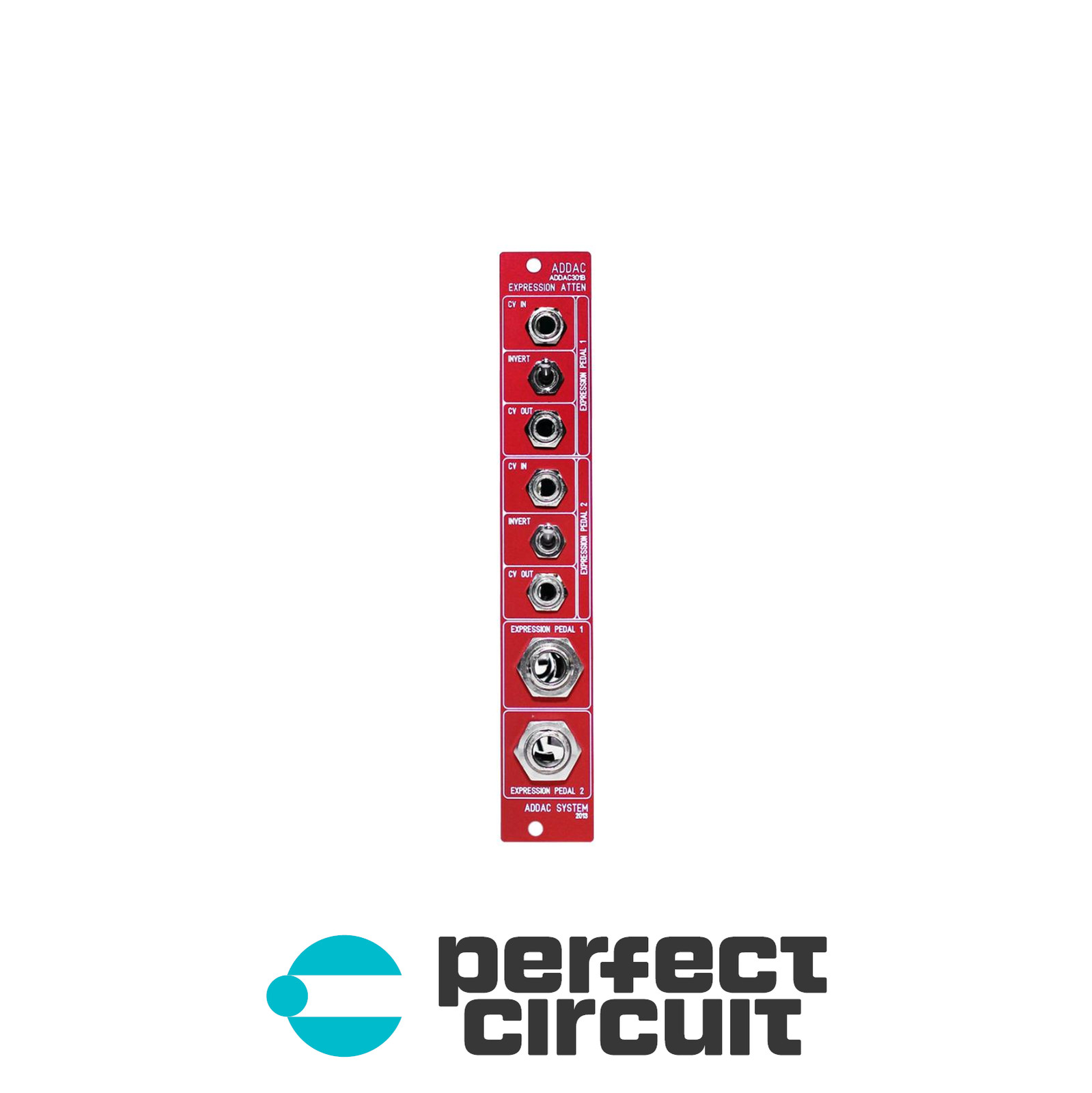
You don’t plug this module in to hear it—its magic is in what it lets you do without cables in your hands or your eyes off the crowd. The ADDAC 301B isn’t a sound source, an envelope, or a filter; it’s a quiet facilitator, the kind of module that disappears into your rack until the moment you realize you can’t live without it. It’s a passive dual expression attenuator, which means it doesn’t need power, doesn’t color your signal, and doesn’t get in the way—just lets you use one or two expression pedals to control CV or audio signals with smooth, hands-free precision.Born in 2014 as part of ADDAC’s 300 Series of expressive control modules, the 301B arrived at a time when Eurorack was exploding with utility options but still lacked elegant, dedicated solutions for integrating foot control. Most players were jury-rigging solutions with mixers, attenuators, or DIY circuits. ADDAC didn’t overthink it: they built a module that does one thing—attenuate signals via expression pedals—and does it cleanly. Each of its two channels takes a CV or audio input, routes it through a passive circuit, and lets you sweep its amplitude using a standard TRS expression pedal. A simple invert switch on each channel flips the pedal’s response, so heel-down can mean full signal or zero, depending on your patch. That might sound trivial, but in a live set, where muscle memory matters, that flexibility saves awkward recalibration mid-performance.
It’s not flashy, but that’s the point. At 4 HP wide and only 3 cm deep, it tucks into tight skiffs or crowded systems without complaint. And because it’s passive—no power draw, no noise, no interference—it’s always on, always ready. You can patch a filter cutoff into one side and a VCA into the other, then use two pedals to sculpt tone and volume in real time, like a synth player finally getting their own version of a guitarist’s wah and volume swells. Or run a clock divider’s reset into it and let your foot control rhythmic tension. The lack of active circuitry means no headroom limits or impedance matching worries; it just passes the signal through, letting the pedal act as a variable resistor in your patch.
Still, its simplicity demands honesty: it’s not a CV processor, so you can’t offset or scale the output beyond the pedal’s native range. If your expression pedal only swings from 1V to 8V, that’s what you get—no tweaking it to span 0–10V like you could with the powered ADDAC 301. And because it’s passive, it can’t boost signals, only reduce them. That’s rarely a problem in modular, where overloading is more common than under-driving, but it’s worth noting if you’re used to active attenuverters. The build is solid—clean silkscreen, sturdy jacks, recessed switches—but it’s not armored. Drop it, and the PCB or jack alignment might suffer. No power means no LEDs, so you’re flying blind; you won’t see your pedal position, just hear it. Some players miss that visual feedback, especially in dark venues.
Specifications
| Manufacturer | ADDAC System |
| Production Years | 2014–Present |
| Original Price | 65.00 € |
| Type | Passive Dual Expression Attenuator |
| Width | 4 HP |
| Depth | 3 cm |
| Power Requirement | None (Passive) |
| Inputs | 2 x 3.5 mm (CV or Audio) |
| Outputs | 2 x 3.5 mm (CV or Audio) |
| Expression Pedal Inputs | 2 x 6.3 mm TRS |
| Control | 2 x Invert Switches (per channel) |
| Compatibility | Standard TRS Expression Pedals (e.g., Moog EP2, Behringer FCV100) |
Key Features
Passive Simplicity, Zero Noise
There’s no circuit to fail, no power to steal from your bus board, and no noise floor to worry about. The 301B uses purely resistive attenuation, meaning it doesn’t amplify, invert, or process—just scales. That purity is its strength. In a system full of active modules vying for current and headroom, the 301B is a silent partner. It won’t load down a delicate LFO or clip a hot audio signal. You put in 8V, you get a variable fraction of that out, cleanly. This makes it ideal for attenuating clock signals, modulation sources, or even audio-rate signals when you want to fade a waveform in and out with your foot—like a real-time crossfader for your patch.
Dual Independent Channels with Invert Switches
Two channels mean you can run separate expression controls without daisy-chaining pedals or using multiple modules. Want to fade in a drone while simultaneously sweeping a filter? Patch one signal to channel A, another to B, plug in two pedals (or Y-cable one), and go. The invert switch on each channel is more useful than it first appears. Say you’re using a pedal to open a VCA—normally, toe-down (heel-up) gives you full volume. But if you’re using the pedal as a “mute” footswitch, you might want heel-down to be full signal. Flip the switch, and the taper reverses. It’s a small detail, but it eliminates the need for extra logic modules or inverted CV sources.
Compact and Skiff-Friendly
At just 3 cm deep, the 301B clears nearly every case and skiff on the market. Its 4 HP width is standard for a dual utility module, but in this case, it feels generous—there’s room to plug and unplug even with thick cables. The recessed toggle switches keep them safe from accidental kicks, and the jacks are spaced to avoid crowding. It’s not flashy, but it’s thoughtfully laid out. The front panel comes in black or red as standard, with custom colors available directly from ADDAC, though most users leave it as-is—this isn’t a module meant to draw attention.
Historical Context
The ADDAC 301B emerged in early 2014 as part of a five-module wave of expressive control interfaces from the Lisbon-based modular company. At the time, Eurorack was still maturing beyond the basic building blocks—VCOs, filters, envelopes—and players were hungry for ways to interact with their systems more dynamically. While MIDI controllers and touch interfaces existed, there was a growing desire to bring physical, gestural control back into modular—something you could stomp, twist, or sway with. ADDAC’s 300 Series answered that with solutions ranging from muscle sensors to power starvation, but the 301B stood out for its humility. It didn’t invent anything; it just made expression pedal integration straightforward.
Compared to contemporaries like the Doepfer A-178 (Theremin interface) or the earlier, more complex expression solutions from Livewire or Intellijel, the 301B was refreshingly literal. No calibration, no power, no menu diving. It assumed you already had a pedal—most synth players did, often left over from keyboards or guitar effects—and just needed a way to plug it in. That philosophy aligned with a broader trend in Eurorack: the rise of the “utility” module as a category. Suddenly, things like attenuators, mixers, and signal routers weren’t afterthoughts—they were essential tools for managing complex patches. The 301B wasn’t the first attenuator, but it was among the first to treat expression control as a first-class patching concern.
Collectibility & Value
The ADDAC 301B has never been rare or hyped, and that’s part of its appeal. It’s been in continuous production since 2014, available directly from ADDAC or through dealers like Perfect Circuit, Thomann, and Reverb. Original price was 65.00 €, and it still sells new in that range—around $75–$85 depending on region and markup. Used units typically go for $50–$65, often selling quickly because they’re small, useful, and fail-proof. There are no known failure points—no ICs, no power regulation, no moving parts beyond the switches and jacks. The only wear items are the 1/4" jacks, which can loosen over time with frequent plugging, but even that’s uncommon.
When buying used, check that the expression pedal inputs aren’t wobbly and that the toggle switches click cleanly. Since there’s no power, you can test it with any TRS expression pedal (Moog EP2, Behringer FCV100, or even a modified Line 6 pedal) and a multimeter or simple CV source. Patch in a steady voltage, sweep the pedal, and verify the output scales smoothly. No jumps, no dropouts. If it passes, it’ll likely last another decade. Because it’s passive, it’s also immune to power rail issues or bus board incompatibilities—plug it in, and it works.
For collectors, the 301B isn’t a showpiece. It doesn’t appreciate, it doesn’t have limited editions, and it’s not sought after for its sound (it has none). But in a “best utility modules” list, it earns a quiet spot. It’s the kind of module you don’t notice until it’s gone—like a good cable or a sturdy rack tray. If you play live, or just hate reaching into your rack mid-phrase, the 301B is one of those “buy it once, forget about it” tools that makes modular feel less like engineering and more like playing.
eBay Listings
As an eBay Partner, we earn from qualifying purchases. This helps support our independent vintage technology research.