ADDAC 215 Dual S&H+ (2019–)
A tiny Eurorack powerhouse that turns randomness into orchestral chaos—or serene order—with surgical precision and clever internal routing.
Overview
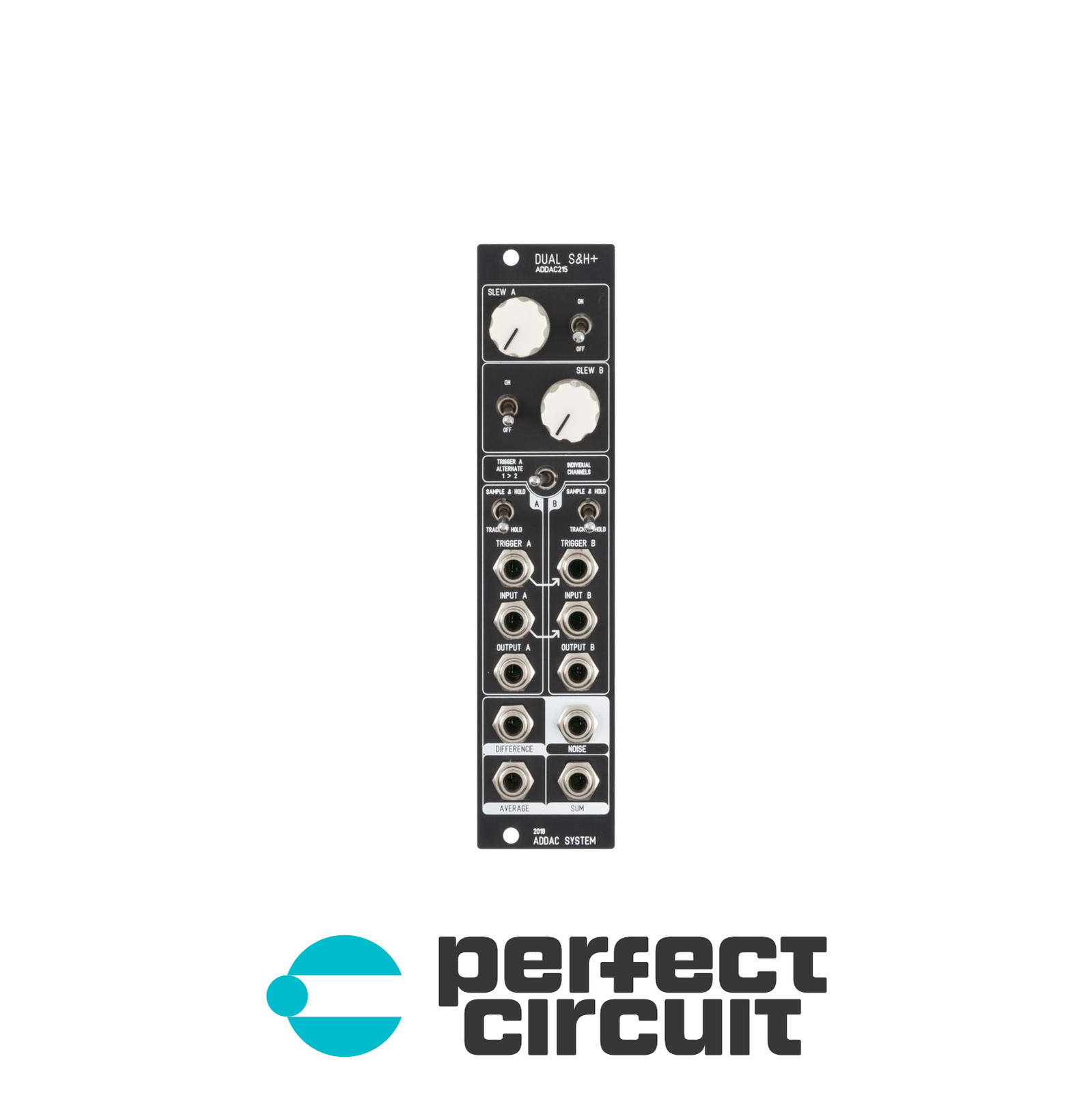
Plug in the ADDAC 215 Dual S&H+ and your modular system suddenly gains a nervous system of its own—one that can stutter, sync, glide, and surprise with the flick of a switch. Don’t let the 6HP width fool you: this module packs dual precision sample & hold circuits, a noise source, track & hold functionality, independent slew limiters, and a suite of derived outputs that feel like getting four modules in one. It’s the kind of piece you reach for when you want to inject unpredictability into a sequence, smooth out jagged modulation, or generate complex interlocking control voltages without patching half your case. The fact that it holds voltage so cleanly—less than 0.01V drop over 20 minutes—means it’s not just for texture; it’s reliable enough to modulate pitch in quantized sequences without noticeable detuning, which is no small feat in the analog world.
What sets the 215 apart isn’t just what it does, but how elegantly it does it. The internal noise source is normalled to both S&H inputs, so the moment you clock it, you’ve got two streams of random voltages ready to go. Flip the Track & Hold switch and suddenly you’re not freezing a voltage at a moment in time, but capturing a continuous window—perfect for smoothing chaotic modulation or creating evolving swells. The slew limiters on each channel aren’t an afterthought; they’re fully controllable with a single knob for attack and decay, and can be toggled on or off per channel. That means you can have one side snapping to values with digital precision while the other glides like a ribbon controller. And then there’s the alternate trigger mode: patch a clock into Trigger A, flip the switch, and every pulse toggles between latching Channel A and Channel B. It’s a built-in flip-flop, creating rhythmic alternation that’s great for call-and-response sequences or stereo panning effects.
But the real magic lives in the extra outputs—Noise, Difference, Average, and Sum. These aren’t just convenience jacks; they’re compositional tools. The Difference output (A minus B) can create tension between two random sources, while the Average output smooths them into a median path. The Sum output is a quick way to layer modulations, and the dedicated Noise output means you don’t have to patch into an S&H input just to access the internal generator. Used together, they turn the 215 into a modulation hub, letting you build complex, self-contained patches that evolve in unexpected ways. It’s no wonder users report using it for “glitchy weird sub voices” or “pseudo-velocity” effects—this module doesn’t just respond to your system, it starts making decisions of its own.
Specifications
| Manufacturer | ADDAC System |
| Production Years | 2019– |
| Original Price | €139 (DIY kit) |
| Format | Eurorack |
| Width | 6 HP |
| Depth | 40 mm |
| Current Draw +12V | 50 mA |
| Current Draw -12V | 50 mA |
| Channels | 2 |
| Functionality | Sample & Hold / Track & Hold (per channel) |
| Slew Limiter | Per channel, adjustable attack/decay, on/off switch |
| Noise Source | Internal white noise, normalled to both S&H inputs |
| Trigger Modes | Normal (A or B), Alternate (A/B toggle via Trigger A) |
| Additional Outputs | Noise, Difference (A–B), Average ((A+B)/2), Sum (A+B) |
| Voltage Hold Accuracy | 0.3% max deviation from input, 0.01V drop over 20 minutes |
| DIY Availability | Yes, SMD/through-hole hybrid kit |
| Panel Color | Black anodized aluminum |
| Build Level | Easy/Medium (kit) |
Key Features
Two Channels, Four Personalities
The ADDAC 215 isn’t just dual—it’s divergent. Each channel operates independently with its own signal input, trigger input, output, slew control, and Track & Hold switch. That means you can sample an external LFO on Channel A while tracking a chaotic audio-rate modulation on Channel B, each with its own slew behavior. One can be sharp and immediate, the other slow and languid. The alternate trigger mode adds another dimension: instead of syncing both channels to the same clock, you can have them take turns, creating rhythmic alternation that feels almost conversational. It’s a simple trick, but in practice it opens up stereo sequencing, ping-pong effects, and dynamic layering that would otherwise require multiple modules and complex patching.
Slew That Doesn’t Sabotage Pitch
Many slew limiters in modular systems are designed for audio or slow modulation, not precise CV smoothing—so when you try to use them on pitch, you get detuning, lag, or voltage drift. The 215’s slew circuits are engineered to avoid that. While some users report the default slew times as “too long” for tight pitch sequences (on the order of seconds), the DIY nature of the kit allows for capacitor swaps to tailor the response—either for fast 1V/oct smoothing or slower, more expressive glides. Documentation confirms you can even configure each channel differently, letting you fine-tune the module to your system’s needs. It’s not a one-size-fits-all solution, but a customizable tool that respects the integrity of your control voltages.
Modulation Math in a 6HP Space
The inclusion of Difference, Average, and Sum outputs transforms the 215 from a passive sampler into an active modulation processor. These aren’t just summed signals; they’re intelligent derivations that let you explore relationships between two random or stepped sources. The Difference output can create tension—say, modulating filter cutoff in opposite directions on two oscillators. The Average output is ideal for creating a “center” voltage from two extremes, useful for morphing between states. And the Sum output can layer modulations for richer, more complex movement. Combined with the internal noise source, which is available at its own output, the 215 becomes a self-contained engine for generative patches, capable of producing evolving textures with minimal external input.
Historical Context
The ADDAC 215 Dual S&H+ arrived in 2019, a time when Eurorack was shifting from boutique curiosity to mainstream tool for electronic musicians. Sample & hold modules weren’t new—Doepfer’s A-148 had been a staple since the 1990s—but the 215 reimagined what they could do in a compact format. While many manufacturers were adding digital brains or complex sequencing, ADDAC went analog but clever, focusing on precision analog performance and smart routing. The module reflects a broader trend in the late 2010s toward “utility-plus” modules—small form factor units that do more than their category suggests. Competitors like Intellijel’s Shifty or Joranalogue’s Select 2 offered pitch-stable S&H, but few packed in noise sources, slew limiters, and mathematical outputs in 6HP. The 215 also speaks to ADDAC’s hybrid philosophy: though analog in signal path, it’s designed with digital-era patching in mind, where modularity and interconnection are paramount. It’s not trying to be a vintage clone; it’s a modern solution to modern patching problems.
Collectibility & Value
The ADDAC 215 Dual S&H+ is not a vintage classic in the traditional sense—it’s too new to be considered vintage by the archive’s 2005 cutoff—but it’s already earned a cult following among Eurorack enthusiasts for its density of features and build quality. As of 2024, the DIY kit sells for around €139, with assembled units trading on Reverb and eBay for €200–€250 depending on condition and seller. Because it’s a kit, condition varies widely: some units are professionally built with flawless soldering, while others show the marks of a first-time builder. When buying used, check for cold solder joints, especially on SMD components, and verify that both channels hold voltage accurately—though reports suggest the design is stable, a poorly assembled unit might exhibit drift. The module draws 50mA on both +12V and -12V rails, so ensure your case power supply can handle it, especially in densely packed systems. Failures are rare, but the toggle switches and jacks are the most likely points of wear. Owners note that the module’s value lies not in rarity, but in utility: it’s the kind of module you don’t realize you need until you use it, then wonder how you ever patched without it.
For DIY builders, the kit is rated “easy/medium”—it includes both surface-mount and through-hole parts, so some SMD experience helps. The build guide is well-documented, and the ability to swap capacitors for different slew rates adds long-term customization. However, if you’re not comfortable with soldering, buying an assembled unit is worth the premium. There are no known firmware issues or design recalls, but early forum discussions questioned the slew timing for pitch use—this isn’t a flaw, but a design choice that can be modified. Overall, the 215 is a low-risk acquisition: it’s not going to skyrocket in value, but it’s unlikely to become obsolete. It’s a tool, not a trophy, and one that earns its place on the panel every time you patch it.
eBay Listings
As an eBay Partner, we earn from qualifying purchases. This helps support our independent vintage technology research.