ADDAC107 ACID Source ()
A 9 HP Eurorack tornado of saturated bass and squirming resonance—born as a drum module, reborn as an acid assassin.
Overview
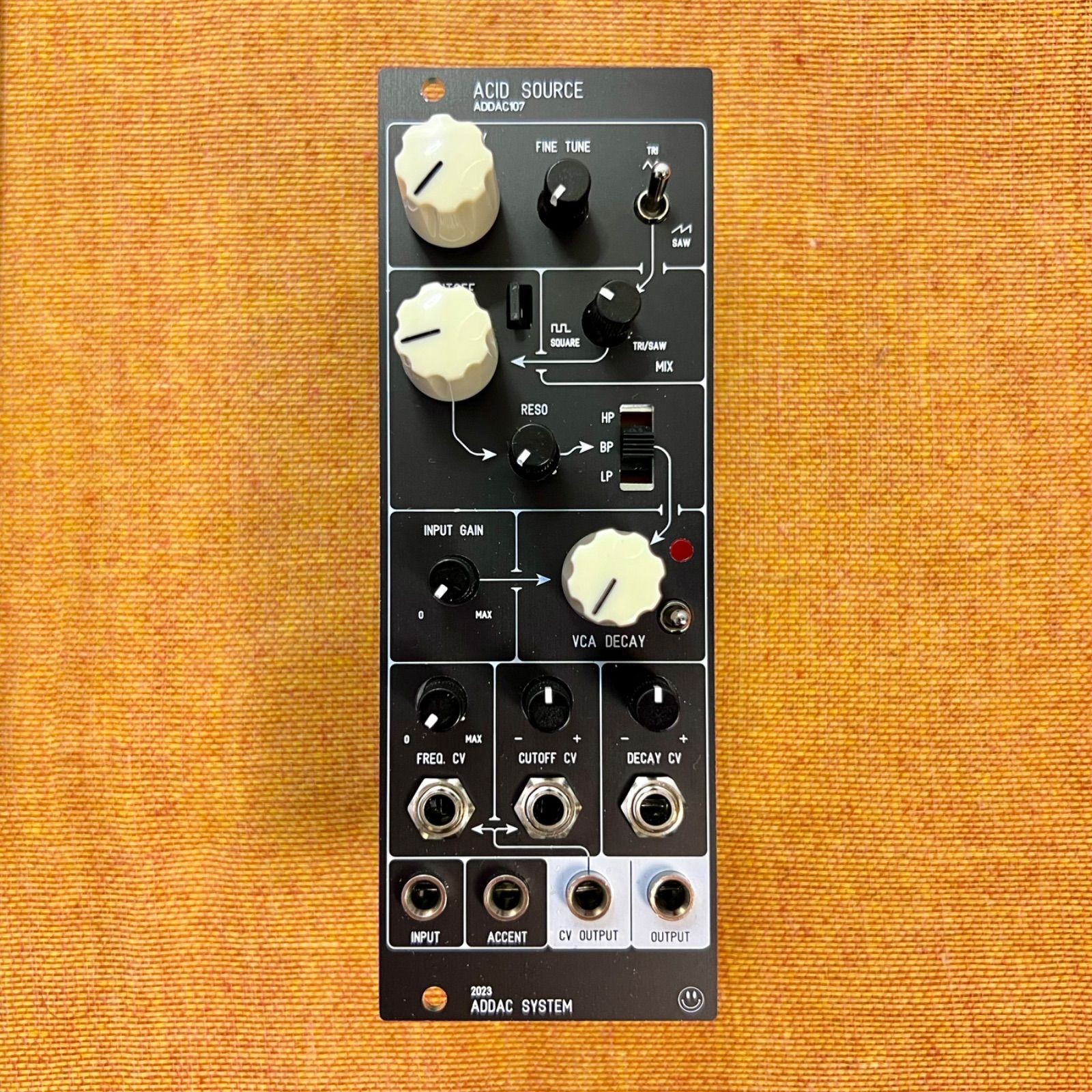
The ADDAC107 ACID Source isn’t just another compact synth voice—it’s a concentrated hit of analog aggression squeezed into 9 HP. Built by ADDAC System, this Eurorack module packs a full signal chain: VCO, VCF, and VCA, all tuned for maximum grit and punch. It doesn’t pretend to be polite. If you’re after clean pads or pristine leads, look elsewhere. But if you want a module that can tear holes in your mix with fat, distorted basslines and screaming acid squelch, the Source delivers with a sneer.
Owners report it excels in the dirtiest corners of electronic music—acid, industrial, noise, and anything that benefits from a little sonic violence. The design leans hard into saturation, letting the VCA distort when pushed, and the filter howls when resonance climbs. It’s not a Roland 303 clone, but it’s clearly gunning for that same anarchic spirit. And while it doesn’t nail every detail of the 303 experience—more on that later—it carves its own niche with a raw, immediate character that feels alive, unstable, and dangerously fun.
What’s striking is how much is packed into such a narrow footprint. For a single module, it offers a surprising amount of control: waveform blending, filter type switching, accent input, and a built-in AD envelope. It’s not trying to be a full synth—it’s trying to be a weapon. And like any good weapon, it has quirks. It demands attention. It fights back a little. But when it clicks, it’s electrifying.
Specifications
| Manufacturer | ADDAC System |
| Product type | Eurorack module; a full synth voice (VCO/Mixer/VCF/VCA) |
| Width | 9 HP |
| Depth | 40mm |
| Power Consumption | 80mA +12V, 80mA -12V |
| VCO tunable across | four octaves |
| DIY availability | Available as a DIY kit |
Key Features
VCO: Simple but Effective
The oscillator is straightforward but potent. It offers a choice between triangle and sawtooth waveforms via a slide switch—no sine, no pulse width modulation, no bells. But where it gets interesting is the waveform mixing: the selected waveform (triangle or saw) can be blended with a square wave, letting you thicken the sound or add bite. The FREQUENCY and FINE TUNE knobs cover a range of four octaves, and there’s a CV input with an attenuverter, so you can modulate pitch externally. It’s not the most flexible VCO out there, but it’s stable enough and tuned for character over precision.
Filter: Switchable and Screamy
The filter is where the Source really starts to snarl. It’s a resonant VCF with a 3-position slide switch to select between highpass, bandpass, and lowpass modes—unusual flexibility in such a compact module. The CUTOFF and RESO knobs let you sweep from murky rumbles to piercing shrieks, and at high resonance, the filter can self-oscillate, acting as a second tone source. There’s a CV input for cutoff with its own attenuverter, so you can modulate the filter dynamically. But notably, there’s no CV control over resonance or input gain, which limits some expressive possibilities. And owners report a quirk: cranking the cutoff can actually affect the oscillator’s pitch, creating an unstable, wobbly interaction that’s either a bug or a feature depending on your mood.
VCA and Envelope: Fast, Fierce, and Fuzzy
The VCA is where the distortion magic happens. It accepts an external input signal and has an INPUT GAIN knob that can boost the signal by up to 2x. Push it too far, and the VCA circuit overloads—intentionally. When the AD envelope opens (with a fixed short attack and adjustable decay), it slews the control voltage, which is also sent to a CV OUTPUT and an LED for visual feedback. The envelope only goes up to +5V for unity gain; beyond that, it saturates, adding harmonic grit. This isn’t clean amplification—it’s amplification with attitude. The Accent input lets you inject a transient boost, perfect for punchy bass hits or snappy leads.
Signal Flow and Normalization
The module’s signal path is cleverly normalized: the CV OUTPUT is patched to both the Frequency and Cutoff inputs by default, meaning the envelope from the VCA can simultaneously shape pitch and filter in a classic “acid” contour. This makes it easy to get that iconic 303-style sweep without patching a single cable. But because there’s no dedicated filter envelope generator, you’re stuck using the VCA’s AD envelope for both amplitude and filter modulation—limiting polyphonic or complex modulation setups. It’s a trade-off: instant gratification for monophonic acid lines, but less flexibility for advanced sound design.
Historical Context
The ADDAC107 ACID Source didn’t start life as a synth voice. It was originally conceived as a complex drum source, aimed at generating rich, evolving percussive tones. But during development, the design pivoted—what emerged was a compact, full-featured analog voice built for aggressive, modulated bass. This shift explains some of its quirks: the accent input, the emphasis on saturation, the tight integration of envelope and filter. It’s a module born from experimentation, and that experimental DNA is still audible in its unstable, raw character.
Collectibility & Value
As of now, there’s no confirmed data on current market prices or original retail cost. The module remains available as a DIY kit, which keeps it accessible to builders and tinkerers. This availability likely keeps resale prices in check, though condition and build quality will vary widely among user-assembled units.
Collectors and users note several pain points. The slide switches—used for waveform and filter selection—are a common complaint; some find them clunky or unreliable over time. The trim pots, particularly for resonance and CV offset, have been described as “wiggly,” suggesting potential drift or instability in live use. Tuning and tracking can be inconsistent, especially when pushing the VCO across its range or modulating pitch via the filter cutoff. At high resonance, the filter’s cutoff sweep becomes limited, reducing expressiveness when you’re trying to nail that smooth acid glide.
There’s also a design critique: the lack of a dedicated filter envelope, no CV over input gain or resonance, and the shared modulation path mean it’s not a true 303 replacement. As one user put it, “you’ll have to find some workarounds for an acid-typical filter envelope.” Another noted it “feels like an idea that needs more development and design work (and product testing) before launch.” But even with these flaws, the consensus is clear: for the price, packing a full analog voice into 9 HP with this much character is hard to beat. It’s not perfect—but it’s powerful.
eBay Listings


As an eBay Partner, we earn from qualifying purchases. This helps support our independent vintage technology research.