ADDAC 105 4 Voice Cluster (2020–)
A compact, chaotic little beast that turns tiny knob tweaks into unpredictable rhythms and pitched clangs—like a wind chime wired on espresso.
Overview
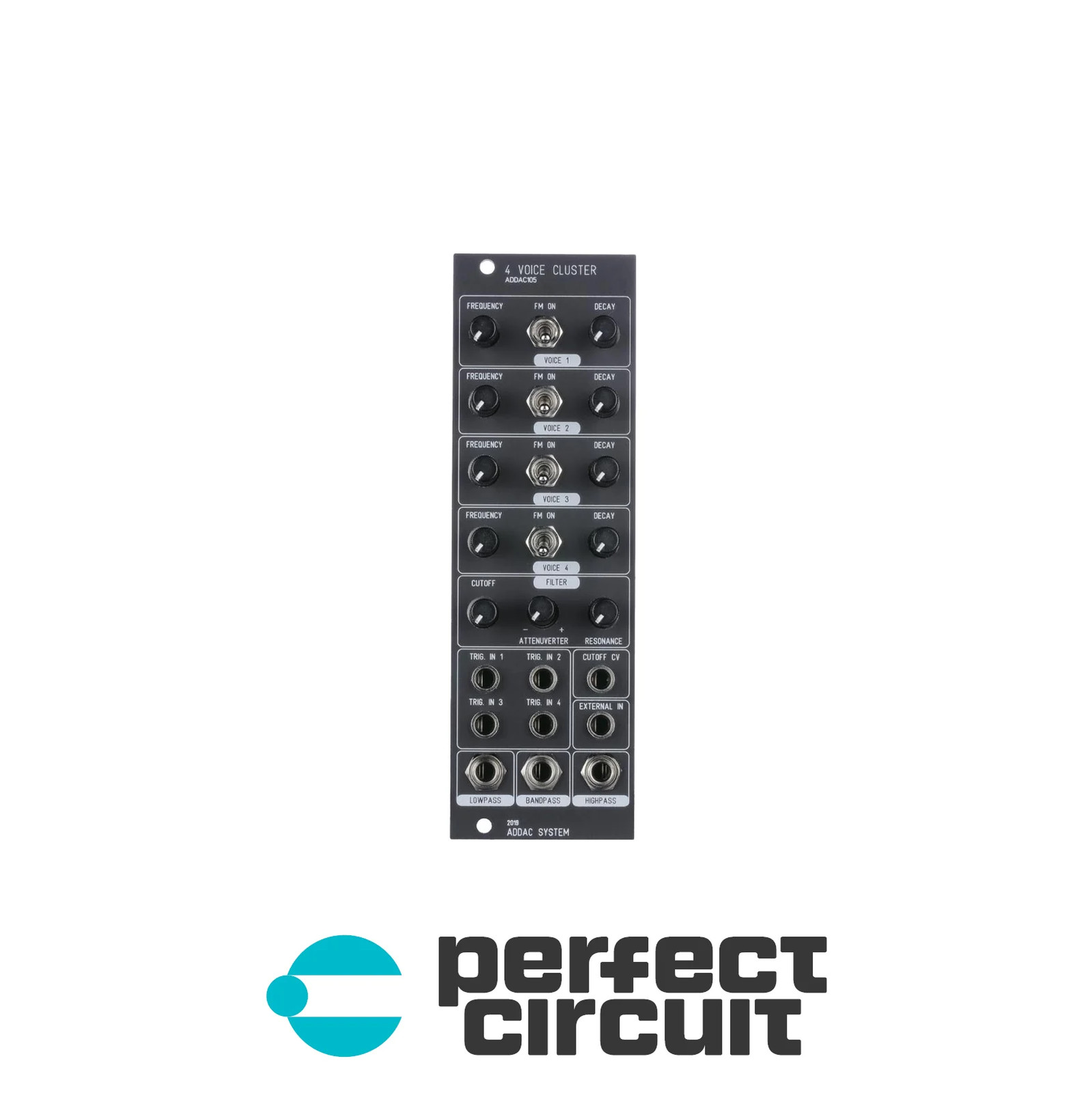
The ADDAC105 4 Voice Cluster isn’t trying to be your main melody machine. It’s the module you patch in when you want something to feel slightly unstable, a little raw, and full of surprise. Built by ADDAC System out of Lisbon, Portugal, this 8 HP Eurorack sound source landed in May 2020 as part of their no-frills, idea-forward 100 Series. It’s not a precision instrument—far from it—but that’s exactly where its charm lives. You’re not tuning concert pitch here; you’re nudging four square wave oscillators into a jittery, FM-coupled conversation and seeing what kind of metallic hiccup they come up with.
Each of the four voices has its own frequency knob, trigger input, and a decay control that doubles as a mute when turned fully counterclockwise. That decay isn’t a classic envelope—it’s a slew applied to the incoming trigger, shaping how quickly the voice responds. Patch in a clock, tweak the decay, and you’ve got anything from tight clicks to smeared thuds. The voices feed into individual VCAs, but there’s no dedicated CV input for amplitude—instead, any signal (gate, trigger, CV) can be patched into the VCA input, letting you modulate volume with whatever you’ve got spare. It’s scrappy, flexible, and encourages patching that bends the rules.
All four voices get summed and sent straight into a multimode filter with low-pass, bandpass, and highpass outputs available simultaneously. The filter’s cutoff has a CV input with a bipolar attenuverter, so you can precisely control how much external modulation affects it—whether you’re sweeping it smoothly or letting random voltages tear through. And then there’s the jumper on the back: route the external input to the filter for processing outside signals, or send it to all four voices’ frequency controls for uncalibrated, experimental pitch wobbling. It’s not 1V/octave, so don’t expect tracking—expect warble, drift, and happy accidents.
At 120€ (excl. VAT) new, or 96€ for the DIY kit, it’s an intentional bargain. ADDAC didn’t skimp to cut corners—they did it to keep the design focused. No pitch CV, no fine-tuning, no digital brains. Just analog immediacy. And that’s why owners either love it or walk away confused. If you’re looking for repeatability, this isn’t it. If you’re okay with patches that vanish when you sneeze near the knobs, you’re in for a treat.
Specifications
| Manufacturer | ADDAC System |
| Width | 8 HP |
| Depth | 45 mm |
| Current consumption | 40 mA (+12 V) / 40 mA (-12 V) / 0 mA (+5 V) |
| Function | 4 voice Square Oscillator with VCA, FM switch, slew decay for Trigger IN, and Multimode Filter |
| Per channel features | Trigger input, adjustable decay envelope (slew), adjustable frequency, and switchable FM from the previous voice |
| Filter | Multimode filter with cutoff and resonance controls |
| Filter outputs | Low-pass, Bandpass, and Highpass |
| Filter control | Cutoff CV input with bipolar attenuator (attenuverter) |
| External input routing | [EXTERNAL IN] can be routed via a rear jumper to either the filter input (for processing external audio) or to all 4 voices' Frequency control (for experimental CV over pitch, not 1V/oct calibrated) |
Key Features
Four Voices, One Chaotic Mind
The ADDAC105’s four square wave oscillators don’t play nice—they’re meant to rub against each other. Each voice has a frequency knob and a trigger input, but no pitch CV, which keeps the module compact and focused on immediate, hands-on tweaking. The real fun starts with the FM switches: each voice can be modulated by the one before it, with Voice 1 looping back from Voice 4. Flip a few switches, patch in a clock, and you’ve got an FM chain that can spiral into rhythmic chaos or lock into weirdly musical patterns. It’s not clean FM synthesis—it’s gritty, nonlinear, and prone to sudden jumps. But that’s the point. Tiny adjustments to frequency or decay can completely reshape the output, which reviewers note makes exact recall nearly impossible. But if you’re chasing moments, not presets, that’s a feature.
Decay as Expression, Not Just Timing
The [DECAY] knob isn’t just an envelope—it’s a slew on the trigger path. Turn it up, and your sharp clock pulses stretch into slow rises, turning clicks into bloops. Turn it all the way down (fully anti-clockwise), and the voice mutes entirely. It’s a clever dual-purpose design that saves space and adds character. Since the slew happens before the VCA, the timing of each voice’s onset becomes part of the texture. Layer a few voices with different decay settings, and you get a sense of motion even without modulation. It’s especially effective for percussive sequences where you want some hits to snap while others swell in.
Filter with Teeth—and Three Faces
After the summing stage, all four voices feed into a single multimode filter with cutoff and resonance controls. It’s not a surgical filter, but it’s responsive, and the resonance can get squelchy and vocal when pushed. The real strength is having low-pass, bandpass, and highpass outputs available at once. You can send the LP to your main output, feed the BP into a delay, and route the HP to modulate another module—all from the same source. The cutoff CV input comes with a bipolar attenuverter, so you can invert or scale incoming modulation, making it easy to blend multiple CV sources without external attenuators. It’s a practical, no-nonsense filter section that does exactly what it needs to, without overcomplicating.
External Input: Fork in the Road
The [EXTERNAL IN] jack is a pivot point. Via a jumper on the back, you can route it to one of two places: the filter input, so you can process outside audio through the ADDAC105’s filter and outputs, or to all four voices’ frequency controls for experimental pitch manipulation. That second option is wild—patch in a slow LFO or random voltage, and the entire cluster starts wobbling in unison, but since the frequency inputs aren’t 1V/oct calibrated, you’re not tuning notes. You’re warping the sonic fabric. One reviewer noted you can even loop one of the filter outputs back into the external input via a VCA for self-oscillating feedback patches. It’s a gateway to textures that feel more like malfunctioning machinery than music—and that’s often where the best sounds live.
No CV? By Design.
The lack of pitch CV inputs isn’t an oversight—it’s a design decision. ADDAC purposely left it out to keep the module compact, affordable, and focused on immediate, experimental play. This isn’t a lead synth or a bass machine. It’s a texture generator, a rhythm disturber, a sound design sandbox. By removing CV, they kept it to 8 HP and at 120€ (excl. VAT), which makes it accessible. But it also means you’re not going to integrate it into a melodic sequence unless you’re okay with approximations. That’s the trade-off: stability for spontaneity, precision for personality.
Collectibility & Value
The ADDAC105 4 Voice Cluster remains available new at 120€ (excl. VAT), with a DIY kit option at 96€ (excl. VAT), making it one of the more affordable entry points into ADDAC’s 100 Series. There’s no secondary market data suggesting significant price fluctuation, and However, its value to collectors lies more in its character than its rarity. It’s not a “holy grail” module, but it’s a cult favorite among those who appreciate chaotic, hands-on sound sources.
Custom panel options add a personal touch: available in Red, Green, Blue, White, Silver Gray, Yellowed Silver, Dark or Light Bronze, with print colors in Black, White, Red, Yellow, Blue, or Green. These come at an additional cost and require a 4–6 week lead time, but they make the module stand out visually in a crowded rack. Given its ongoing availability and stable pricing, it’s unlikely to become a high-value collectible, but it’s a smart buy for anyone wanting a compact, unpredictable sound generator that punches above its size.
eBay Listings
As an eBay Partner, we earn from qualifying purchases. This helps support our independent vintage technology research.