ADDAC 102 VC FM Radio (Years Unknown)
Crackling with static, broadcasting ghosts from the electromagnetic ether—this is FM radio reborn as a modular synth instrument.
Overview
There’s something quietly unhinged about tuning a live FM broadcast into your Eurorack stack. One minute you're deep in a voltage-controlled drone, the next you’re knee-deep in a weather report from a station 30 miles away—then it dissolves into a burst of static that sounds like a dying satellite. That’s the ADDAC 102 VC FM Radio: a fully functional, voltage-controllable FM receiver shrunk into an 8HP Eurorack module, where radio isn’t for listening—it’s for *playing*. This isn’t a sample player or a looper; it’s a live wire to the airwaves, pulling in whatever’s floating through the electromagnetic soup at any given moment. It’s absurd, unpredictable, and utterly brilliant when you want to inject real-world chaos into a tightly controlled modular system.
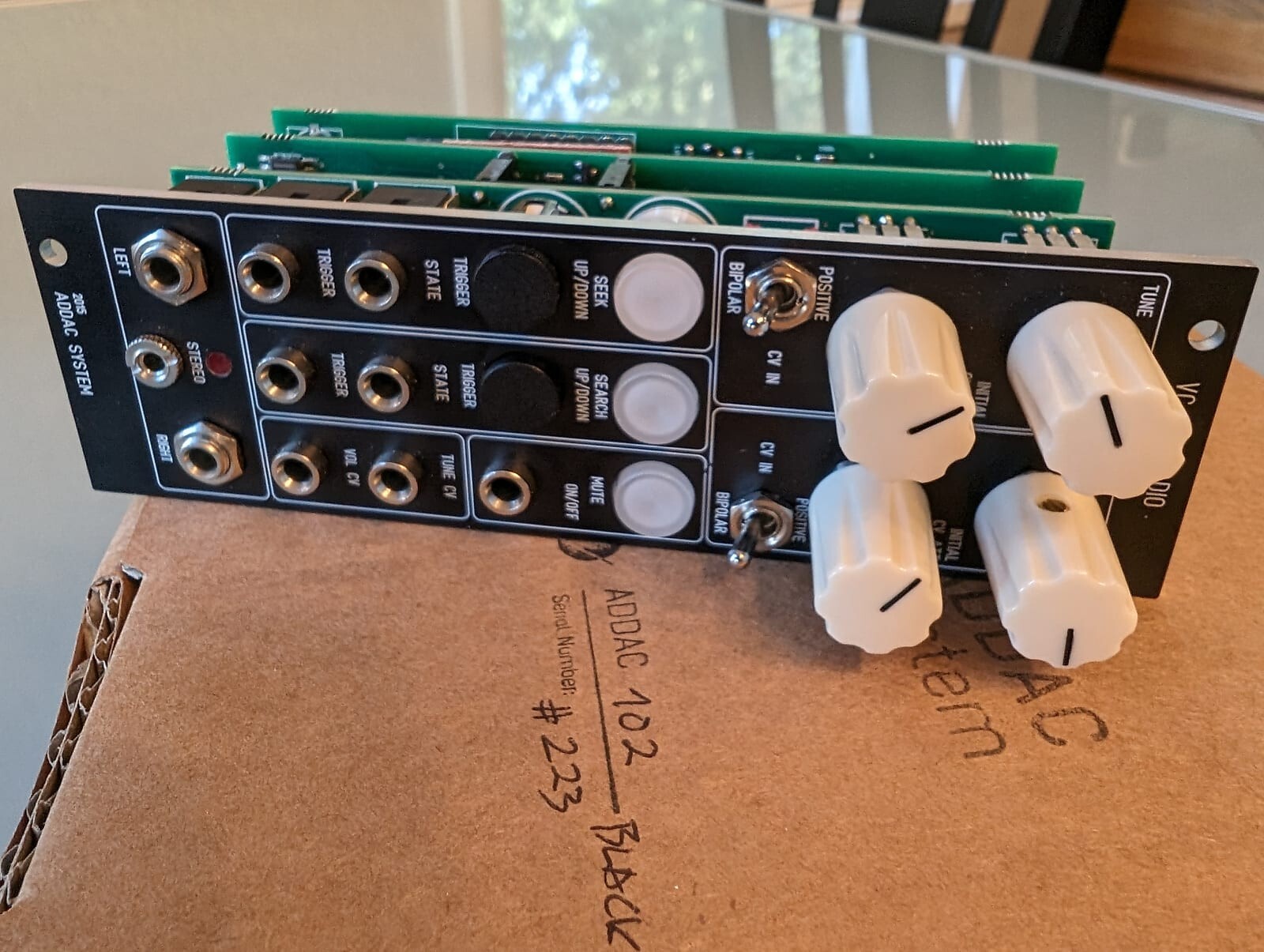
Manufactured by ADDAC as part of their ADDAC100 Series, the 102 VC FM Radio blurs the line between instrument and antenna. Its primary role is clear: capture live FM broadcasts (86–106 MHz) and route them as audio sources within a modular setup. But in practice, it’s just as valued for what happens *between* stations. The static, the interference, the faint hum of digital bleed—it’s all raw material. Users report that it excels as a noise generator, picking up electromagnetic artifacts that feel organic and unpredictable in a way that pure analog noise circuits often aren’t. It’s like having a Geiger counter for radio waves, clicking and popping with the unseen energy around you.
And yes, you can mute it—thankfully. The module includes a hard mute function, controllable via gate, so you can cut out a sudden burst of pop music mid-performance. But the real magic lies in its voltage control. Every major function—tuning, volume, station seeking—can be automated or modulated. Want to sweep through the dial with an LFO? Done. Trigger a station hop with a sequencer pulse? Easy. The CV inputs for tune and volume come with attenuators and can handle both unipolar and bipolar signals, making it flexible in any system. It’s not just a novelty; it’s a genuinely playable interface with the invisible spectrum around us.
Specifications
| Manufacturer | ADDAC |
| Width | 8HP |
| Depth | 60mm |
| Power consumption | 100 mA +12V / 100 mA -12V / 0 mA 5V |
| Tuning range | 86-106 MHz (FM band) |
| Controls | Tune, Volume, Seek/Mute |
| CV Inputs | Tune and Volume with attenuators (switchable unipolar/bipolar); Station Search and Direct Station Selection triggers; Mute gate input |
| Outputs | Stereo (Left and Right) |
Key Features
Live Radio as Sound Source
The ADDAC 102 doesn’t simulate radio—it is radio. It pulls in actual FM broadcasts, turning live programming into modular fodder. A talk show host’s voice can become a rhythmic element when chopped by a sample and hold; a snippet of jazz can be pitch-shifted into oblivion. But the real draw is the unpredictability. You never quite know what you’ll get. One patch might yield a gospel choir bleeding through the noise; the next, a traffic update from a city you’ve never visited. It’s a reminder that sound is everywhere, even when you’re not looking for it.
Voltage-Controlled Tuning and Navigation
What elevates this from a curiosity to a serious tool is its full voltage controllability. The tune and volume parameters accept CV with dedicated attenuators, letting you scale incoming control voltages precisely. Whether you’re using a slow ramp to drift through the dial or a stepped sequence to jump between preset frequencies, the response is smooth and immediate. The station search function can be triggered via CV, stepping up or down in 0.1 MHz (EU) or 0.2 MHz (US) increments—perfect for algorithmic station hunting. Direct station selection triggers allow for precise jumps, making it possible to recall “favorite” interference zones or broadcast sweet spots.
Stereo Output with Mute Control
The module provides true stereo output—left and right channels—so if a station is broadcasting in stereo, you get the full spatial image. That might not matter when you’re feeding it into a granular processor, but it adds fidelity when sampling or processing externally. The mute function is both manual and gate-controllable, which is essential in live performance. There’s nothing worse than a sudden burst of commercial jingle during a delicate passage, and the gate input ensures you can silence the module on command, whether from a sequencer, footswitch, or logic trigger.
Analog Circuitry, Real Interference
Despite its digital-like functionality (station search, precise tuning steps), the ADDAC 102 relies on analog circuitry to capture and process the RF signal. This contributes to its character—especially in the way it handles static and electromagnetic interference. It doesn’t just generate noise; it *receives* it. Users describe the static as “crackling with texture,” full of micro-transients and organic grit. When no strong station is present, the module becomes a live mic for the electromagnetic environment: computers, power supplies, Wi-Fi routers—all leave their ghostly imprint. It’s not a flaw; it’s a feature. Some owners report using it specifically for this, tuning to dead zones and letting the ambient EM field drive their patches.
Module as Antenna
The module itself acts as the antenna—no external wire needed. That makes it convenient but also means placement in your case matters. Mount it near a power supply or digital module, and you might pick up more interference. Move it to the edge, and reception could shift dramatically. This sensitivity isn’t a bug; it’s part of the instrument. The physical layout of your rack becomes part of the sound design process. Some users have reported that touching the module with their hand changes the tuning or increases static—another tactile layer in an already expressive system.
Collectibility & Value
The ADDAC 102 VC FM Radio isn’t a rare unicorn, but it’s not common either. Current market listings show a representative price of £298.00 or $318, with a B-stock unit noted at $328—suggesting strong demand even for imperfect units. There’s no data on original MSRP or production years, so it’s unclear how long it’s been in circulation, but its presence across multiple retailers (Thomann, Reverb, Signal Sounds) indicates ongoing availability. Collectors and experimental musicians are drawn to its conceptual boldness: it’s not just another oscillator or filter, but a portal to the outside world. Its value lies less in vintage prestige and more in its utility as a unique sound generator. Owners report high satisfaction, praising both its build quality and its ability to deliver unexpected sonic moments. There’s no public data on common failures or maintenance issues, but given its analog RF design, long-term reliability in high-EMF environments might warrant attention—though nothing has been documented.
eBay Listings

As an eBay Partner, we earn from qualifying purchases. This helps support our independent vintage technology research.