4ms QCD (2010–Present)
A tap tempo button that feels like striking a match in the dark — suddenly, everything in your rack has a heartbeat.
Overview
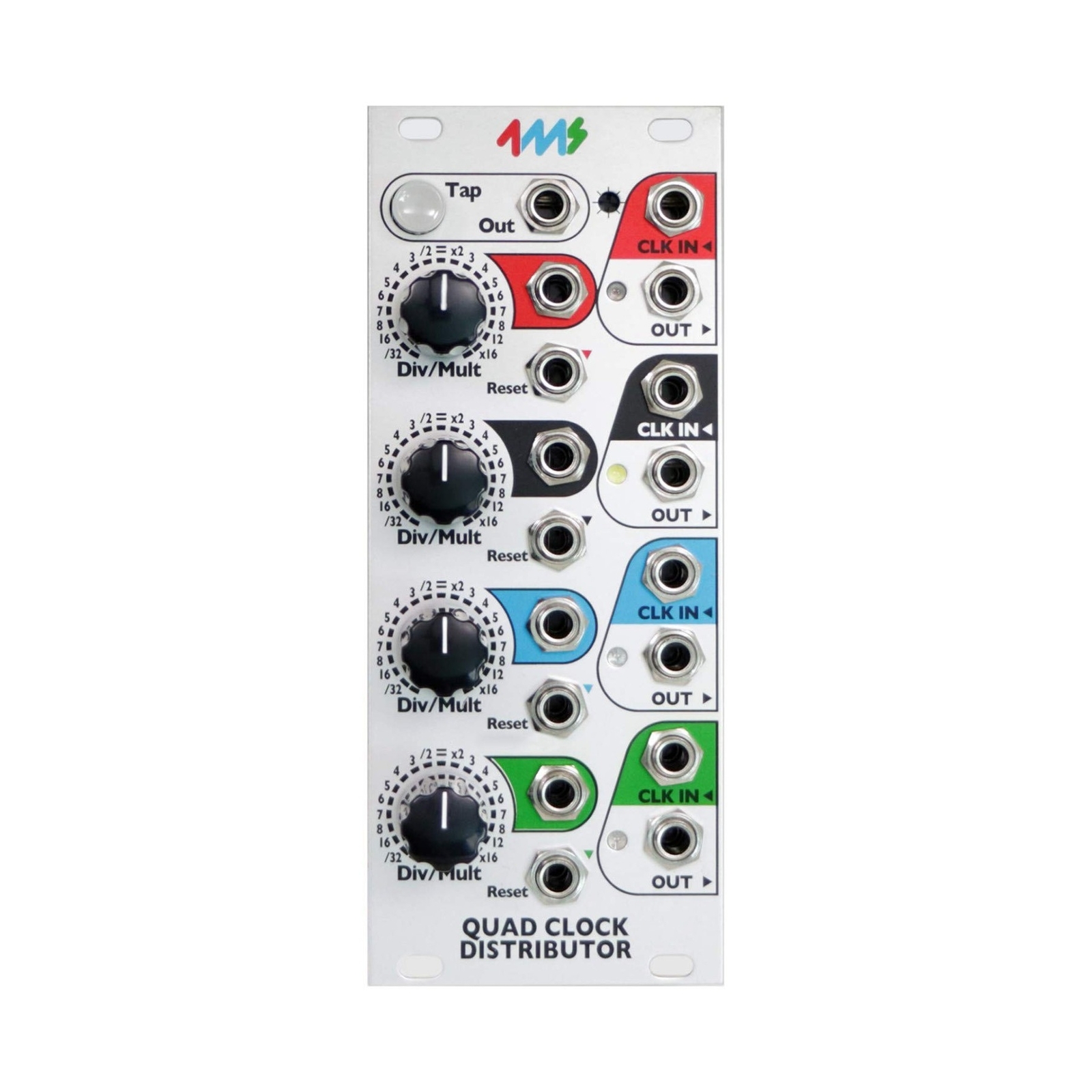
There’s a moment when you first patch in the 4ms QCD and tap in a tempo—just a few quick, nervous taps—and suddenly your entire modular system snaps to attention. It’s not flashy, not trying to be a sequencer or a brain, but it *organizes*. The QCD doesn’t just distribute clock; it becomes the nervous system’s pacemaker, the quiet conductor no one sees but everyone follows. Four channels of voltage-controlled clock division and multiplication, each with its own reset, CV control, and independent clock input, give you surgical precision over rhythm. You can chain them, cross-patch them, modulate them into stuttering polyrhythms or smooth, cascading subdivisions. It’s the kind of module that makes you realize how messy your timing was before—ghost triggers, drifting sync, clocks that never quite locked. The QCD fixes that. It’s not a rhythm generator in the way a sequencer is, but more like a master timekeeper with a mind of its own, capable of spawning complex, interlocking patterns from a single pulse.
And that tap tempo button? It’s mechanical, clicky, satisfying—like a metronome with attitude. Press it a few times, and the module locks in with rock-solid consistency, sending that tempo to five outputs: the tap clock itself and one per channel. The LED indicators pulse in time, each a tiny lighthouse blinking at its own rate, making it easy to see at a glance who’s dividing by three, who’s multiplying by five. The normalization chain—Tap to Red to Black to Blue to Green—means you can start simple and expand outward, daisy-chaining multiple QCDs or syncing in external clocks without rewiring everything. It’s a module designed by people who actually use modular systems, not just design them on paper.
But what really sets the QCD apart is how it behaves when you start patching it back into itself. Send a divided clock from channel 3 into the reset of channel 1, modulate a multiplier with an LFO, patch in a random voltage to shift divisions on the fly—suddenly you’re not just sequencing, you’re *breeding* rhythms. It’s generative, unpredictable, and deeply musical. The fact that it outputs 5V clock pulses—fully buffered and stable—means it can drive just about anything: drum modules, envelope generators, sample-and-holds, other clock dividers. It doesn’t care if you’re running a minimalist techno set or an ambient drone piece; it adapts, it obeys, it enhances.
Specifications
| Manufacturer | 4ms Company |
| Production Years | 2010–Present |
| Original Price | $239 |
| Module Size | 10 HP Eurorack |
| Depth | 26 mm |
| Power Consumption (+12V) | 88 mA max |
| Power Consumption (-12V) | 40 mA max |
| Power Consumption (+5V) | Not used |
| Clock Outputs | 5 (Tap, Red, Black, Blue, Green) |
| Clock Input Normalization | Tap → Red → Black → Blue → Green |
| Division Range | /32 to /1 per channel |
| Multiplication Range | x1 to x16 per channel |
| CV Control | Divide/Multiply CV input per channel |
| Reset Inputs | One per channel (trigger resets clock phase) |
| Tap Tempo Button | Manual tempo input with LED feedback |
| LED Indicators | One per channel, blinks at output clock rate |
| Output Signal | 5V pulse, square wave (default) |
| Expandability | Compatible with QCD Expander for pulse width, inversion, and envelope generation |
| PCB Header | For connection to Quad Pingable LFO (QPLFO) |
Key Features
The Tap Tempo That Thinks
Most tap tempo functions feel like an afterthought—something you use to match BPM and then forget. The QCD’s tap tempo is central to its identity. It’s not just a convenience; it’s a performance tool. The moment you tap in a tempo, the entire module locks to it, and the tap clock output stays active regardless of how the individual channels are clocked. That means you can have one channel running off an external clock, another dividing a random pulse, and still keep a steady master tempo running to your DAW or another module. The LED blinks in real time, giving immediate visual feedback, and the mechanical switch has just enough resistance to feel deliberate, not twitchy. It’s the kind of detail that makes you realize how much thought went into the user experience.
Self-Modulating Rhythm Engine
While the QCD is often described as a “clock distributor,” that label undersells it. Each channel is a full voltage-controlled divider/multiplier with CV input, reset, and independent clock input. This means you can patch channel 2’s output into channel 3’s clock input, modulate channel 1’s division with an envelope, and reset channel 4 from a snare hit—all at once. The result is a living, breathing rhythm generator that can create evolving, non-repeating patterns without any external sequencer. It’s not a preset machine; it’s a system you *play*, like a drum machine with no pads. The detented knobs snap to integer values, so you’re not guessing at divisions, but the CV input lets you glide between them for rhythmic sweeps or glitchy stutters. It’s this balance of precision and chaos that makes the QCD a favorite among experimental and live performers.
Expandability as Philosophy
The QCD was designed to grow. The optional QCD Expander isn’t just an add-on—it’s a transformation. Plug it in, and suddenly you gain pulse width control, inversion, and the ability to generate four independent envelopes via the QPLFO header. The expander turns the QCD from a clock module into a full rhythmic control center, capable of shaping not just timing but timbre and dynamics. But even without the expander, the module’s PCB includes a header for connecting to the Quad Pingable LFO, hinting at a deeper ecosystem of intermodular communication. This isn’t a closed box; it’s a node in a network, built for tinkerers and patch philosophers who want to push beyond standard clock distribution.
Historical Context
When the 4ms QCD arrived in the early 2010s, the Eurorack scene was exploding, but clock management was still a mess. Most racks relied on basic clock dividers, DAW sync, or drum machines with limited outputs. The idea of a centralized, intelligent clock distributor wasn’t new—studio musicians had used master clocks for decades—but translating that concept into a compact, voltage-controlled Eurorack module was. The QCD filled that gap with elegance. It wasn’t the first to offer multiple clock divisions, but it was among the first to make them musically flexible, with CV control, reset inputs, and intelligent normalization. It arrived just as modular users were moving beyond simple looping sequences into generative, reactive systems, and it became a staple in racks that valued rhythm as much as melody.
Its closest competitors at the time—like the Doepfer A-160 series or the Intellijel Metropolis—offered division and multiplication, but few matched the QCD’s combination of tactile control, expandability, and clean signal integrity. The QCD didn’t try to be a sequencer or a brain; it stayed focused on timing, and in doing so, it became essential. It also reflected 4ms Company’s broader design ethos: no frills, maximum utility, built for the long haul. Unlike flashier modules that chased trends, the QCD was a tool, not a toy. It found its way into experimental setups, live performance rigs, and studio racks where reliability and flexibility mattered more than flashy visuals or preset storage.
Collectibility & Value
The 4ms QCD has never been a “rare” module in the collector’s sense—production has been steady since 2010, and it’s still available new from the manufacturer and dealers. But its value lies in ubiquity born of excellence. A used QCD in good condition typically sells for $180–$220, while new units hold close to the original $239 MSRP. There’s little price inflation because supply meets demand, but also because the module hasn’t been discontinued or reissued in multiple revisions that create scarcity. What you see is what you get: a workhorse module that doesn’t depreciate much because it’s too useful to sell.
That said, condition matters. The tap tempo button is mechanical and, while durable, can wear out with heavy use. Owners report that sticky or unresponsive buttons are the most common failure, usually fixable with contact cleaner or replacement. The power draw—88mA on +12V, 40mA on -12V—is modest but not negligible in a large system, so check your case’s headroom before adding one. The module uses no +5V, which is a plus for older or budget power supplies. There are no known circuit-level failure points beyond standard electrolytic capacitor aging, but given the digital-heavy design, there’s little to “recap” anyway. The real maintenance is mechanical: keeping the jacks tight, the knobs secure, and the front panel free of stress cracks from over-tightened screws.
When buying used, test all four channels with a scope or logic probe if possible. Verify that the tap tempo locks consistently and that the LEDs respond correctly. Check for firmware updates—while the QCD doesn’t have a traditional firmware chip, 4ms has released minor PCB revisions that improve stability and expand functionality. Most importantly, confirm whether the QCD Expander is included; standalone expanders can cost nearly as much as a used QCD, and the two are often bought together. A full QCD + Expander setup is a premium configuration, commanding $400–$450 on the used market, and worth it for those who want the full rhythmic toolkit.
eBay Listings
![4MS QUAD CLOCK DISTRIBUTOR QCD : NEW : [DETROIT MODULAR]](https://i.ebayimg.com/images/g/To0AAeSwGCdod9cY/s-l1600.jpg)

![4MS BLACK FACEPLATES : NEW : [DETROIT MODULAR]](https://i.ebayimg.com/images/g/JrgAAeSwL05od8DU/s-l1600.jpg)
As an eBay Partner, we earn from qualifying purchases. This helps support our independent vintage technology research.