4MS QCD Expander (2014)
Plug this into your QCD and suddenly your clock isn’t just keeping time—it’s dancing, stumbling, breathing.
Overview
You know that moment when a synth module stops being a utility and starts feeling like a collaborator? The 4MS QCD Expander doesn’t just expand the Quad Clock Distributor—it rewires your relationship with rhythm. On paper, it’s an add-on: 12 HP of circuitry that bolts onto the back of the QCD via a ribbon cable. But in practice, it’s alchemy. It turns a precise, almost clinical clock distributor into something that swings, stutters, and surprises. Before the Expander, the QCD was already a favorite in Eurorack for its clean tap tempo and four independent CV-controllable dividers/multipliers. But it was rigid—square, in every sense. Add the Expander, and those square pulses start to breathe. You get delay, inversion, shuffle, and CV control over pulse width, all with tactile knobs and switches that make experimentation feel immediate, not menu-dived.
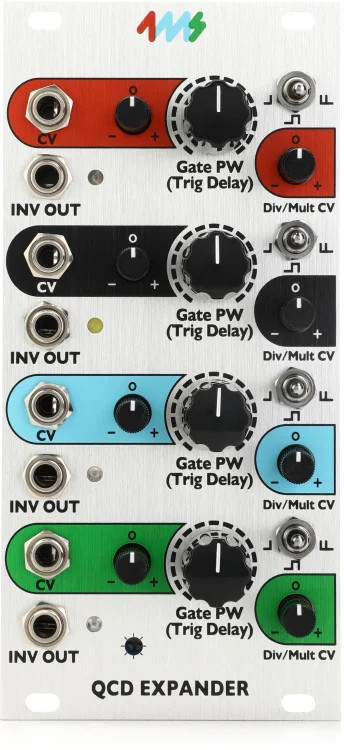
What makes the Expander special isn’t just the features—it’s how they’re integrated. Each of the four channels gains a secondary output labeled “INV OUT,” which can be switched into one of three modes: Delayed Trigger, Inverted Gate, or Shuffle (a mix of delayed and original trigger). That might sound dry, but patch it once and you’ll hear it: a hi-hat that alternates with a kick not because you programmed it, but because one gate inverts the other. A snare that fires slightly late, then earlier, modulated by an LFO nudging the delay time. The PW/DELAY knob per channel controls both the pulse width of the main QCD output and the delay time (or gate width, depending on mode) of the INV OUT—meaning a single knob can simultaneously tighten a kick drum’s click and stretch a percussive tail. And because each channel has an attenuverter for the Div/Mult CV input, you can use one channel’s output to subtly (or wildly) modulate another’s division ratio, creating cascading, evolving polyrhythms that feel alive.
It’s not a sequencer in the traditional sense, but it plays one in traffic. Patch the Expander’s outputs into drum modules, envelope triggers, or other clocked logic, and it becomes a generative rhythm engine. The Shuffle mode, in particular, is deceptively powerful—instead of relying on a global swing parameter, you get per-channel shuffle, so one voice can lurch forward while another stays rigid. That kind of asymmetry is gold for breaking out of grid-locked patterns. And because the Expander doesn’t generate its own clock—it piggybacks on the QCD’s architecture—it forces you to think in relationships, in feedback, in interplay. It’s modular thinking at its best: no presets, no screens, just patch cables and consequences.
Specifications
| Manufacturer | 4ms Company |
| Production Years | 2014–present |
| Original Price | $150 USD |
| Module Size | 12 HP Eurorack |
| Depth | 0.98" (25mm) |
| Power Consumption (+12V) | 44mA max |
| Power Consumption (+5V) | not used |
| Power Consumption (-12V) | 30mA max |
| Power Connector | 16-pin Eurorack power header |
| Included Cables | 10-to-16 pin power cable, 16-to-16 pin power cable (for QCD connection) |
| Expansion Interface | 16-conductor ribbon cable to QCD |
| Outputs per Channel | Main OUT (CV-controllable pulse width), INV OUT (switchable mode) |
| INV OUT Modes | Delayed Trigger, Inverted Gate, Shuffle (delayed + original trigger) |
| Control Per Channel | PW/DELAY knob, mode switch, CV input with attenuverter for PW/DELAY, Div/Mult CV attenuverter |
| Global Controls | LED brightness trimpot (front-panel accessible) |
| Kit Availability | Yes (intermediate to advanced soldering required) |
Key Features
Per-Channel Inverted Logic and Delay
The heart of the Expander’s magic is the INV OUT jack on each channel. It’s not just an inverted output—it’s a multimodal rhythm tool. In Delayed Trigger mode, it outputs a version of the main clock that’s slightly late, with the delay time set by the PW/DELAY knob or modulated via CV. This isn’t a fixed percentage like traditional swing; it’s a continuously variable delay, meaning you can go from tight ghost notes to full half-time echoes. In Inverted Gate mode, the output is a gate that’s high when the main output is low, creating natural alternation between two events—perfect for ping-pong delays, alternating filters, or classic disco kick-hat patterns. And because the inversion is level-shifted to stay within 0–5V, it plays nice with the rest of your system. The Shuffle mode combines both: it outputs the original trigger and the delayed one simultaneously, effectively creating a dual-pulse output that can drive two voices with staggered timing. This isn’t just swing—it’s structural asymmetry baked into the module’s DNA.
CV Control with Attenuverters
Most clock modules offer CV inputs, but few let you shape how that CV affects the signal. The Expander adds attenuverters to both the PW/DELAY CV input and the Div/Mult CV input on each channel. That means you can take a modulation source—say, an LFO or envelope—and not only apply it, but invert it and scale it precisely. Want one channel’s pulse width to widen as another’s division ratio speeds up? Patch channel 1’s output into channel 2’s Div/Mult CV, turn up the attenuverter, and tweak the polarity. The result is interdependent timing that evolves organically. This kind of cross-modulation is where the Expander shines: it doesn’t just respond to your system, it converses with it. The attenuverters eliminate the need for external mixers or offset modules, keeping patches compact and responsive.
Seamless Integration with QCD
The Expander isn’t a standalone module—it’s a symbiotic upgrade. It connects to the QCD via a ribbon cable that routes power, clock signals, and CV paths between the two. Once attached, the Expander’s controls directly influence the QCD’s behavior: the PW/DELAY knob adjusts the pulse width of the main QCD output, not just the Expander’s delayed signal. This tight integration means you’re not just adding features—you’re transforming the host module’s character. The QCD’s original tap tempo, reset inputs, and divider/multiplier knobs remain fully functional, now enhanced rather than replaced. And because the Expander mounts behind the QCD, it doesn’t take up extra panel space, making it ideal for skiff-friendly builds. It’s rare for an expansion to feel this cohesive; most feel tacked on. This one feels inevitable.
Historical Context
When the QCD Expander launched in 2014, Eurorack was shifting from boutique curiosity to mainstream force. Modules were getting smarter, but many still treated rhythm as a static foundation rather than a dynamic element. Clock distributors were utilitarian—clean dividers, maybe a tap tempo, often CV-controlled but rarely expressive. The QCD was already ahead of the curve with its four independent, voltage-controllable channels and cascading normalization. But the Expander pushed it into new territory by treating timing not as a grid but as a malleable medium. At a time when digital sequencers like the MakeNoise René or Expert Sleepers Temps Utile were offering complex pattern generation, the QCD + Expander combo stood out for its analog immediacy. No menus, no encoders, no screens—just knobs, switches, and patch cables shaping time in real time.
It arrived alongside a wave of modules that embraced generative, feedback-driven design—Mutable Instruments’ Marbles, ALM’s Pamela’s New Workout, 4ms’s own Quad Pingable LFO. But where those modules generated sequences or complex CV, the QCD Expander worked at the pulse level, manipulating the very fabric of timing. It wasn’t trying to replace sequencers; it was trying to make clocks more interesting. And in a format increasingly dominated by complex digital brains, the Expander’s purely analog, hands-on approach felt like a quiet rebellion. It didn’t compute rhythms—it coaxed them out through interaction, delay, and inversion. That philosophy resonated with a segment of users who wanted systems that surprised them, not just obeyed.
Collectibility & Value
The QCD Expander has never been rare—4ms Company maintained steady production, and the kit version kept it accessible to builders. But its collectibility isn’t about scarcity; it’s about utility. A used Expander in good condition typically sells for $120–$150, roughly matching its original $150 price. That stability speaks to its enduring relevance: it’s not a nostalgia piece, but a working tool. The kit version, aimed at intermediate to advanced builders, is still sought after by DIY enthusiasts, though pre-built units dominate the secondhand market. There are no known design flaws or chronic failures—the module is solid-state, with no moving parts beyond jacks and switches, and the ribbon cable connection to the QCD is reliable when properly seated.
That said, buyers should verify the module powers up cleanly and that all four channels respond to CV and knob adjustments. Because the Expander draws power through the QCD, a faulty ribbon cable or misaligned header can cause intermittent behavior or channel dropouts. Testing the INV OUT modes on each channel is essential—especially Inverted Gate mode, which should produce a clean, full-voltage inverse of the main output. The front-panel trimpot for LED brightness is a nice touch, but if it’s been over-adjusted, it could indicate internal tinkering. Otherwise, maintenance is minimal. There are no electrolytic capacitors to dry out, no firmware to update, and no calibration needed. It’s about as low-risk as Eurorack gets. If you own a QCD and want to unlock its full potential, the Expander isn’t just a nice-to-have—it’s the missing half of the conversation.
eBay Listings
As an eBay Partner, we earn from qualifying purchases. This helps support our independent vintage technology research.