4ms PEG
A dual envelope generator that dances to your clock, not your DAW’s timeline
Overview
Tap it, ping it, clock it—however you trigger it, the 4ms PEG doesn’t just respond, it redefines what an envelope can be. This isn’t your dad’s ADSR, lurking in the corner of a patch with predictable rise and fall. The PEG lives for rhythm, built around the idea that envelope timing should sync to a beat, not float in free time. Plug in a clock, tap the button, or send a trigger, and the envelope’s duration locks to the incoming pulse. That’s the core trick: the length of the envelope is set by the time between “pings.” Want a snappy decay on a kick? A slow, creeping swell on a pad that matches your tempo? The PEG makes it trivial, and then invites you to warp it further.
It’s a dual module, meaning two completely independent envelope generators on a single 20HP panel—compact by Eurorack standards, but not minimalist. Each side gives you full control over division and multiplication of the incoming clock, a shape knob with CV input, skew control, and multiple trigger modes. You can run one side to sync a filter sweep to your sequence, use the other to modulate amplitude in a polyrhythmic pattern, or patch them together for cascading, self-generating rhythms. The beauty is in the immediacy: you don’t need a sequencer to create evolving modulation. Just feed it a clock, tweak the div/mult knob, and you’re already in uncharted territory.
And while it’s digital under the hood—running firmware that’s been updated over the years (v4.3 for PCB v2.x, v4.2 for v1.x)—it doesn’t feel like a cold, clinical processor. It feels responsive, almost playful. Owners report that the internal sampling rate preserves a certain “analog” responsiveness, even if the math is happening in code. That said, not everyone’s charmed. Some purists on forums like Mod Wiggler have griped that the envelopes “feel digital in a bad way” compared to the smoother, more organic response of modules like MakeNoise’s Maths. But that’s a matter of taste. The PEG isn’t trying to emulate vintage voltage control—it’s building something new from the ground up, where timing precision and rhythmic flexibility trump analog warmth.
What really sets it apart is how it encourages happy accidents. Patch the End-of-Rise (EOR) or End-of-Fall (EOF) gate outputs to other modules, and suddenly your envelope is triggering other events, creating feedback loops, or driving secondary sequences. The OR output, which takes the higher of the two envelope voltages, turns the two channels into a kind of dynamic mixer. You can set one side to fast, staccato bursts and the other to slow, sweeping arcs, then let the OR gate decide which dominates in real time. It’s the kind of module that rewards patching blind, just to see what happens when you turn a knob all the way up.
Specifications
| Manufacturer | 4ms Company |
| Production Years | 2010s–present (exact start year not specified in research) |
| HP Size | 20 HP |
| Depth | 1.0 inches (26mm) |
| Power Requirements | Eurorack ±12V; jumper selectable for +5V source (onboard from +12V or from power supply) |
| Firmware Version (PCB v2.x) | v4.3 |
| Firmware Version (PCB v1.x) | v4.2 |
| Envelope Generator Count | Dual |
| Envelope Timing Source | External clock/triggers or tap tempo button |
| Divide/Multiply Range | /32 to x16 (integer steps) |
| Shape Control | 17 selectable envelope curves (asymmetrical and symmetrical, combinations of exponential, linear, logarithmic) |
| Skew Control | Adjusts rise/fall ratio with constant envelope length |
| Trigger Modes | AD (Attack/Decay), AR (Attack/Release), Quantized, Asynchronous, Cycle, Cycle Toggle |
| Tap Tempo | One button per channel |
| Gate Inputs | Ping (clock), QNT (Quantized), ASYNC (Asynchronous), T (Toggle cycle state) |
| Gate Outputs | ENV (scaled), +5V ENV (unscaled), EOR (End-of-Rise), EOF (End-of-Fall), OR (maximum of both channels) |
| CV Inputs | Div/Mult CV, Shape CV, Skew CV |
| Faceplate Material | FR4, 1.6mm (0.063in) thickness, conductive bottom for shielding |
| Color | Satin black with white artwork |
| Availability | Available as assembled module and DIY kit |
Key Features
Tempo-Locked Envelopes That Think in Beats
The PEG’s entire philosophy hinges on the idea that envelopes should be rhythmic, not just dynamic. Traditional envelope generators fire once per trigger and decay at a fixed rate, but the PEG treats the incoming clock as the master metronome. The time between pings defines the total envelope duration—attack, decay, release, whatever you’ve shaped it to be. This means if your clock slows down, the envelope stretches; if the clock speeds up, it tightens. It’s a simple concept, but it changes everything. Suddenly, your modulation is locked to the grid, making it perfect for syncopated filter sweeps, tempo-matched plucks, or evolving drone textures that breathe with the beat. And because you can divide or multiply the clock from /32 to x16, you can create polyrhythmic variations on the fly—say, a hi-hat pattern that triggers every third ping, or a bass swell that only happens on every 16th beat.
Shape, Skew, and the Art of Asymmetry
The shape knob isn’t just a smooth sweep from linear to exponential—it cycles through 17 distinct curves, some symmetrical, some wildly asymmetrical. At the extremes, you get sharp ramps or long tapers; in the middle, smoother arcs. But the real magic is in the skew control, which lets you adjust the ratio between rise and fall times without changing the overall envelope length. Turn the skew knob, and you can morph from a fast attack/slow decay to a slow attack/fast decay, all while keeping the total duration locked to the incoming clock. This is invaluable for sound design—imagine a snare hit that starts slow and snaps shut, or a pad that swells in quickly but lingers forever. And since both shape and skew have CV inputs, you can modulate them in real time, creating envelopes that evolve with each cycle.
Generative Patching with Gate Outputs and OR Logic
The PEG doesn’t just output envelopes—it outputs events. The EOR (End-of-Rise) and EOF (End-of-Fall) gate outputs fire when those phases begin or end, letting you chain envelopes, trigger other modules, or create feedback loops. Patch EOR from one channel to the ping input of the other, and you’ve got a self-oscillating rhythm generator. The OR output adds another layer: it continuously outputs the higher voltage of the two envelope channels. This turns the PEG into a kind of dynamic logic module, where the loudest or most active envelope takes control. It’s perfect for creating call-and-response patches, or for feeding into a VCA to let the more aggressive envelope dominate. These aren’t just utility functions—they’re compositional tools, encouraging patches that generate their own structure.
Historical Context
The 4ms PEG emerged during the mid-2010s Eurorack boom, when modular synthesis was shifting from boutique curiosity to mainstream creative tool. At the time, envelope generators were mostly variations on the classic ADSR—predictable, reliable, but limited in rhythmic flexibility. Modules like MakeNoise Maths had already begun to blur the lines between envelope, LFO, and logic, but the PEG took a different approach: full tempo synchronization as a first-class feature. While Maths offered more analog character and complex looping modes, the PEG leaned into digital precision and immediate rhythmic utility. It wasn’t trying to replace Maths—it was offering an alternative for producers who wanted envelopes that locked to a beat without needing external quantizers or complex clock dividers.
4ms, known for innovative designs like the Spectral Multiband Resonator and the Dual Looping Delay, built a reputation for modules that felt both experimental and practical. The PEG fit that mold: it wasn’t just a utility, but a compositional partner. Its release coincided with a growing interest in generative music and algorithmic composition, where modules that could create evolving patterns without constant manual intervention were highly prized. The PEG, with its dual channels, tap tempo, and feedback-friendly outputs, became a favorite for those building self-playing systems or exploring rhythmic complexity beyond standard sequencing.
It also arrived just before the wave of “pingable” or “clockable” envelope designs that would later appear in modules like the Acid Rain Maestro or Mutable Instruments Tides (in certain modes). While those modules added more features—multiple lanes, memory, complex modulation chains—the PEG remained notable for its simplicity and directness. It didn’t try to do everything; it did one thing exceptionally well: making envelopes that dance to your clock.
Collectibility & Value
The 4ms PEG isn’t a rare bird, but it’s not common enough to be considered a commodity. It’s still in production, available both as a pre-built module and as a DIY kit from retailers like Thonk, so you won’t find it commanding vintage premiums like a discontinued Doepfer or a rare Analogue Solutions unit. That said, it holds its value well—new units typically sell for around $300–$350, and used ones go for $200–$275 depending on condition and seller. The kit version is significantly cheaper, appealing to builders who want to save money or enjoy the assembly process.
Because it’s a modern digital module with firmware updates, condition is less of a concern than with analog gear. There are no capacitors to dry out, no pots to crackle—just a PCB, a few jacks, and a microcontroller. The main failure points are mechanical: damaged jacks from over-tightened patch cables, or issues with the power jumper if it’s set incorrectly. The faceplate is FR4 with a conductive backing for shielding, which is durable but can scratch if mishandled. Firmware can be updated, so even older units can run the latest code (v4.3 for PCB v2.x), ensuring compatibility and stability.
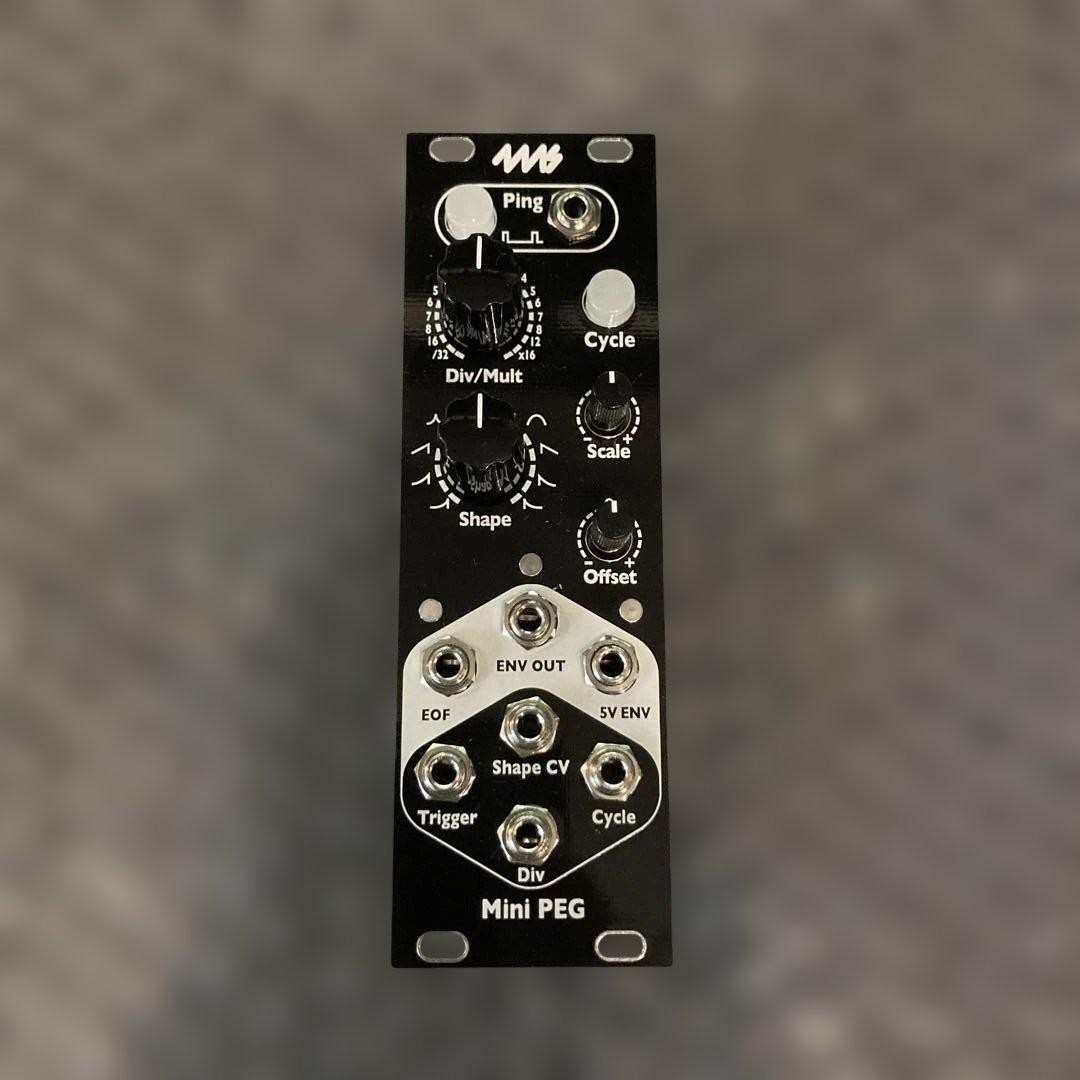
If you’re buying used, check that both channels respond to pings, that the tap tempo buttons work, and that the CV inputs modulate as expected. Since the module relies on precise timing, any jitter or missed triggers could indicate a firmware or hardware issue. But overall, it’s a robust design—owners report years of trouble-free use. The real collectibility factor isn’t scarcity, but utility. For producers focused on rhythmic modulation, generative patches, or tempo-synced sound design, the PEG isn’t just a module—it’s a workflow essential. And while the Mini PEG (a single-channel version with extended div/mult ranges) exists, many users still prefer the full dual-channel layout for its flexibility.
eBay Listings



As an eBay Partner, we earn from qualifying purchases. This helps support our independent vintage technology research.