4ms Mini PEG (2022–)
A tiny gatekeeper of rhythmic chaos, turning clock pulses into breathing, morphing envelopes that feel alive
Overview
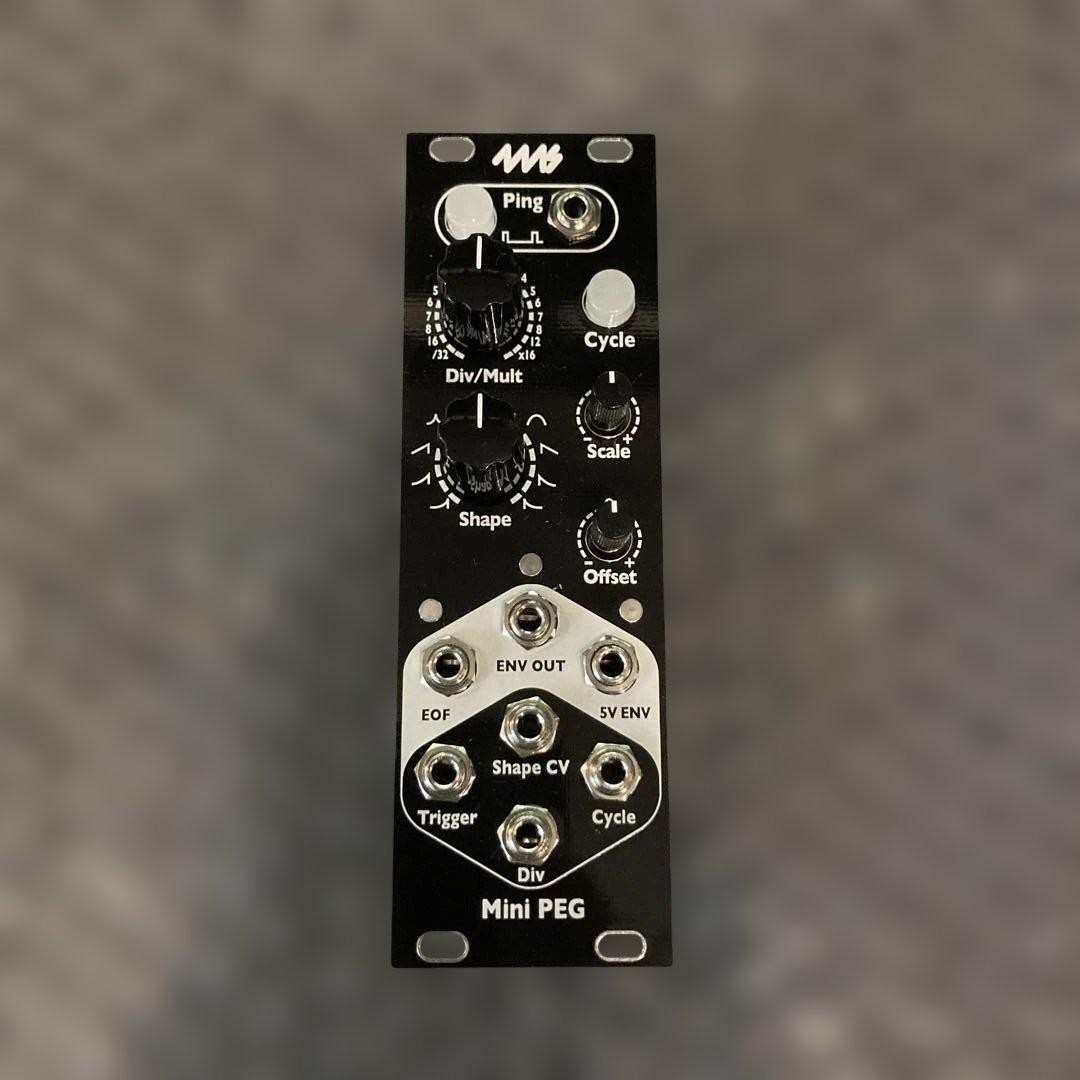
You don’t so much program the 4ms Mini PEG as you negotiate with it. It doesn’t bark out rigid ADSR commands like a dutiful synth module—it breathes, stutters, stretches, and syncs with the nervous system of your rack. The moment you patch in a clock and hear that first envelope swell and decay in perfect lockstep, you realize this isn’t just an envelope generator. It’s a rhythmic organism. Built as a streamlined, single-channel descendant of the cult-classic dual-channel PEG, the Mini PEG strips away the sprawl but keeps the soul: envelopes shaped by incoming “pings,” whether from a clock, trigger, or the satisfying tap of its front-panel button. It’s the kind of module that makes you rewire your whole patch just to follow where it wants to go.
Where the original PEG was a sprawling laboratory experiment in generative modulation, the Mini PEG is its garage-band offspring—leaner, cheaper, and built for action. At 8HP, it’s half the width and far more accessible, yet it doesn’t feel like a compromise. It runs at a 12-bit, 40kHz sample rate, preserving the organic digital texture that made the PEG famous. That means the envelope isn’t a smooth analog glide; it’s stepped, slightly granular, with a character that feels both precise and unpredictable. It can be an envelope, sure, but leave the cycle button on and it becomes a clock-synced LFO with a personality all its own—wobbling filters, panning stereo fields, or modulating pitch with a lurching, humanized rhythm that no triangle wave could ever fake.
And then there’s the shape. Nine internal waveshapes—combinations of exponential, linear, logarithmic, and interpolated curves—are blended smoothly via the Shape knob, with full CV control. This isn’t just attack and release; it’s morphing contour alchemy. Turn the knob and the envelope doesn’t just speed up or slow down—it warps, from snappy transients to long, drawn-out sighs, from punchy drum triggers to slow, pulsing undulations. It’s the difference between drawing a straight line and sketching a living thing.
Specifications
| Manufacturer | 4ms Company |
| Production Years | 2022– |
| Original Price | $159 |
| Format | Eurorack |
| Width | 8HP |
| Depth | 24mm (0.95") |
| Power Connection | 16-pin Eurorack power header |
| Power Consumption (+12V) | 55mA |
| Power Consumption (-12V) | 30mA |
| Power Consumption (5V) | 0mA |
| Envelope Outputs (ENV OUT) | Maximum voltage range: -9.4V to +9.4V |
| Maximum Amplitude (ENV OUT) | 9.5V peak-to-peak |
| 5V ENV Output | 0V to +5V, independent of scale/offset |
| Frequency Response | +/-0.1dB DC to 1kHz, -1.0dB@2.5kHz, -2.0dB@4kHz |
| Sample Rate | 40kHz |
| Resolution | 12-bit |
| Clock Range (Period) | 29.16 hours to 250μs (4kHz) |
| Div/Mult Range | /32 to x16 |
| CV Input Range (Div/Mult, Shape) | -5V to +5V |
| Gate Input Threshold | Rising edge at 2.5V |
| Offset Range | -9.4V to +9.4V |
| Trigger Modes | Quantized Trigger, Async Trigger, Async Gate |
| EOF Output Configurations | End-of-Fall, End-of-Rise, Half-Rise, Tap Clock Out |
Key Features
Ping-Driven Rhythm Engine
The Mini PEG doesn’t wait for you to set time values—it listens. The length of each envelope is determined by the time between incoming clock pulses, or “pings.” This means every envelope is inherently synced to your system’s tempo, whether from a sequencer, drum machine, or another module. The front-panel ping button doubles as a tap tempo, letting you manually trigger or set timing on the fly. But the real magic is in the Div/Mult knob, which scales the incoming clock from division (/32) to multiplication (x16), all with CV control. Want a subharmonic pulse that drags behind the beat? Divide by 8. Need a frantic, skittering modulation that races ahead? Multiply by 4. This isn’t just timing—it’s rhythmic counterpoint, built into the DNA of the envelope.
Shape as Expression, Not Just Control
Most envelope generators offer curve or skew controls, but the Mini PEG’s Shape knob feels more like a performance tool. It doesn’t just adjust a single parameter—it crossfades between nine internal waveshape combinations, blending exponential, linear, and logarithmic responses in ways that transform the feel of a sound. A bass drum can go from tight and clicky to blooming and resonant with a twist. A filter sweep can lurch forward or ease in gently. Because the shape is voltage-controllable, you can modulate it in real time with an LFO, sequencer, or random source, making envelopes that evolve over time. It’s rare for a single knob to have this much expressive weight, but here, it’s the difference between mechanical repetition and something that feels sentient.
Scale, Offset, and the Art of Modulation Tuning
Two often-overlooked but critical controls—Scale and Offset—turn the Mini PEG into a precision modulation source. The Scale knob acts as an attenuverter for the main envelope output, letting you invert and reduce the signal’s amplitude. This is essential when patching into parameters that respond negatively to CV, like a filter cutoff that should close instead of open. The Offset knob, meanwhile, shifts the entire envelope’s DC bias from -9.4V to +9.4V, allowing you to reposition the modulation range anywhere within the bipolar voltage spectrum. Need a 3V–7V envelope to drive a VCA that only responds in that range? Offset and Scale make it trivial. These aren’t just utilities—they’re what let the Mini PEG integrate seamlessly into complex patches without additional utility modules.
Historical Context
The Mini PEG didn’t arrive in a vacuum—it’s the distilled essence of a module that had already achieved near-mythical status. The original 4ms Pingable Envelope Generator (PEG), introduced years earlier, was a beast: dual channels, massive panel, and a cult following among experimental modular users for its ability to generate self-modulating, feedback-rich rhythmic textures. But it was also expensive and space-hungry. The Mini PEG, announced at Superbooth 2022, was 4ms Company’s answer to demand: a compact, single-channel version that retained the core philosophy—clock-driven envelopes with deep morphing capabilities—but in a format that wouldn’t eat half your rack. It arrived during a period when Eurorack was shifting from boutique curiosity to mainstream adoption, and users wanted powerful, intelligent modules that didn’t require a mortgage. Competitors like Make Noise (MATHS) and Intellijel (Dual ADSR) offered flexible envelope/LFO hybrids, but none tied envelope timing so directly to external rhythm. The Mini PEG carved its niche as the go-to for tempo-locked, generative modulation—less a utility, more a collaborator.
Collectibility & Value
Despite being a recent release, the Mini PEG has settled into a stable secondhand market, reflecting its status as a modern essential rather than a speculative collectible. New units sold for $159 at launch in late 2022, and that price has held firm through authorized dealers. On the used market, expect to pay between $120 and $140 depending on region and condition. European buyers often see prices in the €115–€130 range, with faster shipping offsetting the slight premium. Unlike vintage gear, there are no known manufacturing flaws or batch issues—the module is solid-state, digitally controlled, and built to modern Eurorack standards. Failures are exceedingly rare, though service technicians note that the push-button switches (ping and cycle) can accumulate dust over years of heavy use, potentially leading to intermittent triggering. This is easily remedied with contact cleaner, not a board replacement. The biggest risk isn’t mechanical—it’s mispatching. Because the module outputs up to 9.5V peak-to-peak, sending the main ENV OUT directly into a sensitive input (like a microprocessor CV input) without attenuation can cause damage. Owners report using it safely for years, but the advice stands: know your levels. For buyers, the real check is power draw—verify the module pulls around 55mA on +12V and 30mA on -12V. Anything significantly higher could indicate a short. Otherwise, it’s about as low-risk as Eurorack gets. Given its utility and compact size, it’s likely to remain a staple in racks for years, but don’t expect vintage markup—this is a tool, not a trophy.
eBay Listings


As an eBay Partner, we earn from qualifying purchases. This helps support our independent vintage technology research.