4ms DLD (2015–)
Two channels of pristine, clock-synced looping delay that don’t degrade, don’t wobble, and don’t pretend to be something they’re not—just pure digital memory with surgical precision and deep, evolving textures.
Overview
There’s a moment when you first patch in the 4ms DLD and set a long loop—three minutes of silence, then a single plucked oscillator tone hanging in the air, repeating with such crystalline clarity it feels like it was always there, like an echo from another dimension. No wow, no flutter, no saturation smear. Just clean, sample-accurate repetition, locked to your system’s tempo with the rigidity of a quartz oscillator. The DLD doesn’t try to be vintage. It doesn’t want to sound like a Binson or a Roland Space Echo. It wants to be the opposite: a modern, high-fidelity looping delay that treats time like architecture, not weathering tape.
At its core, the DLD is two independent 16-bit digital delays, each capable of up to 2 minutes and 54 seconds of loop time at 48kHz when running in the default mode—nearly three minutes of audio memory per channel, which in Eurorack is borderline absurd. That kind of headroom wasn’t common when the DLD launched around 2015, and even now, few modules offer that depth without resorting to SD cards or external storage. It’s not a looper in the traditional sense—there’s no record/start/stop button sequence—but it loops by default, constantly recording into a buffer. You don’t capture a phrase; you *define* it by setting the loop length via tempo-synced divisions, then freeze it with Infinite Hold. Once locked, the loop plays back perfectly, and you can shift its start and end points in real time using the Feedback knob while holding Infinite Hold—a feature called “Windowing” that lets you scrub through older material buried deep in the buffer, uncovering sonic artifacts you didn’t even know you’d recorded.
The DLD sits in a sweet spot between delay and granular playback, especially when you start modulating the Time parameter with CV. Because the delay time is quantized to musical divisions (1/8ths, whole beats, up to 32 bars), you can dial in polyrhythms with surgical precision. Want a second loop that runs in quintuplets against your main sequence? Set the Time switch to “=” and turn the knob to 5. Need a micro-delay texture at 1/16th note? Flip the switch down to “1/8” and adjust accordingly. Or bypass the quantization entirely by holding the Infinite Hold button and twisting the Time knob—suddenly, you’re in free-run mode, where the delay time becomes continuous, perfect for sweeping effects or ambient smear.
Specifications
| Manufacturer | 4ms |
| Production Years | 2015– |
| Original Price | $415 |
| Module Size | 20HP Eurorack |
| Depth | 0.98" (25mm) maximum with power cable |
| Power Consumption | +12V: 188mA max, -12V: 48mA max, +5V: not used |
| Sampling Rate | 48kHz |
| Bit Depth | 16-bit default, 24-bit selectable via jumper |
| Maximum Loop Time | 174 seconds (2:54) per channel at 16-bit, 88 seconds at 24-bit |
| Audio Input Range | 0Hz (DC) to 24kHz, 16.8V peak-to-peak max before clipping |
| Audio Output Range | 0Hz (DC) to 24kHz, +10.5V to -10.5V max, soft limiting |
| Input Coupling | AC or DC selectable via jumper |
| Feedback Range | 0% to 110% |
| Delay Level Control | Independent of mix |
| Clock Input | Accepts external clock, trigger, or audio-rate signal |
| Clock Output | Main Ping, Loop A, Loop B (0V to 8.2V, low jitter) |
| CV Inputs | Time, Feedback, Level, Delay Feed, Reverse, Infinite Hold |
| Send/Return | Per channel, for external processing in feedback path |
| Firmware Updates | Via audio file playback into input |
| Included Accessories | 16-to-16 pin power cable, 4 M3 knurled screws |
Key Features
Time as a Musical Grid
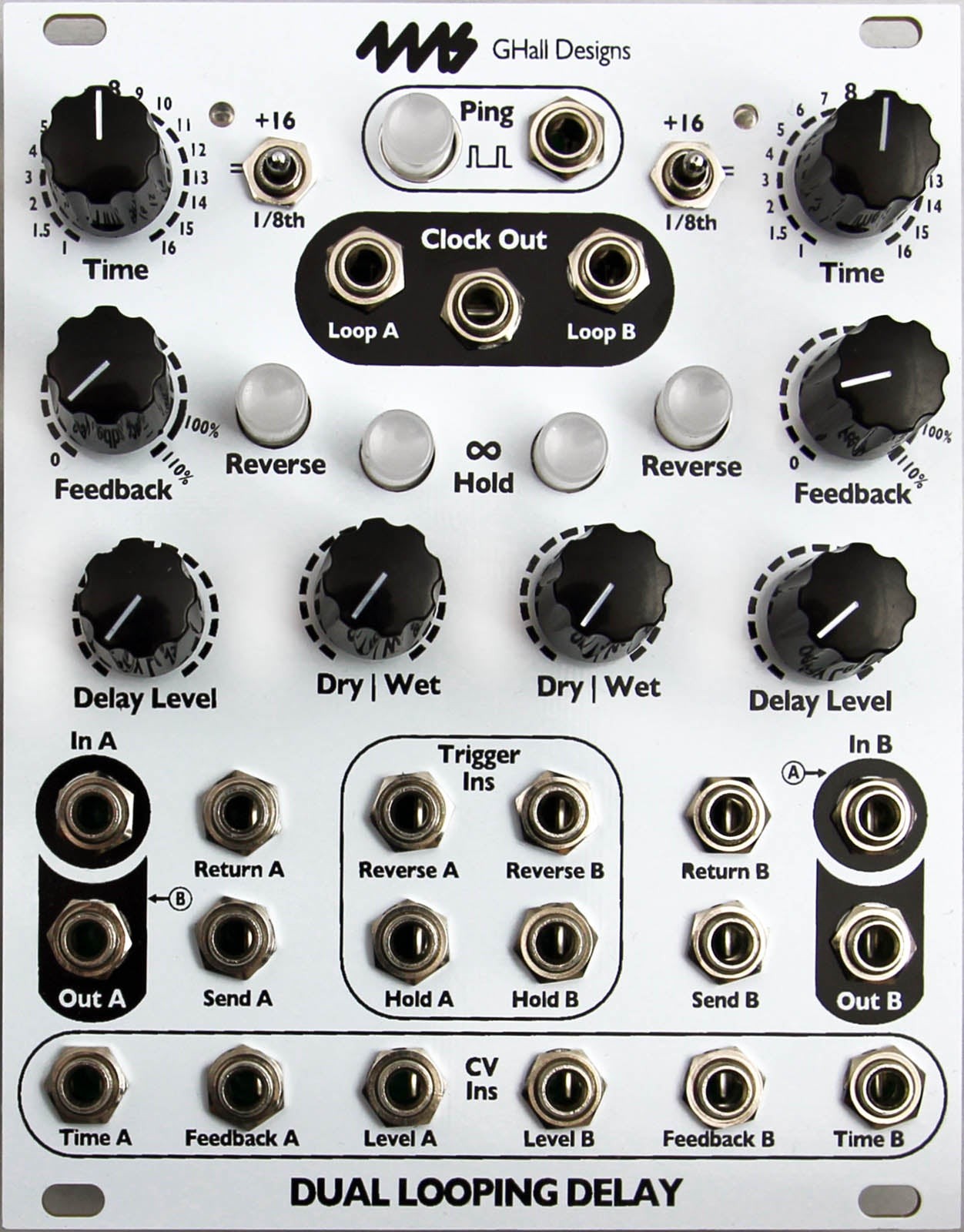
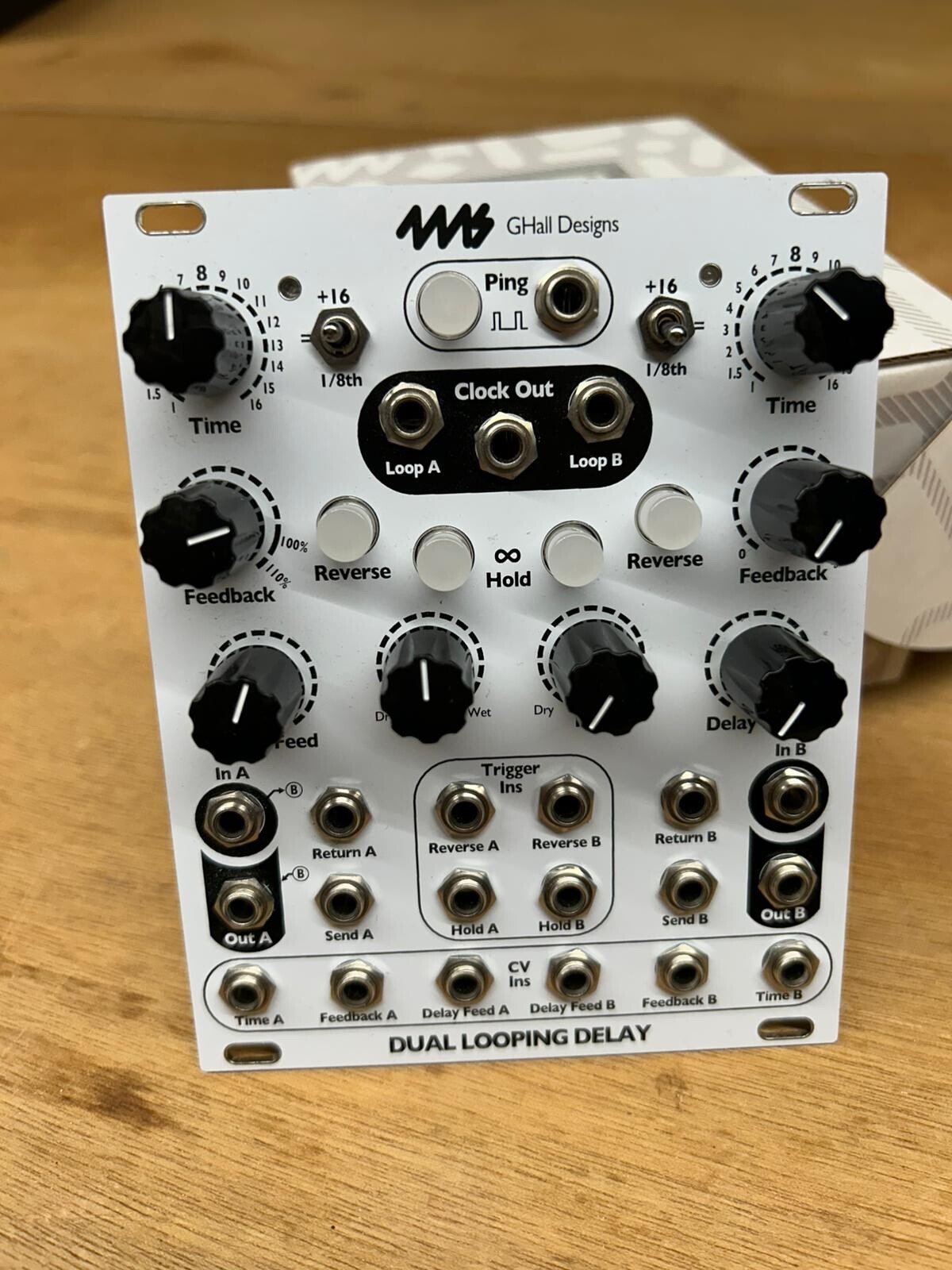
The DLD doesn’t measure delay time in milliseconds. It measures it in beats. The Time knob isn’t a continuous dial—it’s a 17-position switch that sets divisions relative to the master clock (Ping). With the Time switch in the center (“=”), the knob sets the loop length directly: 1 beat, 2 beats, up to 16. Flip it up to “+16”, and it adds 16 beats—so turning the knob to 4 gives you a 20-beat loop. Flip it down to “1/8”, and it divides the value by 8, letting you dial in micro-rhythms like ⅛ or ¾ of a beat. This design forces you to think in musical terms, making it effortless to create polyrhythmic delays that lock into your sequencer. But it’s not rigid: hold the Infinite Hold button and twist the Time knob, and you’re in unquantized mode, where the delay time becomes smooth and continuous. It’s a rare module that gives you both precision and fluidity in the same control.
Windowing: Digging Through Sonic Archaeology
Most loopers erase the past. The DLD remembers everything. Even when you’re not in Infinite Hold, the module is constantly recording into a circular buffer. When you engage Infinite Hold, it locks the current loop in place—but the rest of the buffer is still there, stretching back up to three minutes. By holding Infinite Hold and turning the Feedback knob, you “window” into that buffer, shifting the loop’s start and end points. This means you can suddenly pull in audio you played *before* you even started looping—maybe a bass sequence from two minutes ago, or a filtered noise sweep you thought was gone forever. It’s like time travel for your patch, and it makes the DLD feel less like a delay and more like a living archive of your session.
Send/Return as a Creative Playground
Each channel has its own Send and Return jacks, letting you patch external effects into the feedback path. This is where the DLD stops being just a delay and starts becoming a sound design engine. Run the feedback through a filter, and you can create evolving textures where each repeat gets darker or brighter. Patch in a wavefolder, and the repeats fold in on themselves, generating complex harmonics. Use a second delay, and you’ve got a feedback matrix that can spiral into self-oscillation or ambient drones. The Delay Level knob is key here—it controls how much signal enters the loop, independent of the dry/wet mix. So you can keep the output clean while feeding a distorted or compressed version back into the memory. It’s a subtle but powerful distinction that gives you surgical control over the loop’s evolution.
Historical Context
When the DLD arrived in the mid-2010s, Eurorack was exploding with boutique delay modules—many of them emulating analog or tape-based textures, complete with pitch wobble, saturation, and noise. The DLD stood out by doing the opposite: it embraced its digital nature. Inspired by high-end studio delays like the Lexicon PCM42 and the Eventide H3000, it offered pristine, sample-accurate repeats with none of the coloration. At a time when “character” was king, the DLD said, “What if clarity is the character?”
It also arrived alongside a wave of modules that treated time as a manipulatable dimension—MakeNoise’s Phonogene, Mutable Instruments’ Clouds (later Plaits), and eventually the Qu-Bit Nebulae. But while those modules leaned into granular or spectral processing, the DLD stayed focused on rhythmic precision and long-form looping. It wasn’t trying to mangle sound; it was trying to preserve it, then let you sculpt it over time. Paired with the 4ms QCD (Quad Clock Distributor), it became a centerpiece of tempo-synced modular rigs, allowing entire systems to lock into a single timebase with sample-level accuracy. Firmware updates—delivered via audio file—added features like 24-bit recording, Ping Lock (which lets each channel lock to a different Ping time), and de-jittering algorithms for smoother external clock tracking. It was a module built to evolve, not just sit on a shelf.
Collectibility & Value
The DLD has never been cheap—$415 new—and it hasn’t depreciated. On the used market, expect to pay $300–$375 depending on condition, with units in excellent shape often selling for close to retail. It’s not a rare module, but it’s not common either, and demand remains steady among advanced modular users. There are no major failure points, but firmware updates can be finicky—some users report issues booting into bootloader mode with older or underpowered Eurorack PSUs. The process requires holding Ping and both Reverse buttons while powering on, and if the power supply has a slow ramp-up or noise on startup, it might not trigger. A robust, modern PSU solves most of these issues.
The biggest thing to check when buying used: firmware version. Units shipped with v3, but v5 added critical features like 24-bit recording, Ping Lock, and de-jittering. Updating is possible, but it requires playing a .wav file into the input, so make sure the audio input and output jacks are functional. Also, verify the jumper for 24-bit mode is correctly set if that’s a feature you want. Cosmetic wear is common—knobs can get scratched, and the faceplate (available in white or black) can show scuffs—but the module is built like a tank. No serviceable parts inside for the average user; the PCB is dense SMD, and repairs should be left to professionals.
It’s not a beginner module. The interface is minimal, and the manual is essential. But for those who dive in, it becomes indispensable. It’s the kind of module you don’t realize you need until you hear it—then you can’t imagine a system without it.
eBay Listings

As an eBay Partner, we earn from qualifying purchases. This helps support our independent vintage technology research.