4ms Quad Clock Distributor (2013–)
A tap tempo button that doesn’t just keep time—it starts a rhythm war across four channels of voltage-controlled chaos.
Overview
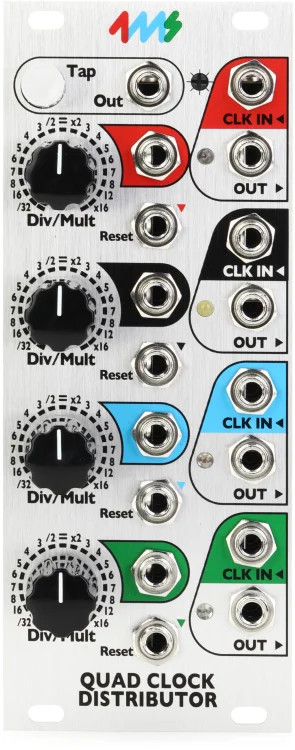
That first tap of the tempo button feels like throwing a stone into still water—ripples spread, but here, they don’t fade. They multiply, divide, collide. The 4ms Quad Clock Distributor (QCD) doesn’t just distribute clock signals; it weaponizes them. You expect a utility module, something to keep your sequencers in line, and instead you get a rhythmic reactor core with four independent fission chambers. Each channel divides or multiplies an incoming clock from /64 to x64, lets you modulate that ratio with CV, reset its phase with a trigger, and pass its output down the line—all while blinking its tempo in real time with crisp LEDs. It’s a master clock, yes, but also a pattern generator, a sync engine, and a feedback playground, all wrapped in a modest 10 HP Eurorack module.
What sets the QCD apart isn’t just its range or flexibility—it’s how it refuses to stay in its lane. Most clock dividers sit quietly at the top of a patch, dutifully metronoming. The QCD, though, begs to be patched into itself, to have its reset outs feeding back into its CV inputs, to be modulated by its own outputs or by external chaos. It’s designed for rhythmic evolution, not just repetition. The normalization chain—Tap → Red → Black → Blue → Green—means you can start with one external clock or tap tempo and cascade it through all four channels, each transforming the timing in real time. Want one channel at /3, another at x5, and a third skipping beats via CV modulation? Done. Need to lock two drum modules to the same pulse while sending a third into polyrhythmic drift? The QCD doesn’t flinch.
And then there’s the tap tempo. It’s not an afterthought. It’s central. Even if the rest of the module is slaved to an external clock, the Tap output keeps pulsing at your manually set tempo—perfect for triggering a lead line or accent that stays locked to your human feel while everything else dances around it. That tactile button, slightly recessed but satisfyingly clicky, turns performance into composition. You’re not just setting a BPM; you’re conducting.
Specifications
| Manufacturer | 4ms Company |
| Production Years | 2013– |
| Original Price | $239 |
| Width | 10 HP |
| Depth | 26 mm |
| Power | 48 mA +12V (external 5V), 88 mA +12V (internal 5V) |
| Power | 40 mA -12V |
| Power | 41 mA 5V (external), 0 mA (internal) |
| Power Connector | 16-pin Eurorack power header |
| Inputs | Clock In (per channel), Reset In (per channel), CV In (Div/Mult per channel) |
| Outputs | Clock Out (per channel), Tap Clock Out |
| Normalization | Clock inputs normalized Tap → Red → Black → Blue → Green |
| Divide Range | /64 to /1 (integer divisions) |
| Multiply Range | x1 to x64 (integer multiples) |
| Control | Detented knobs for Div/Mult per channel, Tap Tempo button |
| Indicators | LEDs per channel indicating output clock tempo |
| Expandable | Yes, via QCD Expander (QCDEXP) |
| Special Features | Onboard +5V generation jumper, PCB header for QPLFO integration, Daisy-chainable via Tap Out |
Key Features
Four Channels of Rhythmic Autonomy
Each of the QCD’s four channels operates as a standalone clock processor, capable of dividing or multiplying any incoming signal from /64 to x64. The detented knobs snap to whole-number ratios, making it easy to dial in precise divisions or multiplications without hunting. But the real magic is in the CV input for each channel’s Div/Mult parameter. Patch in an LFO, an envelope, or even a random source, and you’re no longer locked to static timing. A slow sine wave on the CV input can make a channel drift between /4 and /5, creating a lopsided groove that feels almost human. A stepped sequencer can jump a channel through prime-number divisions, generating phasing patterns that take minutes to realign. And because each channel has its own reset input, you can force phase alignment at any point—say, syncing a snare hit to the downbeat while letting hi-hats run free.
Tap Tempo as a Creative Tool
Most modules treat tap tempo as a convenience feature. The QCD treats it as a compositional element. The Tap output sends a clean, buffered pulse at the manually tapped rate, regardless of what the other channels are doing. This means you can tap in a tempo, send that to a lead synth or sample trigger, and then let the other channels run at wild divisions—say, /7 or x3—so your main melody stays locked to your feel while the rhythm section spirals outward. It’s a subtle but powerful way to maintain musical coherence in otherwise chaotic patches. And because the tap tempo is always active, even when channels are slaved externally, you’re never locked into a machine’s rigid timing.
Expandability and Patch Integration
The QCD wasn’t meant to live alone. The QCD Expander (QCDEXP) adds pulse width control, inverted gate outputs, and attenuverters for the CV inputs—turning rhythmic division into full-on waveform sculpting. Suddenly, you’re not just changing tempo ratios; you’re shaping the duration of triggers, creating ghost notes, or generating complementary rhythms from inverted pulses. There’s also a PCB header that links to the Quad Pingable LFO (QPLFO), letting you use the QCD’s clocks to generate complex, skew-able envelopes. This kind of deep integration is rare in utility modules and speaks to 4ms’s philosophy: build tools that talk to each other, not just to your rack.
Historical Context
When the QCD launched in the early 2010s, Eurorack was exploding, but clock management was still an afterthought for many builders. Most racks relied on a single master clock—often a basic LFO or MIDI-to-CV converter—with dividers tacked on as needed. The QCD arrived as a response to that limitation, offering not just more outputs, but more intelligence. It landed alongside modules like the Mutable Instruments Marbles and the Doepfer A-160 series, but where those focused on randomness or simple division, the QCD embraced control and interactivity. It wasn’t just a distributor; it was a conductor.
4ms had already built a reputation for clever, compact utilities—the Dual Looping Delay, the Spectral Multiband Resonator—but the QCD was different. It was accessible, affordable, and immediately useful, yet deep enough to reward years of exploration. It didn’t try to replace complex sequencers or rhythm computers; it made them better. By giving each channel independent sync options and CV control, it turned clock distribution into a performance instrument. In a scene increasingly obsessed with generative music, the QCD offered a middle path: structured enough to feel musical, flexible enough to surprise.
Collectibility & Value
The QCD has held its value remarkably well, trading consistently between $180 and $240 used, depending on condition and region. Unlike some boutique modules that inflate due to scarcity, the QCD remains widely available new, which keeps the used market honest. That said, units in pristine condition with no bent jacks or scratched faceplates often command closer to retail, especially when bundled with the QCD Expander. The module has gone through minor revisions—Rev 2 is the current standard—but there are no major functional differences that affect collectibility. It’s not a “grail” module, but it’s a “must-have” for many, which means it rarely stays on the market long.
Failures are rare but not unheard of. The most common issue is power-related: the jumper for +5V sourcing (external vs. onboard generation) can be misconfigured, leading to instability or excessive draw on the +12V rail. Technicians note that units set to generate +5V onboard pull 88 mA from +12V instead of 48 mA, which can overload smaller power supplies. Always check the jumper setting before installing. The tap tempo button is mechanical and, while durable, can wear out with heavy use—especially in live rigs. LEDs rarely fail, but if one goes dark, it’s usually a cold solder joint on the PCB, not a dead component. No catastrophic failure modes have been reported, and the module doesn’t rely on obsolete or fragile ICs, so long-term reliability is high.
Buying advice? Test every channel’s division and multiplication range, verify the CV modulation responds smoothly, and check that the reset inputs actually restart the clock phase. Make sure the tap tempo LED blinks cleanly and that the Tap output works independently of external clocks. If the unit comes with an expander, test pulse width control and inverted gates. Otherwise, the QCD is about as low-risk as Eurorack gets—no firmware, no hidden menus, just knobs, jacks, and blinking lights doing exactly what they should.
eBay Listings


As an eBay Partner, we earn from qualifying purchases. This helps support our independent vintage technology research.