4ms Dual EnvVCA (2020–)
Two channels of no-nonsense analog envelopes and VCAs that do everything from glacial drones to audio-rate chaos—without pretending to be more than they are.
Overview
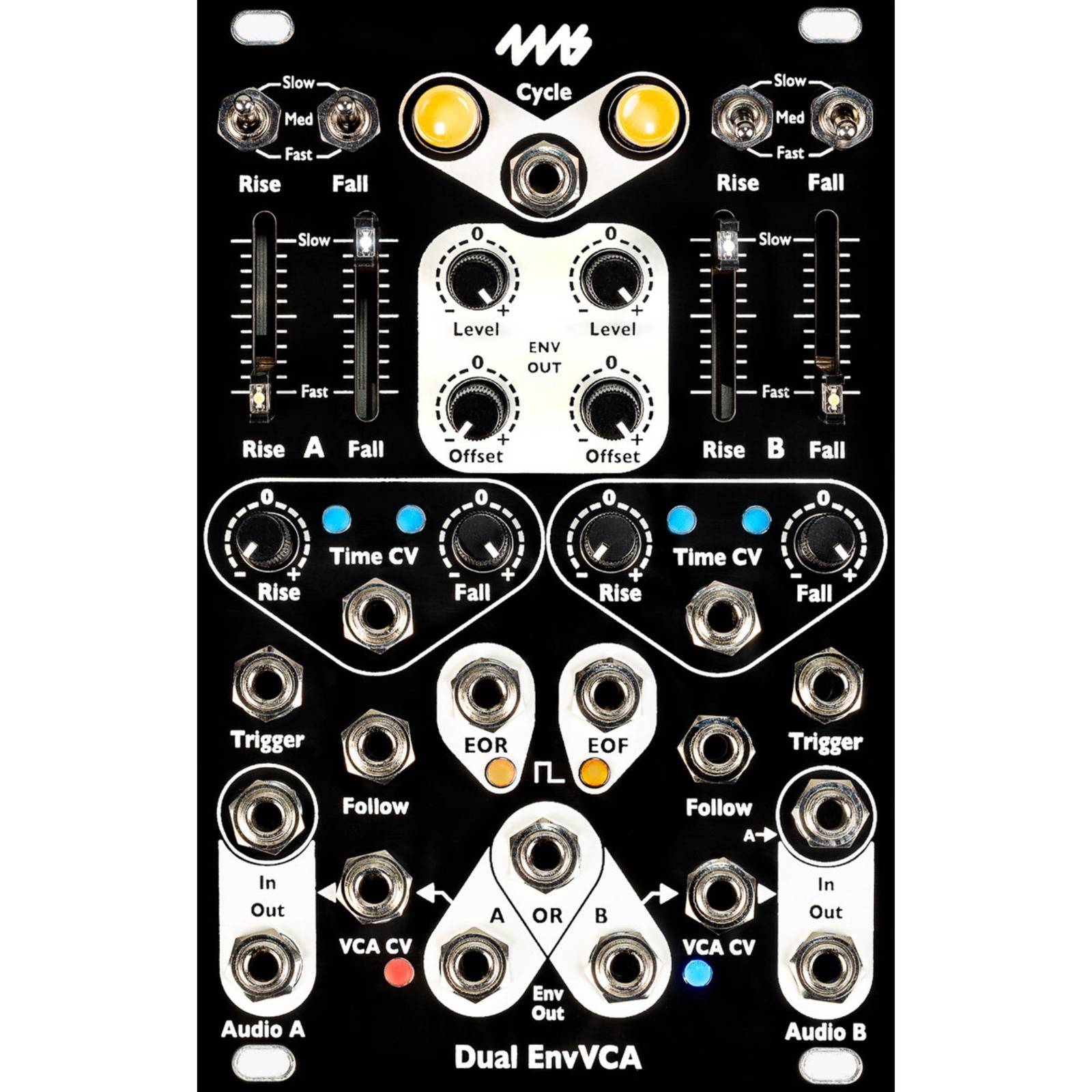
Flip the power on, and the Dual EnvVCA doesn’t dazzle you with flashing lights or menu diving—it just works. No wavefolding, no shape morphing, no digital trickery. What you get is two honest-to-god analog envelope generators paired with clean exponential VCAs, each channel standing fully independent, ready to carve dynamics into your sound or warp into modulation sources. It’s the kind of module you reach for when you’re tired of scrolling through screens or untangling CV spaghetti just to make a simple gated swell. And yet, despite its stripped-down appearance, it’s shockingly flexible—capable of morphing into an LFO, a slew limiter, or even a crude oscillator when pushed into audio rate.
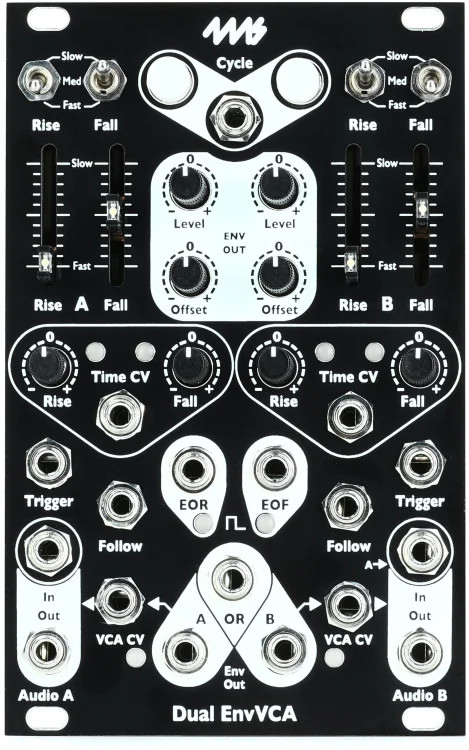
Each channel gives you sliders for rise and fall, backed by a three-way range switch that stretches timing from lightning-fast attacks (down to ~125µs) all the way out to languid, 30-minute decays. That kind of range isn’t just for show—it means you can use this module to create evolving ambient textures that shift over hours or dial in snappy percussive envelopes for tight rhythmic work. The Time CV input further extends that range, letting you modulate the speed of the envelope in real time, which opens up expressive possibilities like tempo-synced swells or voltage-controlled decay sweeps. And because the sliders are linear, you get predictable, repeatable adjustments—no logarithmic guessing games when you’re trying to nail a subtle change.
Where the Dual EnvVCA really earns its keep is in its dual functionality. The VCA isn’t an afterthought bolted on for convenience—it’s a proper, low-noise, DC-coupled exponential amplifier that can handle both audio and CV with equal grace. Patch in a drone from your oscillator, shape it with the envelope, and send it out clean and click-free. Or route the envelope output to modulate filter cutoff, pan, or even another VCA elsewhere in your system. The module’s ability to function as both a dynamics processor and a modulation source makes it a space-saving powerhouse in a crowded rack. And because the VCA gain is internally linked to the envelope by default (unless you patch into the VCA CV input), you don’t need extra cables to get basic envelope shaping up and running.
Specifications
| Manufacturer | 4ms Company |
| Production Years | 2020– |
| Original Price | $225 USD |
| Format | Eurorack |
| HP | 16 |
| Depth | 0.95" (24mm) maximum, including power cable |
| Power Consumption +12V | 156mA max |
| Power Consumption -12V | 131mA max |
| Envelope Type | Analog linear rise/fall (AR/AD/ASR capable) |
| Minimum Envelope Time | ~125µs (8kHz max frequency) |
| Maximum Envelope Time | ~30 minutes |
| VCA Type | Exponential, DC-coupled |
| VCA Input Impedance | 100k |
| VCA Output Impedance | 1k |
| VCA Gain Range | -90dB to +0.9dB |
| VCA Frequency Response | DC to 20kHz, ±0.1dB |
| Trigger Input Threshold | Rising edge, 2.5V |
| Cycle Input Threshold | Rising edge, 2.5V |
| End of Rise/Fall Output | 4.5V–4.95V gate, minimum stable pulse width 1ms |
| Audio Input/Output Range | -10V to +10V, no clipping |
Key Features
Envelope Flexibility Without the Fluff
The Dual EnvVCA doesn’t try to be a Swiss Army knife with waveshaping, complex sequencing, or digital interpolation. Instead, it focuses on doing one thing exceptionally well: generating clean, reliable, voltage-controllable rise/fall envelopes. Each channel has independent rise and fall sliders with selectable time ranges—short, medium, and long—letting you jump between rhythmic precision and glacial evolution in a single flick. The Time CV input accepts a unipolar 0–5V signal and scales the envelope speed exponentially, which means you can sync it loosely to tempo or use another LFO to create rhythmic variations. While it lacks per-envelope CV inputs for rise and fall individually (both share a single CV input, with attenuverters per parameter), this limitation keeps the front panel clean and the workflow direct. For many users, that trade-off is worth it—especially when you’re after a no-fuss, patch-and-play envelope source.
Exponential VCAs That Stay Out of the Way
The VCAs here are exponential, meaning they respond naturally to envelope control—perfect for shaping the amplitude of audio signals with that classic synth swell. They’re also DC-coupled, so they can handle slow modulation signals without low-end roll-off, making them equally useful for CV processing. With 100k input impedance and 1k output impedance, they integrate cleanly into any Eurorack setup, avoiding loading issues when patched into other modules. The VCA gain is internally normalized to the corresponding envelope output, so you don’t need to patch anything to get basic envelope shaping working. But if you want to use the VCA independently—say, to duck a drone with an external envelope—you can simply plug a CV into the VCA CV input, breaking the internal link. This kind of thoughtful normalization makes the module feel intuitive, not restrictive.
More Than Just Envelopes
Thanks to its wide timing range, the Dual EnvVCA blurs the line between envelope generator and utility module. Set the rise and fall times to their shortest settings, patch the output into a VCO’s pitch input, and you’ve got a crude but functional audio-rate oscillator. Use the Follow input to turn it into a slew limiter or an ASR (attack-sustain-release) envelope. Engage the cycle button, and each channel becomes a bipolar LFO with adjustable rise and fall slopes—perfect for creating trapezoidal or triangle-like waveforms that evolve slowly over time. The end-of-rise and end-of-fall gate outputs add sequencing potential, letting you trigger other events at precise points in the envelope cycle. It’s this kind of multi-role utility that makes the Dual EnvVCA feel like more than the sum of its parts.
Historical Context
The Dual EnvVCA arrived in 2020 as part of 4ms Company’s broader push into modular utility and modulation tools—modules that prioritize function, reliability, and analog purity over flashy features. At a time when many envelope generators were leaning into digital control, shape morphing, and complex state sequencing (think MakeNoise Maths or ALM’s PEG), the Dual EnvVCA stood out by going analog and staying simple. It wasn’t trying to replace those more advanced modules; instead, it offered a no-frills alternative for users who wanted predictable, hands-on control without CV overhead or menu diving.
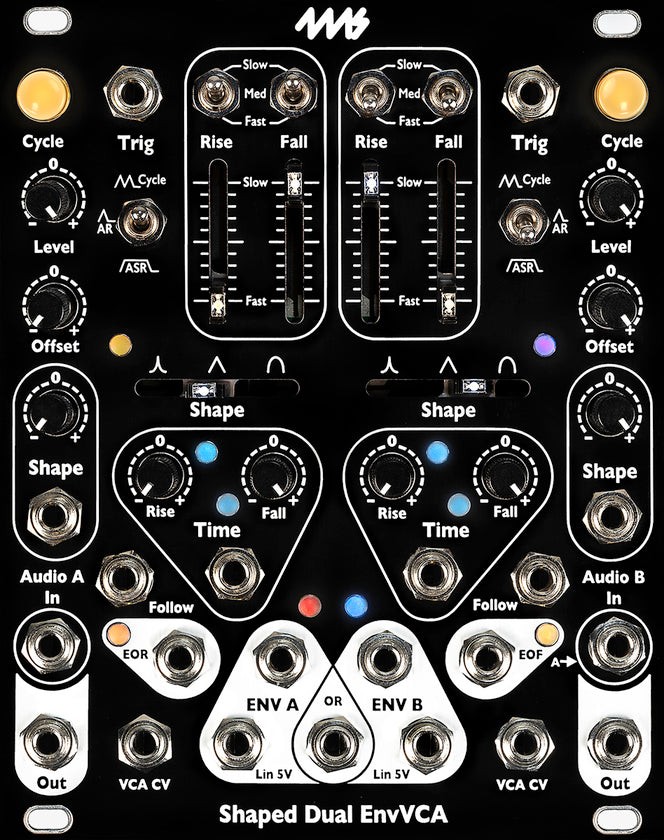
Positioned below the more sophisticated Shaped Dual EnvVCA (which adds waveshaping and independent shape CV), the Dual EnvVCA carved out a niche as the “workhorse” version—ideal for beginners or minimalists who wanted two full envelope/VCA pairs in a compact 16HP footprint. Its $225 price point made it competitive with other dual-function modules, especially considering its full analog signal path and wide timing range. In an ecosystem where “feature creep” often inflates both cost and complexity, the Dual EnvVCA was a quiet argument for restraint: sometimes, all you need is a clean envelope and a good VCA.
Collectibility & Value
The Dual EnvVCA isn’t a rare or sought-after grail—it’s a production module that’s still available directly from 4ms Company. But that doesn’t mean it lacks value on the used market. In excellent condition, with no cosmetic damage and fully functional sliders and jacks, used units typically sell for $175–$200. Units with dirty or scratchy sliders (a known weak point due to the potentiometer quality) may go for as low as $140, especially if they need servicing. Because the module is 100% analog and has no firmware or digital components, it’s relatively stable over time—but the sliders can accumulate dust or wear, leading to crackling in the CV or audio path. Cleaning with contact cleaner often resolves this, but heavily worn sliders may need replacement.
Another consideration is the shared Time CV input. While convenient for globally modulating both envelopes, it limits per-channel CV control unless you use a mixer or attenuator to split and offset the signal. Some users see this as a design flaw; others appreciate the simplicity. Either way, it’s a trade-off worth understanding before buying. The module draws a moderate amount of current (156mA on +12V, 131mA on -12V), so ensure your power supply can handle it, especially in larger systems. There are no known catastrophic failure modes—no overheating, no chip drift, no capacitor plague—so units in good physical condition are likely to perform as intended for years.
If you’re building a modular system on a budget or want a reliable envelope/VCA pair without the learning curve of more complex modules, the Dual EnvVCA remains a smart buy. It won’t do everything, but what it does, it does well—and with a clarity and honesty that’s increasingly rare in modern modular design.
eBay Listings

As an eBay Partner, we earn from qualifying purchases. This helps support our independent vintage technology research.