4ms Shaped Dual EnvVCA (2020–)
A rare beast: a dual analog envelope generator that lets you morph the shape of each stage without touching the timing—like having a fader for how “plucky” or “smooth” your sound feels, independent of how fast it plays.
Overview
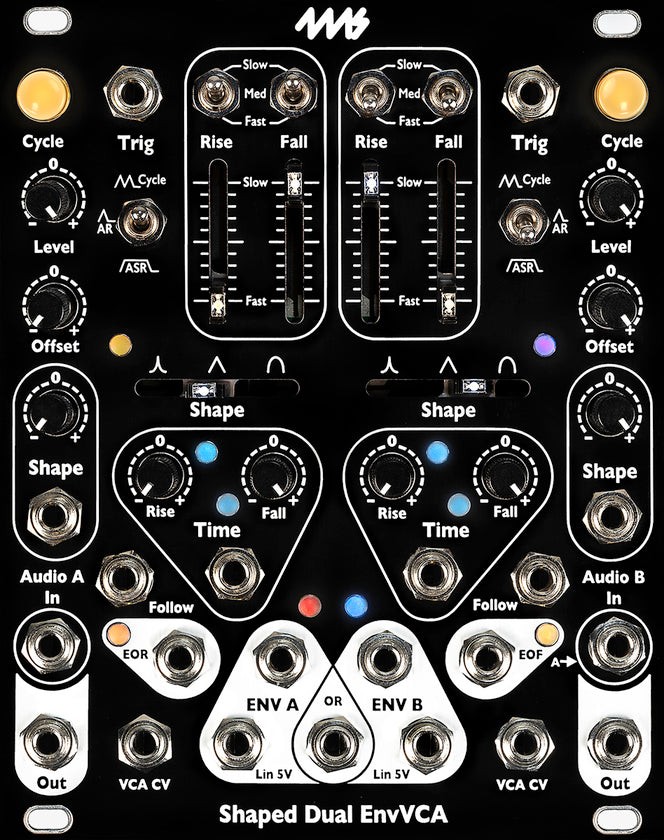
You know that moment when you’ve dialed in the perfect envelope speed—snappy enough for rhythm, slow enough to breathe—but the attack still feels too abrupt, or the decay drags like wet felt? That’s where most analog envelope generators leave you stranded, forcing a compromise between timing and character. The 4ms Shaped Dual EnvVCA doesn’t just solve that problem—it obliterates it. This isn’t another run-of-the-mill EG with Rise and Fall sliders; it’s a dual-channel analog powerhouse that lets you continuously morph each envelope’s shape from logarithmic (fast attack, slow taper) to linear to exponential (slow attack, fast drop) using dedicated sliders or CV, all without altering the timing. It’s like having a tone knob for your envelope’s personality.
Built as the top-tier model in 4ms’s EnvVCA series, the Shaped Dual EnvVCA (often abbreviated ShEV) expands on the simpler Dual EnvVCA by adding this crucial waveshaping capability, an ASR trigger mode, and additional 5V linear envelope outputs per channel. It’s not just an envelope generator; it’s a modulation chameleon. Need a snappy percussive hit? Crank the shape toward exponential. Want a slow, swelling pad that creeps in like fog? Slide into logarithmic. And because the shape control is voltage-controllable, you can modulate it in real time—imagine an envelope that starts soft and rounded, then gets sharper with each repetition, all from a single trigger. That kind of expressive control is usually reserved for software or high-end digital modules, but here it’s all analog, all the time.
Each channel operates independently, with its own Rise and Fall sliders, range switches (offering three time scales), and a Time CV input that extends the envelope duration from a blistering 2.5kHz (400 microseconds) all the way up to roughly an hour. That insane range means it can function as anything from an audio-rate oscillator to a glacial LFO, a slew limiter, or a sidechain processor. The built-in linear VCAs are no afterthought—they’re low-noise, DC-coupled, and can handle both audio and CV signals, making this a true stereo VCA module when you’re not using the envelopes. And because the VCA gain is internally linked to the envelope output unless you patch a CV into the VCA CV input, it’s trivial to set up classic ADSR-style amplitude control with a single cable from a trigger source.
But the real magic is in the flexibility of the output stage. Each channel provides both a linear envelope output and a shaped envelope output, the latter of which can be further processed with dedicated Level and Offset knobs. That means you can scale and shift the envelope’s voltage range independently of the VCA—say, turning a 0–5V envelope into a -2V to +2V LFO for modulating a filter cutoff—without affecting the amplitude of your audio signal. The inclusion of End of Rise (EOR) and End of Fall (EOF) gate outputs on each channel also makes it easy to chain envelopes, create complex sequences, or trigger secondary events with precise timing. It’s the kind of module that doesn’t just do one job well—it redefines how you think about modulation.
Specifications
| Manufacturer | 4ms Company |
| Production Years | 2020– |
| Original Price | $339.00 USD |
| Format | Eurorack |
| HP | 20 |
| Depth | 0.95" (24mm) maximum, including power cable |
| Power | 10-pin Eurorack power header |
| +12V Current Draw | 255mA |
| -12V Current Draw | 230mA |
| Envelope Generator Type | Analog, linear/exponential/logarithmic with waveshaping |
| Envelope Time Range (Panel Control) | ~2ms to >2 minutes |
| Envelope Time Range (with CV) | ~400µs (2.5kHz) to ~1 hour |
| Minimum Rise/Fall Time | ~200µs per segment |
| Maximum Rise Time | >20 minutes (typically >40 minutes) |
| Maximum Fall Time | >12 minutes (typically >20 minutes) |
| VCA Type | Linear, DC-coupled |
| VCA Input Impedance | 100k |
| VCA Output Impedance | 1k |
| VCA Gain Range | -90dB to +2.0dB |
| VCA Unity Gain | 4.4V CV, DC to 20kHz, ±0.1dB |
| VCA Response to CV | Linear from 0V to 5V |
| Trigger Threshold | 1.25V rising edge |
| Follow Input Range | 0V to +5V |
| EOR/EOF Output Voltage | EOR (Ch A): 4.50V, EOF (Ch B): 4.95V |
| Minimum Stable Pulse Width | 1ms |
| Audio Input/Output Range | -10V to +10V without clipping |
| Envelope Output Range | Min: -10.2V, Max: +10.1V, max amplitude 9.3Vpp |
Key Features
Shape Control Without Timing Compromise
The defining feature of the Shaped Dual EnvVCA is its ability to alter the envelope’s response curve—how it accelerates or decelerates—without affecting the total duration of the rise or fall. Most analog envelopes lock you into a fixed shape (usually exponential), forcing you to accept a certain “feel” as part of the timing. The ShEV breaks that link. With a dedicated Shape slider per channel and a CV input with attenuverter, you can smoothly transition between logarithmic, linear, and exponential curves. This isn’t just a novelty; it fundamentally changes how you sculpt sound. A kick drum can go from clicky to thumpy with a twist of a knob, or a filter sweep can evolve from a sudden spike to a gradual swell, all while keeping the rhythmic timing intact. It’s the kind of control that makes you rethink how envelopes should behave.
Dual VCAs with Independent Control
While many envelope generators include VCAs, they’re often an afterthought—basic, noisy, or limited in functionality. The ShEV’s VCAs are serious business: linear response, DC-coupled, low distortion, and capable of handling both audio and CV signals with precision. Each VCA’s gain is internally patched to its channel’s envelope output, so you can use the module as a complete envelope-controlled amplifier with minimal patching. But if you want to use the VCA independently—say, as a CV processor or a secondary modulation destination—you can unpatch that link by inserting a cable into the VCA CV input. The audio inputs and outputs are standard 3.5mm jacks with a -10V to +10V range, making them compatible with virtually any Eurorack signal. It’s rare to find a module that does double duty this well: a top-tier envelope generator *and* a high-quality stereo VCA.
Modulation Flexibility and Utility Outputs
Beyond the core envelope and VCA functions, the ShEV is packed with utility features that elevate it from a simple modulator to a central hub for complex patching. Each channel has an Offset knob and Level attenuverter for the envelope output, letting you shift and scale the CV signal for use in non-amplitude applications—like modulating oscillator pitch or wavefolding depth. The EOR and EOF gate outputs provide precise timing signals that can trigger other envelopes, advance sequencers, or reset LFOs. The Follow input enables slew limiting, sustain (ASR mode), and even exotic filtering effects when patched creatively. And with re-trig jumpers that allow re-triggering during the rise phase, you can create stuttering, gated effects or reset the envelope mid-rise for rhythmic complexity. It’s a module that rewards deep exploration, with layers of functionality that unfold the more you use it.
Historical Context
The Shaped Dual EnvVCA arrived in 2020 as the flagship of 4ms’s EnvVCA series, a family of modules designed to bring the expressive, analog warmth of classic envelope generators into the Eurorack format with modern enhancements. At a time when many manufacturers were leaning into digital complexity—multi-stage envelopes, intricate sequencing, menu-diving interfaces—4ms took a different path: refine the analog foundation, then expand its expressive range through clever analog circuit design. The ShEV was a direct evolution of the earlier Dual EnvVCA, which itself was inspired by the company’s long history of building expressive, utility-focused modules like the PEG (Programmable Envelope Generator) and the Ensemble Oscillator.
What set the ShEV apart was its focus on *feel*—the subjective, almost tactile quality of an envelope’s shape—rather than just functionality. While modules like MakeNoise’s Maths or ALM’s Pong offered multi-function flexibility, they didn’t let you morph the envelope curve independently of timing. The ShEV filled that gap with an analog solution that felt immediate and musical. It arrived alongside a wave of renewed interest in “analog character” in Eurorack, where users were seeking modules that offered hands-on control and sonic personality over digital precision. Competitors like the Intellijel Dual ADSR or the Verbos Quadratt offered deep control, but none matched the ShEV’s seamless shape morphing. It wasn’t trying to be a Swiss Army knife; it was a scalpel for sculpting the emotional contour of sound.
Collectibility & Value
As a relatively recent module (introduced in 2020), the Shaped Dual EnvVCA isn’t yet a “vintage” piece in the traditional sense, but it has quickly gained a reputation as a modern classic among Eurorack enthusiasts. Its original price of $339 places it in the upper tier of analog envelope generators, but the build quality, feature set, and sonic performance justify the cost for many users. On the used market, prices typically range from $280 to $320 in excellent condition, with mint units still in original packaging occasionally fetching closer to $350. It’s not a module that trades at a premium like rare digital synths or discontinued boutique gear, but it rarely sells for a steep discount—owners tend to hold onto them.
The most common failure points are mechanical rather than electronic: the sliders, while smooth and precise, can accumulate dust or wear over years of heavy use, leading to crackling or intermittent response. However, the module uses standard Alps-style sliders, which are readily replaceable. The jacks are robust and soldered directly to the PCB, minimizing strain-related failures. Power draw is relatively high for an envelope generator (255mA/+12V, 230mA/-12V), so users with densely packed cases should ensure their power supply can handle the load. There are no known firmware updates or revisions, and the module has proven stable in long-term use.
When buying used, check that all sliders move smoothly and that the LEDs respond correctly to input signals. Test both trigger modes (AR and ASR) and verify that the EOR/EOF outputs fire as expected. Because the module is fully analog and has no microcontroller, there’s no risk of bricking or software issues—what you see is what you get. For collectors, the ShEV represents a snapshot of analog design philosophy at a time when digital modules were dominating the high-functionality space: a statement that analog circuits could still offer unique, expressive capabilities that software couldn’t easily replicate. It’s not the most flashy module in a rack, but it’s often the one you reach for when you need something to *feel* right.
eBay Listings
As an eBay Partner, we earn from qualifying purchases. This helps support our independent vintage technology research.