4ms Dual DLD (2016–)
Two pristine, syncable loops that remember everything—and love to surprise you with what they dug up.
Overview
You patch in a simple melody, set the clock, and let it breathe. A few minutes later, something whispers back—familiar, but not quite right. A fragment from two loops ago, flipped backward, nudged out of phase. That’s the DLD: less a delay, more a collaborator with a long memory and a mischievous streak. It doesn’t color your sound; it preserves it with clinical clarity, then lets you twist the timeline until it snaps in unexpected places. This isn’t about slapback or slapdash repeats. This is about building evolving soundscapes where the past keeps reappearing in new disguises, where a loop isn’t a loop until you’ve forgotten what started it.
Born in 2016, the Dual Looping Delay (DLD) sits at the intersection of surgical precision and creative chaos. It’s a 20HP Eurorack module that gives you two fully independent digital delay channels, each capable of up to 174 seconds of loop time at 16-bit resolution—nearly three minutes of sonic real estate per side. That alone was staggering at the time, but 4ms didn’t stop there. The DLD records constantly, meaning your audio history lives in memory long after you think you’ve moved on. When you start “windowing”—shifting loop start and end points on the fly—you’re not just editing; you’re archaeology, digging through layers of sound that weren’t meant to coexist. And they don’t always play nice. That’s the point.
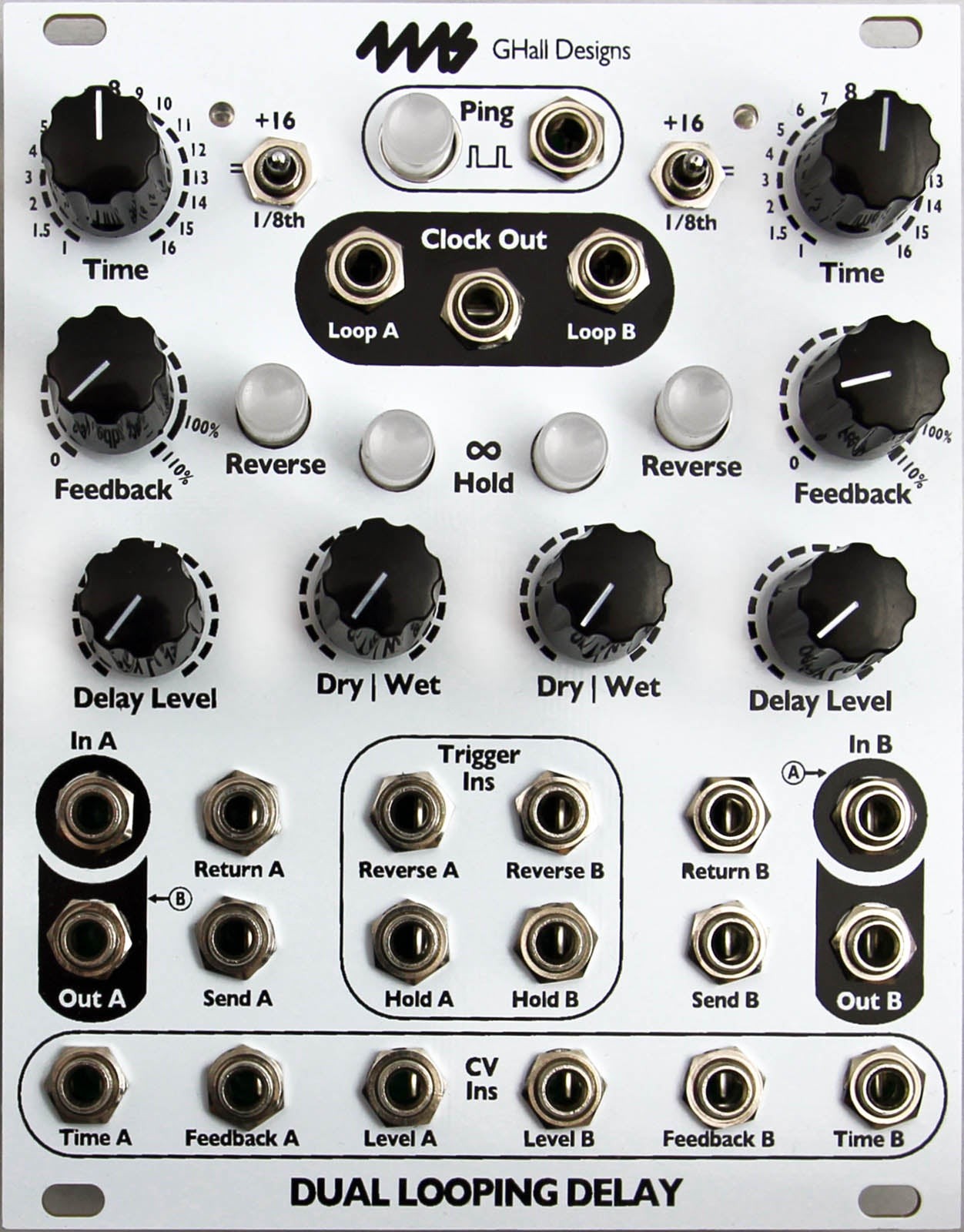
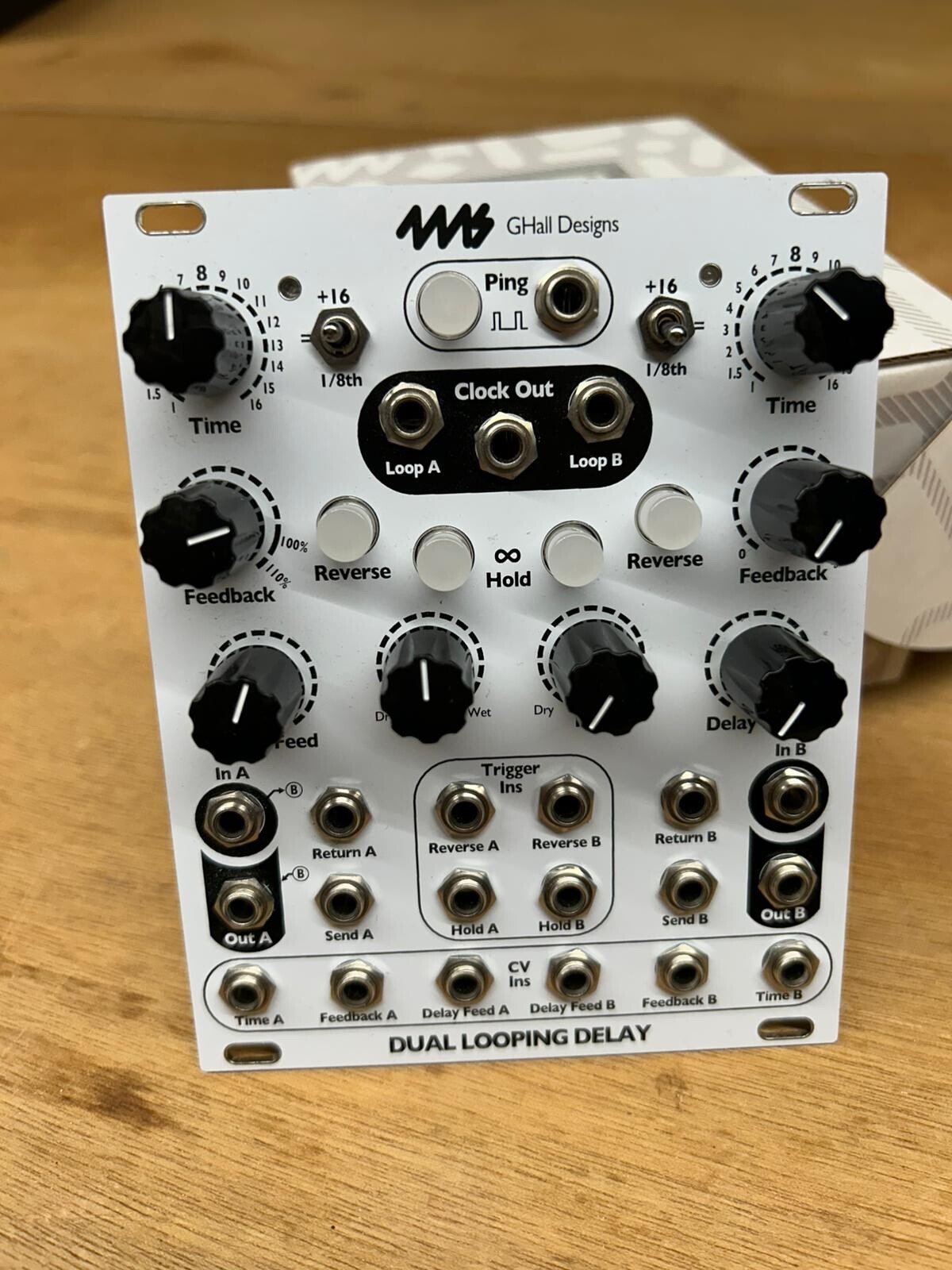
Each channel syncs to a shared clock, which you can tap in manually or drive externally via CV, MIDI, or a pulse from another module. The clock isn’t just for timing—it’s a performance tool. Speed it up, slow it down, modulate it with an LFO, and watch your loops stretch and compress like taffy. The Time knob offers three ranges: one that adds 16 beats to the selected value (for those marathon loops), one that divides by eight (for micro-rhythms), and a direct 1:1 setting. It’s quantized by default, but hold the Infinite Hold button and you’re in unquantized territory, free to sweep time like a radio dial searching for ghosts.
Feedback goes past 100%, hitting 110% to give you that dubby, self-boosting swell. At exactly 100%, the loop sustains forever—no degradation, no noise, just pure digital stasis. But engage Infinite Hold and Feedback is disabled. Instead, you lock a segment of memory and start scrubbing. Turn the Feedback knob while holding Infinite Hold, and you’re adjusting the loop window, sliding the playback window forward or backward through the continuous recording buffer. Do it while the loop plays, and you’ll hear echoes of things you didn’t know you recorded—ghosts in the machine, literally.
And yes, you can reverse playback. But it’s not a simple flip. Because new material keeps recording into the reversed stream, when you exit reverse, those newly recorded fragments now play backward in the forward timeline. The DLD doesn’t forget. It just rearranges.
Specifications
| Manufacturer | 4ms Company |
| Production Years | 2016– |
| Original Price | $415 |
| Module Width | 20HP |
| Power Requirements | +12V: 180mA, -12V: 20mA |
| Sampling Rate | 48kHz |
| Bit Depth | 16-bit (default), 24-bit (jumper-enabled) |
| Max Delay Time (16-bit) | 174 seconds per channel (2:54) |
| Max Delay Time (24-bit) | 88 seconds per channel |
| Total Memory Capacity | Approx. 6 minutes (shared buffer) |
| Inputs | Audio In A/B, Time CV, Feedback CV, Mix CV, Delay Feed CV, Clock In, Reverse CV, Hold CV |
| Outputs | Audio Out A/B, Send A/B, Return A/B, Clock Out A/B, Loop Clock Out A/B |
| Feedback Range | 0–110% |
| Time Control | Manual knob with 3-position range switch (+16, =, 1/8th) |
| Clock Sync | Internal tap tempo (Ping button), external clock input |
| Firmware Updates | Version 5 adds 24-bit recording, de-jitter modes, quantised change mode |
| Weight | Approx. 300g |
| Front Panel | Black anodized aluminum with white silkscreen |
Key Features
Windowing: The Hidden Dimension
Most loopers erase the past as they record the present. The DLD doesn’t. It keeps writing, constantly, to a circular buffer that spans minutes. The “loop” is just a window into that stream. When you adjust the loop boundaries via the Feedback knob while holding Infinite Hold, you’re not just moving start and end points—you’re pulling in audio that was never meant to be part of the loop. That offhand noise from three minutes ago? The ghost of a patch you abandoned? It can suddenly become the centerpiece. This isn’t just editing; it’s improvisation with memory. And because the buffer is shared between channels, crosstalk can happen in subtle, unpredictable ways—especially if you’re using the Send/Return jacks to route feedback through external processors.
Ping Lock: Two Tempos, One Clock
You’d think two delay channels would want independent clocks. But 4ms took a different path. With Ping Lock (introduced in firmware v5), you can freeze one channel’s timing reference while letting the other follow the live clock. This means you can have Channel A locked to a 60 BPM pulse while you modulate Channel B’s clock to 120 BPM—or 37 BPM, or an audio-rate square wave. The locked channel stays in sync with its original Ping value, even as the master clock drifts. It’s not full independence, but it’s clever enough to simulate it, letting you create polyrhythmic textures without needing a separate clock source for each side.
Send/Return Flexibility
The DLD doesn’t just sit there repeating your signal. It invites you to mess with the feedback path. Each channel has dedicated Send and Return jacks, so you can patch in a filter, distortion, phaser, or even another delay to color the repeats. Want a lo-fi, degraded echo? Send it through a wavefolder. Want something that spirals into noise? Run it through a resonant filter on the edge of self-oscillation. The module doesn’t degrade the signal on its own—but it hands you the tools to do it surgically. And because the Send comes after the Feedback stage, you’re processing the entire loop, not just the incoming signal. This is where the DLD stops being a delay and starts being a sound design engine.
Historical Context
The DLD arrived in 2016, a time when Eurorack was exploding beyond basic oscillators and filters into complex, intelligent modules. While many delay modules still focused on emulating analog warmth or tape flutter, 4ms went the opposite direction: clinical, precise, and deeply programmable. It wasn’t trying to be a vintage echo machine. It wasn’t even trying to be “musical” in the traditional sense. It was built for composers and sound designers who wanted to manipulate time itself—not just repeat it.
It drew inspiration from the clean, high-headroom digital delays of the late ’70s and ’80s—the kind used in studio mastering and experimental music—but pushed the concept further. Where those units offered seconds of delay, the DLD offered minutes. Where they had fixed timing, the DLD offered deep CV control and quantisation options. And where most loopers treated memory as disposable, the DLD treated it as a canvas.
Competitors like the MakeNoise Mimeophon or the Strymon El Capistan focused on texture and character. The DLD focused on structure and possibility. It wasn’t a replacement for those units—it was a different animal entirely. It shared DNA with the Elektron Monomachine’s sequencer or the Korg DSS-1’s sampler: tools that recorded, but also reinterpreted.
Collectibility & Value
The DLD has never been cheap, and it hasn’t gotten cheaper. New units still hover around $400–$450, and used ones trade between $300 and $380 depending on condition and firmware version. Units running v5 firmware—especially those with the 24-bit jumper installed—are more desirable, though the sonic difference is subtle. The 16-bit mode already sounds pristine, and many users report that the 24-bit mode doesn’t justify the halved delay time unless you’re doing critical mastering work.
Failures are rare but not unheard of. The most common issue is firmware corruption during updates, usually caused by underpowered or noisy power supplies. The boot loader is finicky; some users report needing a high-current PSU to successfully flash new firmware. Once updated, though, the module is stable. There are no moving parts, no analog degradation—just digital reliability until the next power surge.
When buying used, check for:
- Firmware version (v5 is ideal)
- Clean jacks (no wobble or crackling)
- Responsive buttons (Infinite Hold and Ping should click cleanly)
- No discoloration or deep scratches on the panel
Repairs are straightforward for experienced technicians—the board is well-documented, and 4ms provides full schematics and firmware on GitHub. But because it’s a digital module with surface-mount components, DIY fixes are not for beginners. If it’s not booting, it’s likely a power or firmware issue, not a dead chip.
The DLD isn’t for everyone. It’s not a “set and forget” delay. It demands engagement. But for those who want a delay that evolves, remembers, and surprises, it’s still unmatched. It’s not aging like analog gear—there’s no “warmth” to lose—but it’s aging like a well-written algorithm: quietly, reliably, and with increasing relevance as modular setups grow more complex.
eBay Listings


As an eBay Partner, we earn from qualifying purchases. This helps support our independent vintage technology research.