2hp Slice (2019–)
A microscopic glitch engine that turns rhythmic precision into controlled chaos — all in 2HP of Eurorack real estate.
Overview
You reach for the 2hp Slice when the groove needs to stutter, splinter, or dissolve into digital confetti — and you want to do it with surgical timing and zero clicks. It doesn’t generate sound, but it warps it with the cold efficiency of a glitch surgeon. Feed it a drum loop, a synth stab, or even a vocal phrase, and with a twist of the Size knob or a burst of CV, it slices that audio into rhythmic fragments that repeat, freeze, and collapse in time with your clock. Unlike its sibling Freez, which latches and holds, Slice is built for motion — it’s a beat repeater that lives in the pulse of your sequence, not outside of it. The magic is in how seamlessly it integrates: no pops, no hiccups, just clean, repeatable stutters that range from subtle rhythmic embellishments to full-on digital meltdown.
It’s the kind of module that makes you rethink what "utility" means in a modular rig. At first glance, it’s deceptively simple — one knob, a few jacks, a button — but the depth comes from how it responds to control voltage. The Size parameter can be modulated in real time, letting you sweep from whole-bar repeats down to frantic 1/256th-note blips, all locked to your tempo. That range alone makes it a compositional tool, not just an effect. And the Triplet toggle? That’s the secret weapon. Flick it, and suddenly your rigid grid flexes into triplet subdivisions, opening up trap-style fills and off-kilter grooves without needing a separate clock source. It’s the difference between sounding mechanical and sounding human — or at least, human playing with machines.
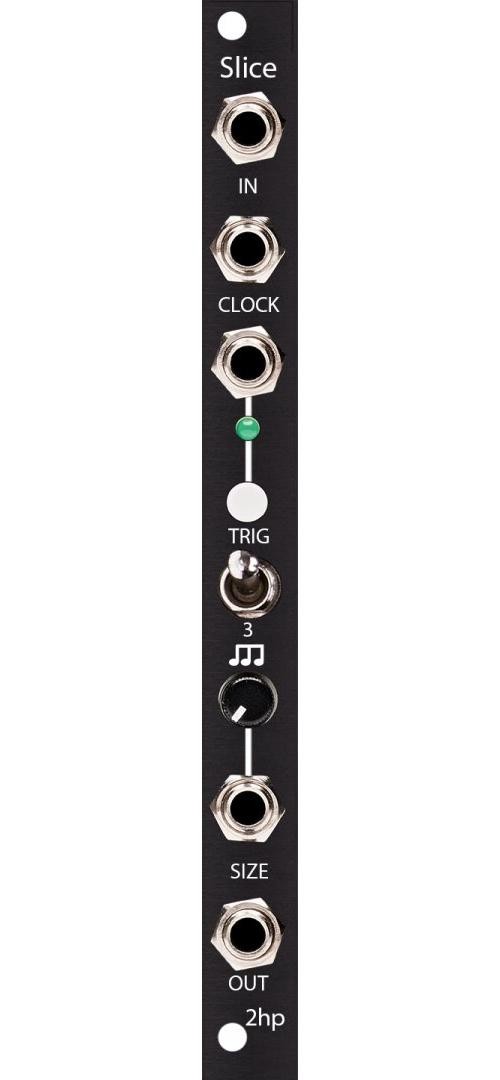
Despite its minimalist footprint, Slice doesn’t feel stripped down. It feels focused. Every element serves a purpose, and the lack of clutter means you’re never hunting for a parameter mid-performance. The LEDs give clear feedback: green for clock rate, white and purple for latching and momentary modes, letting you see at a glance whether the module is frozen, repeating, or waiting for a trigger. In a world where some glitch modules demand patch cables just to get basic functionality, Slice works immediately — but rewards deeper exploration. It’s the rare module that’s equally at home in a live rig for on-the-fly chaos and a studio setup for meticulous rhythmic design.
Specifications
| Manufacturer | 2hp |
| Production Years | 2019– |
| Original Price | $149 |
| Width | 2HP |
| Depth | 45 mm |
| Power Consumption +12V | 85 mA |
| Power Consumption -12V | 7 mA |
| Power Consumption +5V | 0 mA |
| Audio Input | 1 x 3.5mm |
| Audio Output | 1 x 3.5mm |
| Clock Input | 1 x 3.5mm |
| Trigger/Gate Input | 1 x 3.5mm |
| Size CV Input | 1 x 3.5mm |
| Triplet Gate Input | 1 x 3.5mm |
| Size Control | Knob with CV attenuverter |
| Triplet Toggle | Push-button with LED indicator |
| LED Indicators | Green (clock rate), White (latching), Purple (momentary) |
| Function | Beat repeat / glitch effect |
| Repeat Range | 2 bars to 1/256 note |
| Sync Type | External clock required |
Key Features
Click-Less Glitching with Dynamic Timing
The standout feature of the 2hp Slice is its ability to repeat and stutter audio without a single audible click or pop — a rarity in digital glitch modules, where artifacts often betray the processing. This clean behavior stems from its precise buffer management and tight clock synchronization. Because it’s externally clocked, every repeat aligns perfectly with your sequence, making it ideal for rhythmic precision rather than random noise. The Size knob controls the slice duration, from long, drawn-out loops to hyper-compressed bursts that blur into pitch. When modulated via CV, this parameter becomes a performance tool: imagine a filter sweep paired with a widening repeat window, or an LFO slowly tightening the stutter until the audio fractures into digital dust. The CV input includes an attenuverter, so you can scale and invert the modulation for even more expressive control.
Triplet Mode: Rhythmic Flexibility in a Button
Most beat repeaters lock you into straight divisions — quarter notes, eighth notes, sixteenths — but Slice breaks that grid with a dedicated Triplet toggle. Engage it, and the Size knob’s range shifts to include triplet subdivisions, instantly transforming rigid patterns into syncopated, off-kilter grooves. This is where the module earns its reputation in hip-hop and electronic production, where triplet-based fills are a staple. The button can be triggered manually or via gate, allowing for automated triplet injections in a sequence. There’s no menu diving, no mode shifts — just a physical switch that flips your rhythm from binary to human. It’s a small feature in execution, but enormous in musical impact, especially in genres that thrive on rhythmic tension.
Minimal Footprint, Maximum Integration
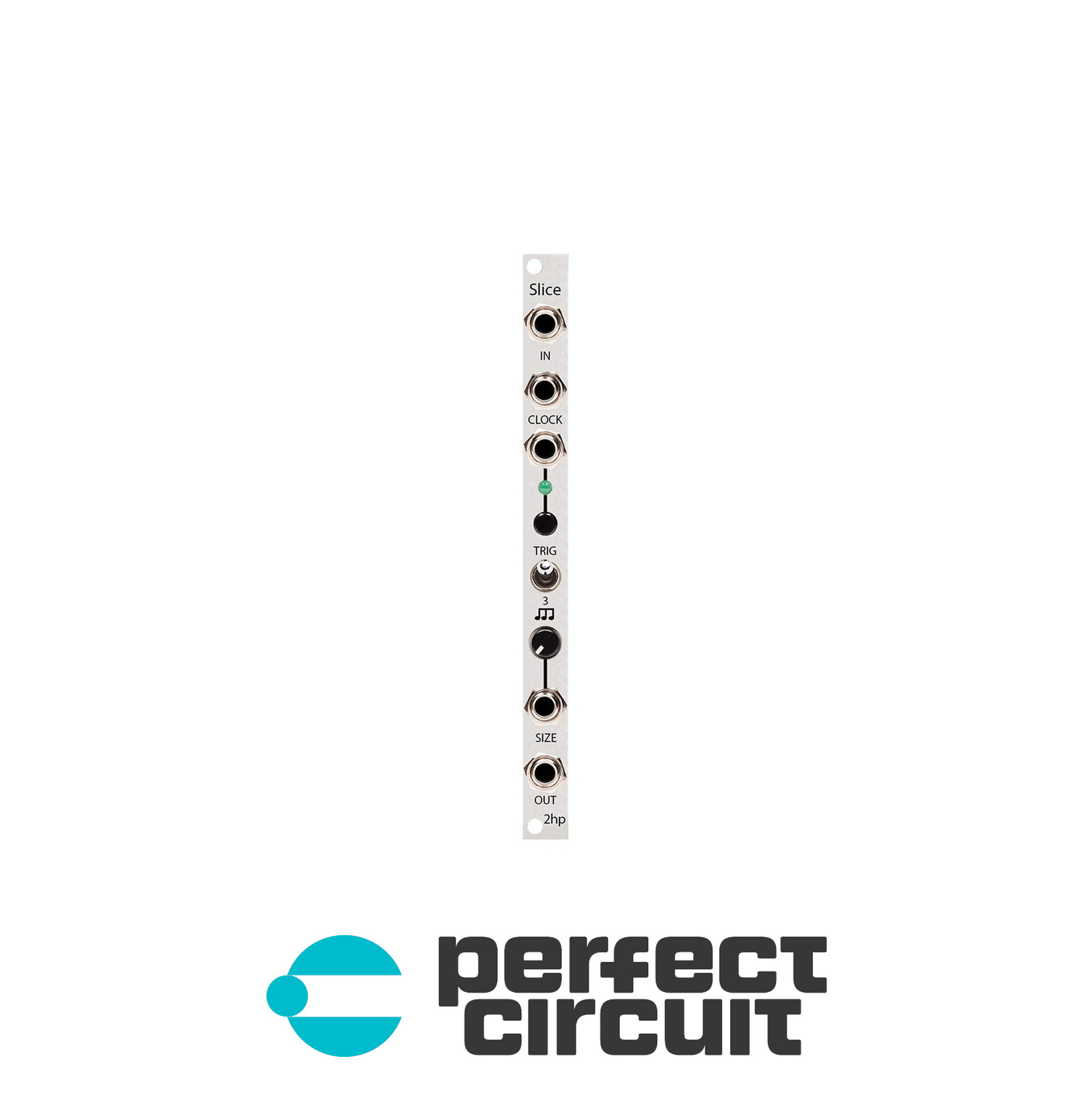
At just 2HP wide, Slice is one of the most space-efficient glitch modules on the market, yet it doesn’t sacrifice connectivity or functionality. It includes dedicated inputs for clock, trigger, Size CV, and Triplet gate — everything needed for full integration into a complex patch. The lack of +5V power draw is a bonus in power-limited systems, and the 45mm depth ensures it fits in even the shallowest cases. Despite its size, the panel layout is intuitive: the large knob dominates the face, flanked by clearly labeled jacks and a prominent button. There’s no display, no hidden modes — just immediate access to the core function. This makes it a favorite for touring musicians and minimalists alike, who value reliability and speed over flashy interfaces.
Historical Context
The 2hp Slice arrived in 2019, a time when Eurorack was shifting from experimental curiosity to mainstream adoption among electronic musicians. While early modular setups focused on raw sound generation, performers and producers began demanding more rhythmically intelligent effects — tools that could manipulate time as precisely as they shaped tone. The Slice filled that niche with ruthless efficiency. It wasn’t the first beat repeater in modular, but it was among the first to offer glitch processing in such a compact, clock-synced, and click-free form. Competitors like the Qu-Bit Nebulae or 4ms Spectral Multiband Resonator offered more complex granular manipulation, but they came with steep learning curves and wider footprints. Slice stood out by doing one thing exceptionally well: rhythmic repetition with surgical precision.
It also reflected 2hp’s design philosophy — minimalism without compromise. Founded by Tony Rolando, the company built a reputation for elegant, functional modules that prioritized musicality over feature bloat. The Slice followed in the footsteps of classics like the Turing Machine and Shades, proving that small modules could have outsized creative impact. In an era where some manufacturers competed on polyphony, polyphony, and screen-based interfaces, 2hp doubled down on immediacy. The Slice wasn’t trying to be a standalone instrument — it was a scalpel in the hands of a composer, designed to slice cleanly through the grid and expose the rhythm beneath.
Collectibility & Value
The 2hp Slice has settled into a stable spot in the used market, typically selling for $100–$130 in good condition — slightly below its original $149 price, which reflects its ongoing production and broad availability. Unlike rare or discontinued modules that inflate in price, Slice remains accessible, which is part of its appeal. It’s not a collector’s trophy; it’s a working musician’s tool. That said, units in mint condition with original packaging can still command close to retail, especially from buyers building boutique racks or seeking specific color variants (black or silver).
Failures are rare, but not unheard of. Service technicians observe that the most common issue is related to power — while the module draws minimal current, some early units were sensitive to voltage fluctuations, particularly on the -12V rail. A faulty power cable or overloaded bus board can cause erratic behavior or LED flickering, but these are usually resolved with a proper power check. The buttons and jacks are durable, but given the module’s reliance on momentary triggering, owners report that heavy stage use can eventually wear the switch mechanism. Replacement is straightforward, but it’s a reminder that even the most robust modules aren’t immune to physical stress.
When buying used, test the core functions: feed it a steady clock and audio signal, then trigger repeats at various Size settings. Listen for clicks or dropouts — a healthy Slice should stutter cleanly at any division. Verify that the Triplet button toggles reliably and that the CV input responds smoothly with an LFO or sequencer. Also check the LEDs: the green clock indicator should pulse in time, and the white/purple mode LEDs should light correctly based on trigger behavior. Because the module is firmware-based, ensure it’s running the latest update (available from 2hp’s website), as early versions had minor timing glitches in triplet mode.
eBay Listings


As an eBay Partner, we earn from qualifying purchases. This helps support our independent vintage technology research.