2hp Turing Machine (2015–)
A sliver of silicon that thinks it’s alive—until you realize you’re the one being toyed with.
Overview
There’s a moment when patching the 2hp Turing Machine that stops you cold: the sequence it just generated feels too good to be random. It’s not just noise with a pulse—it’s a melody that breathes, a rhythm that swings, a pattern that seems to anticipate your next move. That’s the illusion, of course. It’s a shift register with a probabilistic brain, cycling through 1 to 32 steps of voltage chaos, nudged by your touch or a CV input. But the magic isn’t in the math—it’s in how it *feels* like collaboration. You’re not programming it; you’re negotiating with it. And sometimes, it wins.
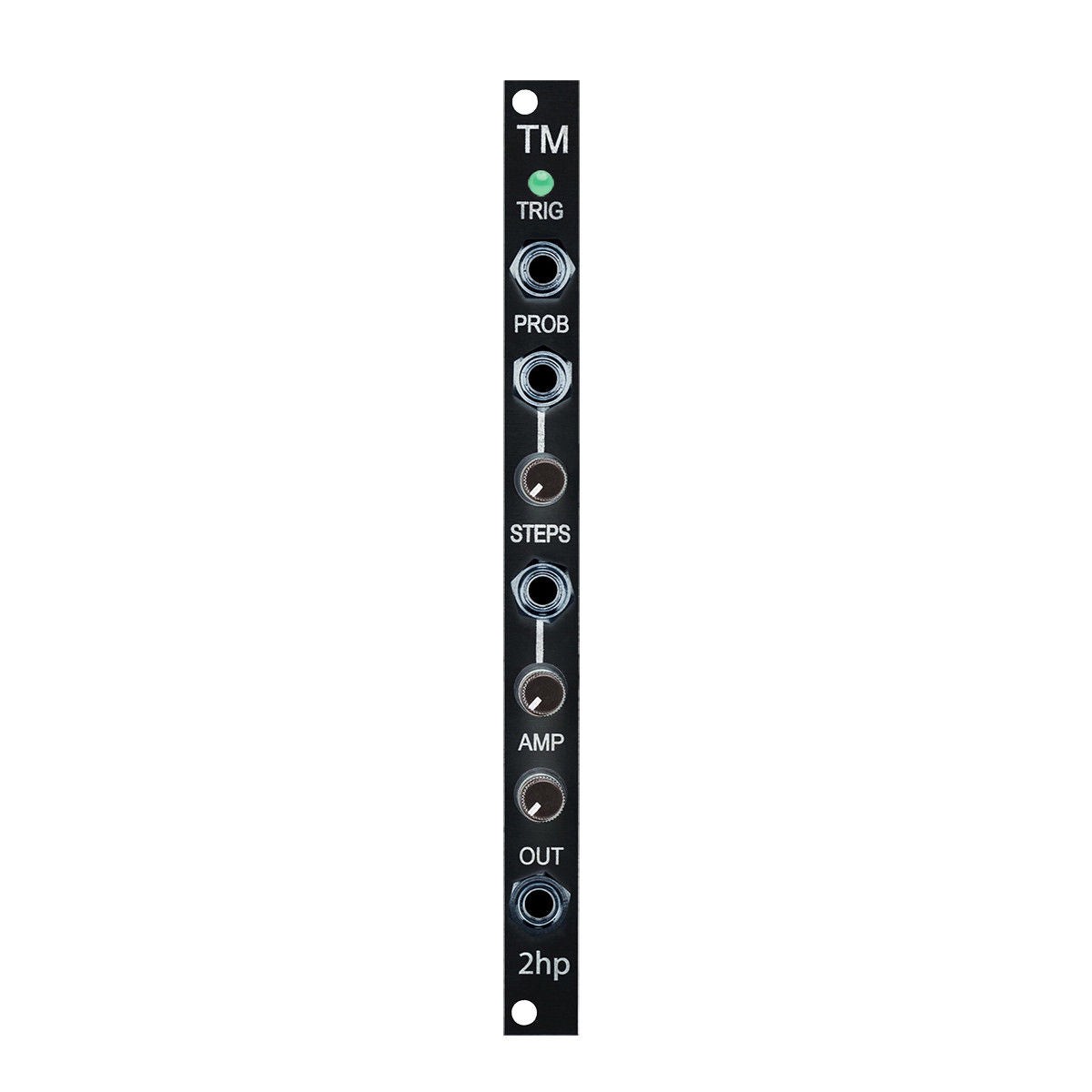
Born from the open-source ethos of the Music Thing Modular’s original Turing Machine, the 2hp version is a ruthless distillation. No blinking LEDs, no dedicated gate outputs, no front-panel scale quantizer—just the core idea: analog randomness with memory. It doesn’t *just* generate random voltages; it lets you freeze a sequence you like, tweak its randomness on the fly, or let it drift into uncharted territory. The “lock” function is its secret weapon: dial in a sequence you love, hit lock, and it becomes a repeating phrase—your accidental masterpiece, preserved. Then, nudge the “random” knob, and it starts mutating, note by note, like evolution with a sense of humor.
At 2HP wide and 42mm deep, it’s a space-saving paradox. It does less than its bigger siblings, yet somehow feels more essential in a crowded rack. You don’t buy it for its features—you buy it because it changes how you compose. It’s the module that shows up to the party uninvited and ends up writing the setlist. But don’t mistake minimalism for simplicity. The lack of visual feedback—no step indicators, no blinking lights—means you’re flying blind. You learn its moods by ear, by feel, by the way a certain patch makes your bassline suddenly *lurch* in a way you didn’t expect but can’t live without.
It’s not a sequencer. It’s not a noise source. It’s a co-writer with commitment issues.
Specifications
| Manufacturer | 2hp |
| Production Years | 2015– |
| Original Price | $120 |
| Format | Eurorack |
| Width | 2 HP |
| Depth | 42 mm |
| Current Draw +12V | 30 mA |
| Current Draw -12V | 15 mA |
| Step Range | 1–32 steps |
| Randomness Control | Manual knob with CV input |
| Step Length Control | Manual knob with CV input |
| Lock Function | Manual button |
| Outputs | CV Out, Gate Out (derived) |
| Inputs | Clock In, Reset In, Random CV In, Step Length CV In |
| Power Connector | 4-pin Eurorack power header |
| Weight | 35 g |
Key Features
The Art of Controlled Chaos
The Turing Machine doesn’t generate randomness the way a dice roll does—it *curates* it. At one end of the “random” knob, you get a fresh, unpredictable sequence every time. At the other, it locks into a single voltage, unchanging. In between? It’s a sliding scale of mutation. Turn it up during a performance, and your pristine melody starts sprouting dissonant neighbors, a single note at a time. It’s not glitchy—it’s *organic*. This isn’t LFO chaos; it’s algorithmic evolution. The CV control over randomness means you can modulate the mutation rate with an envelope, an LFO, or even another Turing Machine (yes, people do that). Pair it with a quantizer, and those drifting voltages snap into key—suddenly, your generative noodling becomes a jazz soloist with perfect pitch.
Size as a Feature
In a world where Eurorack modules keep getting wider and deeper, the 2hp TM is a statement. It fits in the gaps—the 2HP spaces left behind by logic modules, attenuators, or blank panels. It’s the module you install because you *can*, not because you planned for it. But that size comes with trade-offs. The knobs are tiny, the labels are easy to misread, and the lack of visual feedback means you’re relying entirely on your ears. Some users report patching errors because the “step length” knob looks too much like the “random” knob. It’s not ergonomic—it’s *anti*-ergonomic. But in a skiff, in a travel case, in a system where every millimeter counts, its footprint is its superpower.
The Gate Conundrum
Unlike the original Music Thing Modular version, the 2hp TM doesn’t have a dedicated gate output per step. Instead, it generates a gate signal derived from the CV output—a pulse that triggers when the voltage changes significantly. This works fine for many applications, but it’s not foolproof. In quiet sequences, where voltages shift subtly, the gate might not fire. For percussion, this can be a dealbreaker. Some users chain it into a comparator or use an external clock divider to generate reliable triggers. It’s a compromise born of space constraints, not design philosophy. If you need rock-solid gates, you’ll need to patch around it. But for modulating filters, pitch, or panning—where the CV is the star—the gate is just a bonus.
Historical Context
The 2hp Turing Machine arrived in 2015, right as Eurorack was shifting from boutique curiosity to mainstream synth culture. At the time, random voltage sources were still niche—most composers relied on sequencers or LFOs for variation. The original Music Thing Modular Turing Machine, released in 2011, had already proven that probabilistic sequencing could be musically compelling, but it was a DIY kit, 16HP wide, and visually busy. 2hp saw an opportunity: distill the concept into something that could live in the cracks of any system. They weren’t the first to miniaturize—Mutable Instruments’ Braids and STG Soundlabs’ Matchstick were already pushing density—but the TM was different. It wasn’t just small; it was *minimal*. No extras. No compromises on the core idea. It arrived alongside a wave of “utility with soul” modules—things like the Intellijel Metropolis or the ALM Busy Circuits series—that proved small modules could be generative, not just functional.
It also rode the crest of the “generative music” trend, fueled by Brian Eno’s legacy and the rise of algorithmic composition in digital audio workstations. But where software solutions could feel clinical, the 2hp TM felt alive—imperfect, unpredictable, *human*. It wasn’t trying to replace the composer; it was trying to surprise them. Competitors like Noise Engineering’s Mimetic Digitalis or Grayscale’s Permutation offered more features—multiple sequences, built-in quantizers, scale memory—but they were wider, pricier, and often more complex. The 2hp TM didn’t compete on specs. It competed on *presence*.
Collectibility & Value
The 2hp Turing Machine has never been rare—production has been steady since 2015—but it’s become quietly essential. Used units sell for $80–$110, depending on condition, while new ones hover around $120. Unlike vintage synths, its value isn’t rising; it’s stabilizing. Why? Because it’s still in production, still relevant, and still being used in new systems. There’s no collector’s premium—just utility value.
But that doesn’t mean it’s without issues. The most common complaint is mechanical: the step length knob is a continuous pot with no click stops. In a live set, it’s easy to misjudge the setting. You think you’re at 16 steps; you’re actually at 22. There’s no visual indicator, no tactile feedback. Some users add nail polish marks or tiny stickers to the knob. Others avoid live knob tweaks entirely, relying on CV control instead.
Another quirk: the module can “lock up” in a zero state—where all bits in the shift register are off, outputting a flat 0V. This isn’t a failure; it’s a mathematical inevitability. But it can be jarring mid-performance. The fix? A reset pulse or a quick clock burst. Some users patch a momentary switch to the reset input for emergencies.
Maintenance is minimal. No moving parts, no displays, no firmware. The PCB is simple, the components are standard, and 2hp’s build quality is consistent. If it fails, it’s usually a power issue—check the ribbon cable or the bus board. There’s no “recapping” culture around it like vintage synths. It either works or it doesn’t.
Buying advice? Test the knobs. Make sure they turn smoothly and respond to CV. Check for cold solder joints if buying used—rare, but possible. And if you’re pairing it with a quantizer, test the combo: some users report slight voltage drift that can push notes out of key. Otherwise, it’s about as low-risk as Eurorack gets.
eBay Listings

As an eBay Partner, we earn from qualifying purchases. This helps support our independent vintage technology research.