2hp Logic (2010s)
A tiny gate logic module that turns simple pulses into rhythmic complexity with just two operations: AND and OR.
Overview
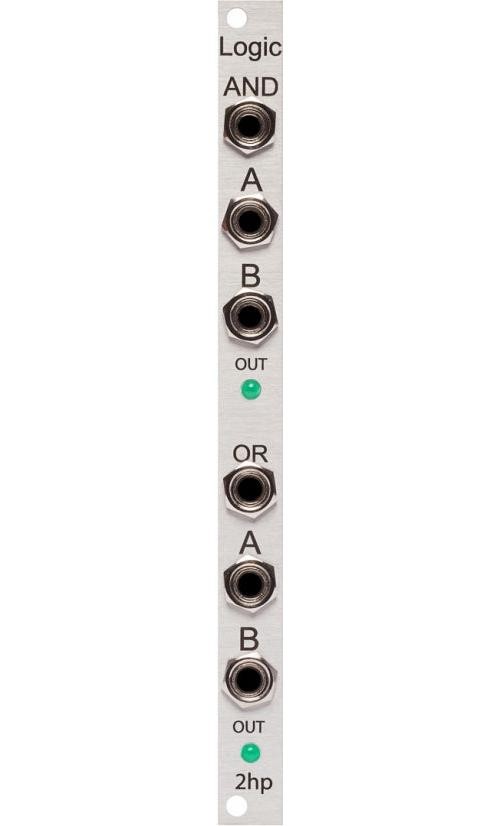
You’ll find it hiding in the cracks of a packed Eurorack case—two little jacks on the left, two on the right, and barely enough front panel to scribble a name. The 2hp Logic doesn’t announce itself like a wavetable oscillator or a resonant filter, but once you patch it in, you realize it’s been missing from every rhythmic sequence you’ve ever made. It’s not a sound generator, not a processor, not even a utility in the traditional sense. It’s a decision-maker. It listens to two gate or clock signals and answers a simple question: should this pulse pass? The answer depends on whether you’re using the AND channel or the OR channel, and that binary choice opens up a surprising amount of rhythmic depth.
The AND function only outputs a gate when both inputs receive a signal at the same time. It’s like a bouncer at a secret club: both invites must be presented simultaneously, or you’re not getting in. This makes it perfect for creating syncopated hits that only fire when two separate rhythmic streams converge—think of a snare that only plays on the offbeat if a hi-hat is also ticking, or a bass note that slips through only when two LFOs align. It’s also a stealthy way to gate modulation sources, so an effect only engages when multiple conditions are met, adding dynamic behavior that feels intentional, not random.
Flip over to the OR channel, and the logic inverts. Now, any pulse from either input gets passed through. It’s a merger, a combiner, a way to layer two clock sources into a denser, more complex pattern. If one sequencer is pulsing on quarter notes and another on eighth-note triplets, the OR output becomes a jittery, polyrhythmic stream that feels alive. This is where the module earns its keep in drum patches—merging trigger sources, stacking percussion events, or feeding a noise VCA with multiple timing streams to create fills that don’t just repeat, but evolve.
There’s a subtle but crucial detail in the design: the first channel normalled to the second. That means if you only patch one input into the AND side, it automatically feeds into the OR side as well. This isn’t just a convenience—it’s a design philosophy. It assumes you’ll want to process a single signal through both logic types, or chain them together without extra cables. In practice, it encourages experimentation. You can feed a master clock into AND, combine it with a delayed version of itself, then let the OR channel mix the original and the gated result, creating echo-like rhythmic artifacts without any delay module at all.
Specifications
| Manufacturer | 2hp |
| Format | Eurorack |
| Width | 2HP |
| Depth | 45mm |
| Power Consumption | 35 mA @ +12V, 3 mA @ -12V |
| Function | Dual-channel boolean gate operator |
| Logic Operations | AND, OR |
| Inputs | 2 x Gate/Trigger (AND channel), 2 x Gate/Trigger (OR channel) |
| Outputs | 1 x AND output, 1 x OR output |
| Normalization | AND channel input normalled to OR channel input |
| Signal Type | Digital gate/trigger (5V typical) |
| Module Type | Utility / Logic |
| Manual Available | Yes (PDF) |
| Production Era | 2010s |
| Country of Origin | USA |
| Color Options | Silver, Black |
Key Features
The AND Gate: Rhythmic Precision Through Exclusion
The AND channel is where timing becomes surgical. It doesn’t generate events—it filters them. Two pulses must coincide for an output, which means you can use it to create ghost notes, conditional triggers, or rhythmic intersections that would be difficult to program manually. Patch a clock into one input and a delayed version of the same clock into the other, and you’ll only get an output when both align—essentially creating a narrow time window for a trigger to pass. This is useful for tightening up slop in a sequence or generating a “pulse within a pulse” effect. Some users even feed envelope gates into the AND input to ensure a sound only plays when both a note is triggered and a modulation envelope is active, adding a layer of conditional playback that feels almost compositional.
The OR Gate: Rhythmic Expansion Through Inclusion
Where AND tightens, OR expands. It’s the simplest form of signal summation for gates—any incoming pulse gets passed, regardless of source. This makes it ideal for merging multiple sequencers, combining clock divisions, or layering percussion triggers. But its real charm lies in the unpredictability it introduces. When two unrelated rhythms feed into OR, the resulting output isn’t just a sum—it’s a new rhythm altogether, full of off-kilter accents and syncopations. It’s also a no-frills way to fan out a single trigger to multiple destinations without loading down the source, though it lacks buffering, so long cable runs or high fan-out patches might need a dedicated mult downstream.
Minimalism as a Design Statement
In a world where Eurorack modules keep getting bigger, deeper, and more feature-laden, the 2hp Logic is a quiet rebellion. It does two things, and it does them in 2HP. There are no switches, no attenuators, no CV inputs, no blinking LEDs. It’s passive in the best sense—transparent, reliable, and always ready. The lack of extras isn’t a limitation; it’s a focus. You’re not patching it to tweak parameters, but to make decisions. Its simplicity means it never gets in the way, and its normalization encourages chaining with other 2hp modules like the Mixer, Attenuverter, or Delay. Together, they form a micro-ecosystem of compact utilities that can handle surprisingly complex tasks without eating up valuable panel space.
Historical Context
The 2hp Logic emerged in the early 2010s, right as Eurorack was shifting from boutique curiosity to modular mainstream. At the time, cases were filling up with oscillators, filters, and effects—but many builders were realizing they needed more than just sound sources. They needed tools to organize, route, and manipulate signals. That’s where utility modules like Logic found their niche. While other companies were building multi-function logic modules with XOR, NAND, and flip-flops, 2hp took the opposite approach: strip it down to the essentials, make it tiny, and let patching do the rest.
It arrived alongside a wave of minimalist design in Eurorack—Think L-1, 4ms’s Pod, or ALM’s SQIJ. But 2hp stood out by committing fully to the 2HP form factor across its entire lineup. The Logic wasn’t just small; it was part of a philosophy that every function, no matter how minor, deserved a dedicated, compact module. This appealed to skiff builders, minimalists, and anyone tired of wasting space on oversized panels. It also reflected a broader trend in modular synthesis: the idea that complexity arises from connection, not from individual modules. The Logic doesn’t do much alone, but in a patch, it can be the difference between a static sequence and a living rhythm.
Competitors like Intellijel and Doepfer offered more comprehensive logic modules with additional functions and buffered outputs, but they also took up 4HP or more. The 2hp Logic wasn’t trying to win on features—it was trying to win on density. For users building compact systems or filling small gaps, it was often the only logic module that fit. And because it focused on the two most commonly used boolean operations, it covered 80% of use cases in half the space.
Collectibility & Value
The 2hp Logic has never been rare or particularly valuable, and that’s part of its charm. It’s a $94 module, and it stays that way—both new and on the used market. You won’t find collectors flipping it for profit, and you won’t see prices spike on eBay. That stability makes it accessible, but it also means there’s little incentive for 2hp to reissue or revise it. If you see one, it’s likely in working order, and if it’s not, the circuit is simple enough that most technicians can diagnose issues quickly.
Failures are uncommon, but when they happen, they’re usually power-related. The module draws 35mA from the +12V rail, which is modest, but in a heavily loaded system, a reversed power cable or a noisy bus board can stress the onboard regulator. There are no moving parts, no pots to wear out, and no buffers to fail—just passive components and logic chips. That simplicity means it’s one of the most reliable modules you can own, but it also means there’s no serviceable wear items. If the IC fails, it needs replacement, but documentation is available, and the design is open enough that DIY repairs are feasible.
When buying used, check for bent pins on the power connector and verify that both outputs respond to input signals. Some users report faint crosstalk between channels in high-gain patches, but this is usually due to cable quality or grounding issues rather than the module itself. Because it’s so basic, there’s little variation between units—no “vintage” or “reissue” versions to track. What you get is what it’s always been: a no-nonsense logic gate in the smallest possible package.
eBay Listings


As an eBay Partner, we earn from qualifying purchases. This helps support our independent vintage technology research.