1010music Bitbox mk2 (2021–)
A touchscreen sampler in your Eurorack that thinks like a DAW, plays like a synth, and glitches like a performance instrument.
Overview
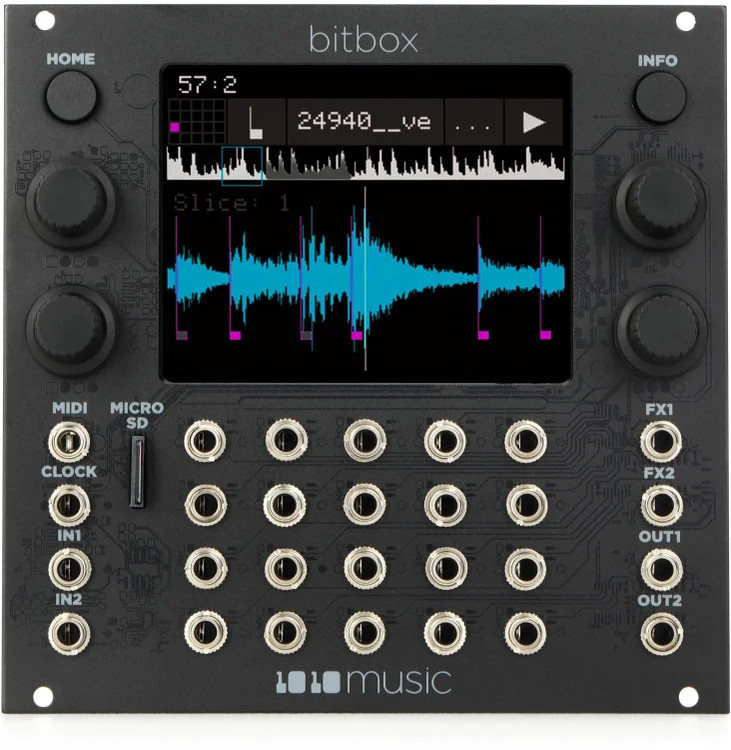
That first tap on the 3.5-inch touchscreen feels like flipping on a light in a dark modular rig—suddenly, you’re not just patching, you’re navigating. The Bitbox mk2 doesn’t just add sampling to Eurorack; it imports the logic of Ableton Session View into a 26 HP slot, complete with clip launching, slicing, granular mangling, and real-time looping that locks to your internal or external clock. It’s the kind of module that makes non-modular producers lean in and say, “Wait, you can *do* that in there?” And you can. But it’s not just a sampler. Depending on which firmware you load from the microSD card, it can morph into a wavetable synth, a multi-effects processor, or a full-blown audio mangler with stutter, reverse, and pitch-shifting tricks that feel more like Max/MSP patches than fixed functionality. The mk2 doubles the processing power of the original Bitbox, letting it stream samples up to 4 GB directly from the card—no need to preload, no memory limits that strangle creativity mid-session.
Still, it’s not without its quirks. The 16 trigger pads are software-based, not velocity-sensitive, and while they can be launched via MIDI, CV, or touch, the tactile feedback is minimal. You’re trading physical pads for screen real estate, and that’s a design choice, not a flaw. But it means your workflow leans toward preparation and performance, not live drumming. The screen, while bright and responsive, can feel cramped when editing granular parameters or slicing dense audio. And though the four front-panel knobs are assignable and useful, they don’t light up or auto-map—so you’re constantly glancing back at the screen to see what they’re doing. That said, the UI is logical once learned: tap a pad, swipe to scrub the waveform, dive into parameters with a second tap. Loop points adjust with pinch-zoom, and slice points snap to transients with eerie accuracy. It’s the kind of interface that rewards time invested, not instant gratification.
Positioned above the more compact Bitbox Micro but below the desktop Blackbox, the mk2 is the sweet spot for Eurorack integrators who want screen-based control without sacrificing patchability. It’s deeper than the Micro, more flexible than most dedicated sample players, and far more accessible than something like the Elektron Octatrack in a modular context. But it’s not trying to replace those. Instead, it carves out a niche: the event-based sampler for the modular stage, the loop engine for live sets, the audio canvas for generative patches. And unlike many screen-heavy modules, it acknowledges its environment—there’s a screen-flip mode so you can mount it in a front-row performance row without cables blocking your view. That small detail speaks volumes about who this was built for: players, not just tweakers.
Specifications
| Manufacturer | 1010music |
| Production Years | 2021– |
| Original Price | $549 / £589 |
| Form Factor | Eurorack (26 HP) |
| Touchscreen | 3.5 inch color display |
| Sample Playback Polyphony | Up to 24 stereo voices |
| Sampling Resolution | 24-bit / 48 kHz |
| Max Sample Size | 4 GB per file |
| Audio Inputs | Stereo (Eurorack level) |
| Audio Outputs | Stereo main output, two additional stereo outputs (configurable) |
| MIDI Connectivity | TRS MIDI (Type A/B compatible) |
| CV/Gate Inputs | 16 trigger inputs, 4 assignable CV inputs |
| File Storage | MicroSD card (supports up to 512 GB) |
| Sampling Time | Up to 4 hours of stereo recording |
| Firmware Flexibility | Multiple firmware options (sampler, wavetable synth, effects processor) |
| Effects | Onboard reverb, delay, and modulation effects |
| Looping | Musically intelligent looping with quantization and sync |
| Granular Engine | Yes, with adjustable grain size, density, and pitch |
| Weight | 0.6 kg |
| Power Draw | +12V: 200 mA, -12V: 100 mA |
Key Features
The Screen That Changes Everything
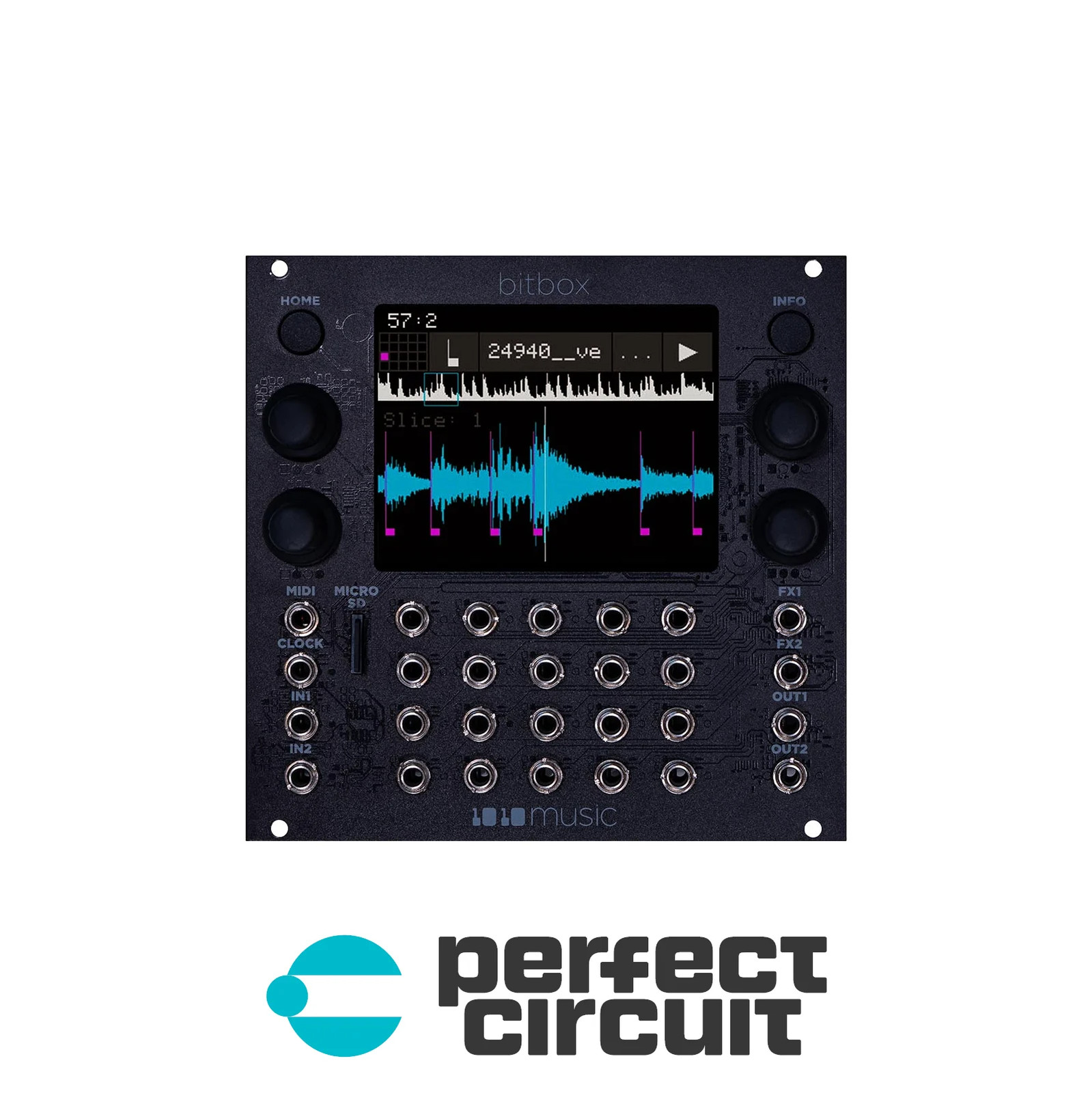
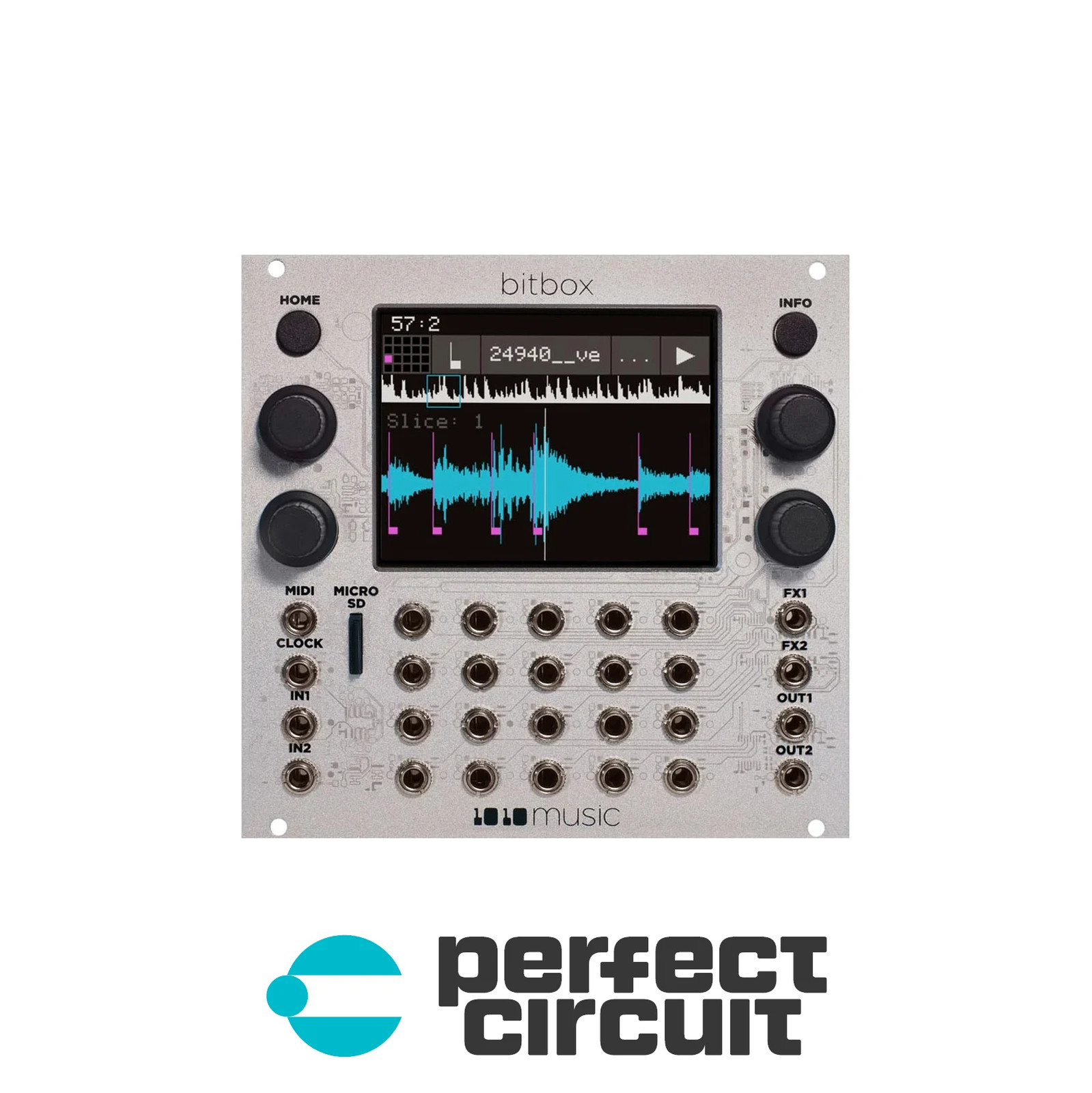
Most Eurorack modules ask you to imagine the waveform, infer the timing, or trust the LED. The Bitbox mk2 shows it to you. The 3.5-inch touchscreen isn’t just a convenience—it’s the central nervous system. You can scrub through a sample with your finger, set loop points by dragging on a zoomed-in waveform, or slice a breakbeat with a single tap that auto-detects transients. The visual feedback transforms abstract CV manipulation into something immediate and musical. Want to reverse a section? Highlight it and swipe. Need to adjust the ADSR on a pad? Tap twice and it’s there, with graphical envelopes you can reshape in real time. This isn’t menu diving; it’s direct manipulation, and it makes the mk2 feel more like a standalone instrument than a module. The screen also supports rotation, so if you’ve got it mounted in a performance-oriented row, you can flip the UI 180 degrees and still use it without contorting around patch cables.
More Than a Sampler—It’s a Shape-Shifter
Load a different firmware from the microSD card, and the Bitbox mk2 becomes something else entirely. Run the wavetable synth firmware, and it’s a four-oscillator digital synth with full MIDI control and stereo outputs. Switch to the effects firmware, and it turns into a multi-FX unit with tempo-synced delays, granular freeze, and spectral processing—all modulatable via CV. This flexibility is rare in Eurorack, where most modules do one thing well. The mk2 does several things decently, and one thing exceptionally: being a performance hub. It’s not the highest-fidelity sampler on the market—modules like the Van Rossum Assimil8or edge it out in converter quality and pitch-shifting transparency—but it’s the most versatile screen-based module under 30 HP. And because it can run alternate firmwares, it avoids obsolescence. You’re not just buying a sampler; you’re buying a platform.
Workflow Designed for Live Play
The Bitbox mk2 assumes you’re going to use it on stage. That’s why it supports internal and external clocking, why clips can be quantized to the beat, and why you can chain loops and slices into evolving arrangements. It’s also why the 16 trigger inputs are assignable per pad, letting you map external triggers to specific samples or slices. But there’s a trade-off: the CV implementation isn’t as deep as some purists would like. Only four of the 16 inputs can accept assignable CV (for pitch, filter, or effects), and the rest are gate-only. If you’re trying to modulate multiple parameters across multiple samples in real time, you’ll need additional modules. And while the built-in effects are usable, they’re not high-end—think “creative color” rather than “studio-grade.” But for live texture, stutter, and surprise, they’re perfect. The real strength is in the event-based workflow: launch a loop, freeze a granular cloud, stutter a vocal hit, then switch to a different firmware to process the output. It’s a performance arc, not just a sound module.
Historical Context
When the Bitbox mk2 launched in 2021, Eurorack was deep into the golden age of digital modules, but screen-based control was still rare. Most samplers were either memory-limited, menu-heavy, or required external computers. The original Bitbox had carved a niche, but it was the mk2 that made the concept stick—by doubling processing power, improving screen responsiveness, and refining the firmware. It arrived at a moment when modular performers were looking for more intuitive, DAW-like workflows without leaving the rack. Competitors like the Squid or René MK2 offered sequencing, but not sample manipulation. The Elektron Digitakt was powerful but standalone. The Bitbox mk2 bridged the gap: a module that could record, slice, loop, and mangle audio in real time, all while syncing to the rest of your system. It wasn’t the first to try—Look MUM, ALM, and others had dabbled—but it was the first to make it feel effortless. And by supporting alternate firmwares, it sidestepped the “one trick” trap that doomed so many screen-based modules. In a world of increasing complexity, the mk2 offered simplicity through versatility.
Collectibility & Value
The Bitbox mk2 hasn’t been around long enough to be “vintage” in the traditional sense, but it’s already a modern classic among modular performers. New units sell for around $549, with the black edition sometimes commanding a $20–$30 premium. Used prices hover between $400 and $480 depending on condition, with most wear集中在 the screen and knobs. The touchscreen is durable, but scratches or calibration drift can occur after heavy use—always test the touch response before buying. The microSD card slot is reliable, but corrupted cards can brick the unit until reformatted, so buyers should ask for a boot test. Firmware updates are still released, but slowly; owners report that 1010music supports the platform but doesn’t rush new features. The biggest complaint among long-term users is the output routing: despite having four physical outputs, all playback defaults to the main stereo pair unless manually reassigned—and even then, the process is clunky. Some users work around this by using the mk2 as a stereo source and relying on external mixers. Another issue: MIDI over TRS can introduce noise in high-gain systems, so opt for optical MIDI isolation if your setup is sensitive. For collectors, the mk2 is a “buy it for what it does, not what it might become” piece. It’s not appreciating in value, but it’s not depreciating fast either—because it still outperforms most rivals in its category. If you want a screen-based sampler that won’t limit your creativity, it’s worth every penny. Just don’t expect flawless CV integration or audiophile-grade converters.
eBay Listings

As an eBay Partner, we earn from qualifying purchases. This helps support our independent vintage technology research.