1010music Bitbox Micro (2020–)
A touchscreen sampler squeezed into 18HP that feels like a full workstation wearing a disguise.
Overview
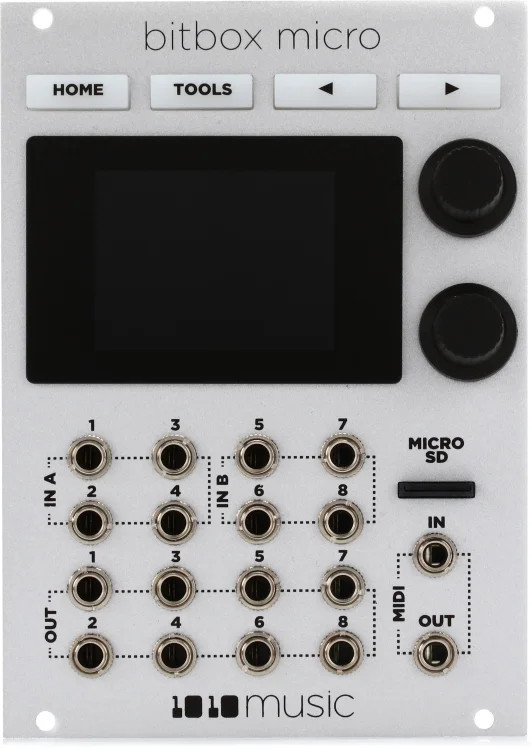
You reach for the Bitbox Micro when your Eurorack case is full but your ideas aren’t—when you need sampling muscle without sacrificing half your panel space. It’s not just a shrunken Bitbox; it’s a recalibration of what a compact module can do, packing a 2-inch touchscreen, 8 stereo sample pads, internal memory, microSD streaming, CV/MIDI control, and real-time recording into a footprint smaller than most dual oscillators. The screen dominates the faceplate, but it’s not a gimmick—it’s the control center for a system that behaves more like a standalone sampler than a typical modular citizen. You can load presets, slice loops, tweak granular parameters, or resample your mix bus without patching a single cable. That level of autonomy is rare in Eurorack, and it’s why the Micro doesn’t feel like a compromise. It feels like a secret weapon.
And yet, it doesn’t try to do everything the larger Bitbox MK2 does. There’s no multisampling across pads—each pad holds one sample, folder, or stream—and the screen is smaller, which makes detailed waveform editing a bit fiddly. But what it lacks in sprawl it makes up for in immediacy. You can plug in a stereo feed, hit record, capture a 4-hour performance, and slice it into playable clips—all from the module itself. The workflow leans toward the event-based logic of an MPC or Ableton session view, making it intuitive for producers who think in clips and triggers rather than raw synthesis. It’s also surprisingly deep in modulation: you can assign CV to nearly every parameter, from grain spread to loop start position, and the Learn function makes mapping MIDI CCs a one-button affair. For live use, that’s gold. You can quantize launches to internal or external clock, sync clips to your DAW’s tempo, or let slices drift in free time for glitchy, organic textures.
What really sets it apart is the balance between self-containment and integration. You *can* treat it like a desktop sampler with a microSD card full of presets and a touchscreen interface that handles everything. Or you can embed it deeply in a modular context—trigger pads with gate signals, modulate pitch with an LFO, record resampled textures from your filter feedback loop. The inputs are DC-coupled, so you can record and play back CV data, opening up bizarre possibilities like storing and replaying complex modulation sequences as audio. It’s not just a sound module; it’s a memory module for voltage. And with firmware updates adding new modes—like FXbox for reverb/delay mangling or Synthbox for wavetable playback—it’s one of the few modules that actually evolves after purchase. That adaptability gives it a lifespan beyond most digital Eurorack units, which often freeze in time once shipped.
Specifications
| Manufacturer | 1010music LLC |
| Production Years | 2020– |
| Original Price | $439 |
| Form Factor | 18HP Eurorack |
| Depth | 32 mm |
| Power Consumption | +12V: 400mA, -12V: 0mA, 5V: 0mA |
| Sample Playback | Up to 24 stereo voices (from internal memory) or up to 8 stereo streams (from microSD) |
| Internal Memory | 64 MB |
| Storage | microSD card (supports up to 4GB files, larger cards compatible) |
| Sample Formats | WAV (16, 24, or 32-bit; any sample rate, 48kHz preferred) |
| Sample Recording | Stereo or mono per pad, up to 4 hours total |
| Audio Inputs | 1 stereo pair (DC-coupled) |
| Audio Outputs | 3 stereo outputs, 6 mono outputs, 1 master stereo output |
| MIDI | TRS MIDI In (Type A and B compatible) |
| CV/Gate Inputs | Up to 8 gate inputs, up to 8 CV inputs, 1 clock input |
| Touchscreen | 2-inch diagonal |
| ADC/DAC | 24-bit |
| Effects | Reverb, delay |
| Sample Modes | Sample, Clip, Slicer, Granular, New Recording |
| Weight | 0.67 lbs |
| Dimensions | 6.9 × 6.75 × 2.4 in |
| Country of Origin | China |
Key Features
The Touchscreen That Does the Work
Most Eurorack modules force you into a patch-first, tweak-later workflow. The Bitbox Micro flips that: the touchscreen is the primary interface, and it’s surprisingly responsive. You can scrub waveforms, adjust loop points with a swipe, or dive into pad parameters without opening a menu tree. The UI is clean, with dedicated screens for mixing, effects, and modulation routing. It’s not as expansive as the MK2’s 3.5-inch display, but it’s dense with information—each pad shows its name, mode, level, and mute status at a glance. When you tap a pad, you get immediate access to start point, pitch, filter, ADSR, and launch mode. Want to turn a field recording into a granular cloud? Two taps and a swipe. Need to time-stretch a loop without changing pitch? Switch to Clip mode and drag the length slider. The screen makes complex operations feel tactile, which is rare for a module this compact.
Sample Streaming From microSD
The 64 MB of internal RAM limits full polyphony to shorter samples, but the real power lies in microSD streaming. You can load hours of audio directly from the card—field recordings, full songs, long ambient drones—and play up to 8 stereo streams simultaneously. This turns the Micro into a clip player for live sets, letting you trigger entire sections of a track with a single gate. The 4GB file limit sounds restrictive, but at 24-bit/48kHz, that’s over two hours of stereo audio per file. And because the module supports folders, you can organize banks of samples by song, mood, or instrument, then load a whole folder into a pad for chromatic triggering. It’s not multisampling in the traditional sense—no velocity layers or round-robin—but it’s close enough for most performance needs. The ability to swap cards also means you can carry multiple sound libraries and swap them mid-gig, like changing tape reels on an old sampler.
Live Recording and Resampling
You don’t need a computer to use the Bitbox Micro. It records Eurorack-level audio directly to internal memory or microSD, with options to sync start/stop to clock, trigger by threshold, or set fixed loop lengths. This makes it ideal for capturing improvisations or resampling your own patches. Want to freeze a chaotic feedback patch as a playable sample? Record the master output, slice it, and play it back through the granular engine. The module even supports MIDI-controlled recording, so you can automate sample capture from a sequencer. And because inputs are DC-coupled, you can record CV signals—say, a slow LFO sweep—and play it back as a modulation source. It’s a bizarre but powerful trick: turning control voltage into a storable, editable, and triggerable asset. Few modules treat CV as data worth archiving, but the Micro does.
Historical Context
When the Bitbox Micro arrived in 2020, Eurorack was drowning in oscillators and filters but still starved for practical sampling. Most samplers were either bare-bones one-shotters or massive, expensive units like the Make Noise Morphagene or 4ms Spectralis. 1010music had already proven its chops with the full-sized Bitbox, a desktop unit beloved for its reliability and workflow. The Micro was a bold move: shrink that power into 18HP without gutting the features. At $439, it undercut competitors while offering more flexibility than most. It arrived alongside a wave of screen-based modules—like the Mutable Instruments Plaits or Expert Sleepers FH-2—but stood out by prioritizing usability over esoteric synthesis. While others leaned into generative chaos, the Micro offered structure: clips, scenes, quantization, and preset recall. It appealed to producers who wanted to integrate modular into a DAW-like workflow, not escape it. In that sense, it was less a synth module and more a bridge between computer-based production and hands-on performance. That positioning—practical, not purist—helped it find a wide audience, from live loopers to ambient composers to techno producers needing a compact clip player.
Collectibility & Value
The Bitbox Micro isn’t vintage in the traditional sense—it’s still in production—but it’s already settled into the secondary market with stable pricing. Expect to pay $350–$425 used, depending on condition and included accessories. The module is solidly built, with no widespread failure points, but the microSD slot can wear out with frequent card swaps, and the touchscreen, while durable, is the most delicate component. Owners report occasional firmware glitches—especially with older versions—but updates from 1010music’s forum have resolved most stability issues. The real cost of ownership isn’t repair; it’s expansion. While the base module works out of the box, getting the most from it means investing in high-quality microSD cards (older, slow cards can cause dropouts during streaming) and possibly a MIDI adapter if your case lacks TRS MIDI. There’s no battery backup for settings, so always save presets before powering down. For buyers, the main red flag is counterfeit units—stick to reputable sellers or verified forums. Otherwise, it’s a low-risk purchase: no electrolytic capacitors to dry out, no moving parts to fail, and firmware updates ensure it won’t feel obsolete anytime soon. It’s not a “grail” module, but it’s a keeper: the kind of utility piece you buy once and keep forever.
eBay Listings



As an eBay Partner, we earn from qualifying purchases. This helps support our independent vintage technology research.