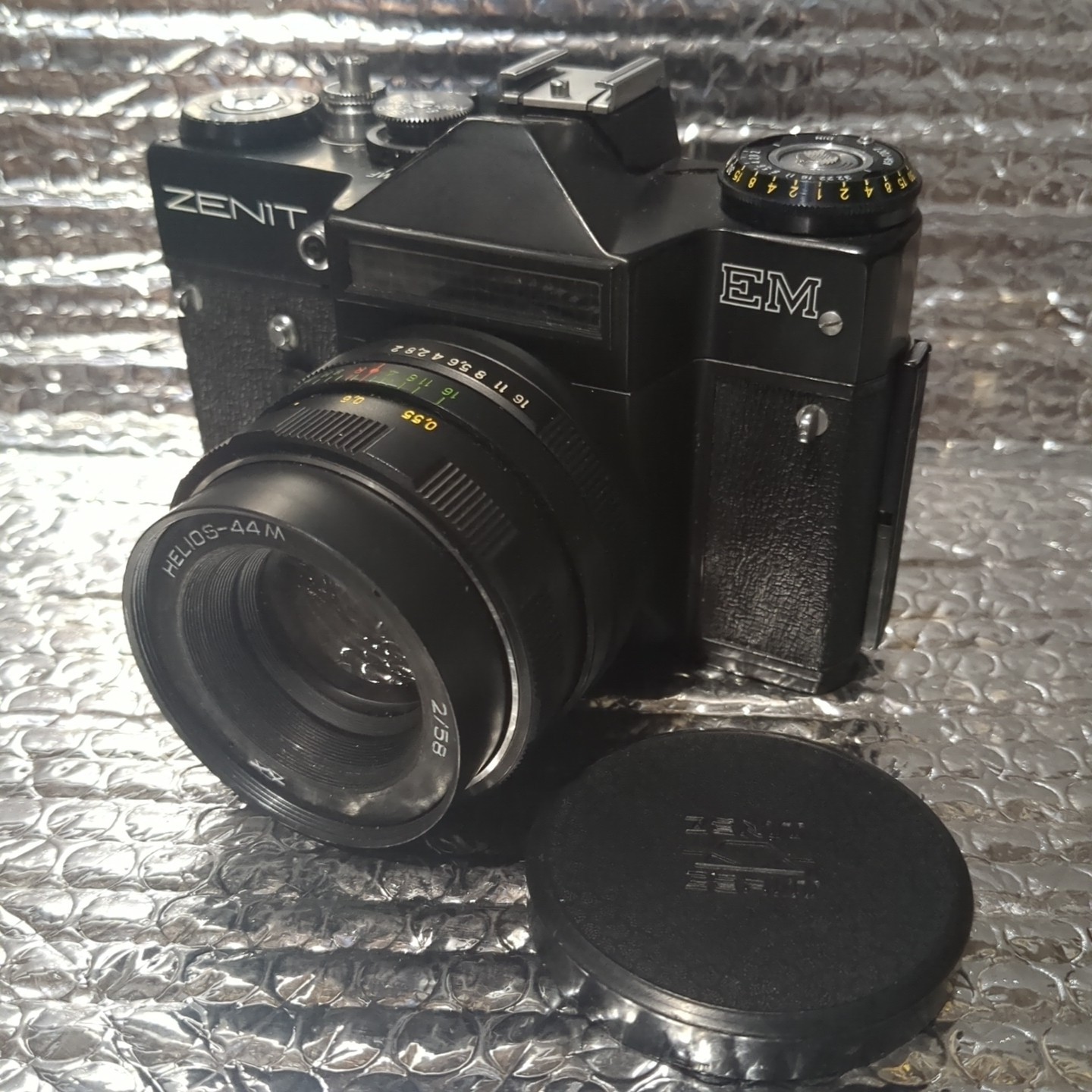
ZENIT EM
The Zenit EM is a 35mm single-lens reflex (SLR) camera produced by KMZ (Krasnogorskiy Mekhanicheskiy Zavod) in the Soviet Union from 1972 to 1985. An evolution of the earlier Zenit E, the EM introduced a crucial improvement: a semi-automatic diaphragm system, making it one of the first mass-produced Soviet SLRs to offer this feature for more efficient exposure control.
Overview
Introduced in 1972, the Zenit EM was developed as an incremental upgrade to the widely distributed Zenit E, which had become a staple of Soviet camera manufacturing since its 1965 debut. While mechanically similar in many respects to its predecessor, the EM distinguished itself primarily through the addition of an automatic diaphragm mechanism, a feature increasingly standard in Western SLRs of the era. This allowed photographers to compose and focus with the lens wide open for brightness, then automatically stop down to the preset aperture at the moment of exposure—improving both focusing accuracy and exposure precision. The EM retained the rugged, all-metal construction and fully mechanical operation typical of Zenit cameras, making it reliable in harsh conditions and appealing to budget-conscious and amateur photographers, particularly within the Eastern Bloc and export markets.
The Zenit EM was positioned as an entry-level SLR, targeting novice photographers and students who required a simple, durable camera without the complexity or cost of advanced metering or electronic automation. It used the M42 screw mount (also known as Praktica thread mount or Universal screw mount), enabling compatibility with a vast array of Soviet and third-party lenses. Despite its mechanical simplicity, the EM played a significant role in democratizing SLR photography in the USSR and served as a bridge between basic manual models and more sophisticated automated systems. Production continued until 1985, reflecting its longevity and reliability in a market with limited access to Western alternatives.
Specifications
| Specification | Value |
| Type | 35mm Manual Focus SLR |
| Film Format | 35mm (135 cartridge) |
| Years Produced | 1972–1985 |
| Lens Mount | M42 (screw mount) |
| Shutter | Focal-plane cloth curtain; speeds 1s to 1/1000s + B |
| Metering | None (no built-in light meter) |
| Exposure Modes | Manual only |
| Viewfinder | Fixed pentaprism, eye-level, with split-image rangefinder and microprism collar |
| Dimensions | Approx. 148 × 90 × 55 mm; Weight: ~650 g (body only, no battery) |
Key Features
- Semi-Automatic Diaphragm: The defining upgrade over the Zenit E, allowing preset aperture operation with automatic stop-down at shutter release.
- Fully Mechanical Operation: No batteries required for shutter or film advance; operates independently of electronics.
- M42 Lens Compatibility: Supports a wide range of Helios, Industar, Jupiter, and foreign M42 lenses.
- Instant-Return Mirror: Ensures uninterrupted viewing after exposure, a standard but important SLR feature.
- Robust Build Quality: Constructed primarily from brass and aluminum with a leatherette-covered steel body, designed for durability.
Historical Context
The Zenit EM was released during a period of modest technological advancement in Soviet camera manufacturing, when domestic producers sought to match basic features found in contemporary Japanese and German SLRs. While Western manufacturers like Pentax (with the Spotmatic series) and Canon (with the FTb) were integrating through-the-lens (TTL) metering and more refined automation, Soviet engineers focused on incremental improvements within the constraints of centralized production and limited access to microelectronics. The EM’s automatic diaphragm was a direct response to market demand for easier exposure workflow, particularly among amateur photographers who found the manual stop-down process of earlier Zenit models cumbersome.
Despite lacking a built-in light meter—a feature already common in mid-range Western SLRs—the EM found a niche in educational institutions, state photography clubs, and export markets in Africa, Asia, and Latin America. Its ruggedness, mechanical simplicity, and compatibility with high-quality Soviet optics (such as the Helios-44 58mm f/2) made it a practical choice in regions with unreliable power supplies or limited access to repair services. While it never achieved the cult status of later Zenit models like the TTL or the S series, the EM represented a pragmatic step forward in usability within the constraints of Soviet industrial policy.
Collectibility & Value
Today, the Zenit EM is regarded as a utilitarian classic rather than a high-value collectible. Units in working condition typically sell for $30–$70 on the secondary market, with prices rising slightly for examples accompanied by original lenses or in exceptional cosmetic condition. Its value lies more in historical interest and mechanical simplicity than in optical or technological innovation. Collectors of Cold War-era technology, Soviet engineering, or M42 lens systems often seek out the EM as a representative example of 1970s Eastern Bloc camera design.
When purchasing a Zenit EM, buyers should inspect the shutter operation across all speeds, particularly 1/1000s, where cloth curtains may exhibit uneven travel or tearing. The film advance lever and rewind crank should operate smoothly, and the mirror movement should be quiet and consistent. Common issues include light seals degradation (leading to light leaks), stiff aperture linkages, and wear in the shutter speed selector mechanism. While repair parts are scarce outside Russia, the camera’s mechanical nature allows for servicing by experienced technicians familiar with M42-era SLRs. Original black leather cases and instruction manuals in Cyrillic can add modest value.
Similar Cameras
- Pentax Spotmatic (1964–1976) – Japanese SLR with TTL metering and M42 mount; far more advanced but contemporaneous.
- Praktica FX3 (1973–1978) – East German M42 SLR with similar mechanical design and automatic diaphragm.
- Fujica ST705 (1974) – Japanese M42 camera with aperture-priority automation, representing the next evolution.
- Yashica Electro AX (1977) – Fully automatic M42 SLR with program mode, showcasing the peak of the mount’s capabilities.
- Zenit E (1965–1982) – Direct predecessor to the EM, lacking automatic diaphragm but otherwise nearly identical.
Repair & Maintenance
The Zenit EM requires no batteries for operation, making it fully functional without power sources. However, users should replace deteriorated light seals (typically perished foam or rubber around the film door) to prevent light leaks. The cloth focal-plane shutter is susceptible to wear, especially at high speeds; if banding or uneven exposure appears, professional cleaning or recalibration may be needed. The automatic diaphragm linkage relies on a mechanical pin system between lens and body—ensure the lens diaphragm operates smoothly and resets correctly. Lubrication of internal gears should only be performed by specialists, as over-greasing can attract dust and impair function. Regular use, proper storage, and periodic inspection are sufficient to maintain the EM’s longevity.
eBay Listings


As an eBay Partner, we earn from qualifying purchases. This helps support our independent vintage technology research.
Related Models
- Zenit 12 (1983–1994)
- Zenit 122 (1990-2005)
- Zenit 3M (1962-1970)
- Zenit B (1968-1973)
- Zenit E (1965–1982)
- Alpa 6 (1948-1953)
- Agfa Agfaflex
- Agfa Ambiflex
- Agfa Easy
- Agfa Futura Af zoom