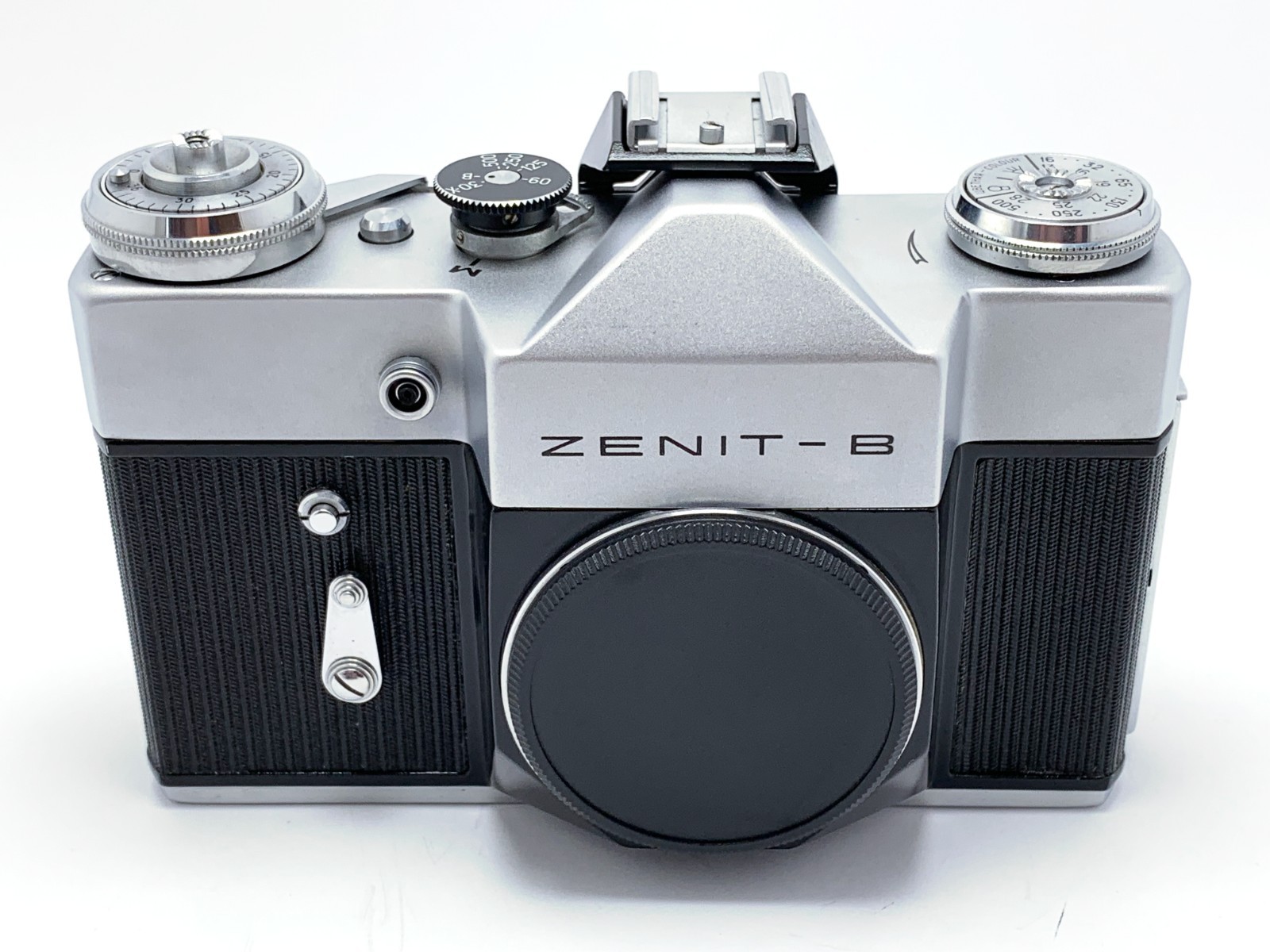
ZENIT B
The Zenit B is a fully mechanical 35mm single-lens reflex (SLR) camera produced by the Soviet manufacturer KMZ (Krasnogorskiy Mekhanicheskiy Zavod) from 1968 to 1973. A simplified, meterless variant of the Zenit-E, the Zenit B was designed for basic, reliable operation without built-in light metering, catering to photographers seeking a rugged and economical manual SLR.
Overview
Introduced during the height of Soviet camera production, the Zenit B occupies a niche within the extensive Zenit SLR family as a stripped-down, no-frills alternative to its metered counterparts. It was developed as a cost-effective model for both domestic and export markets, particularly targeting beginners, students, and users in regions where simplicity and durability were prioritized over advanced features. The camera shares the same core mechanical design as the Zenit-E but omits the selenium light meter and associated circuitry, reducing manufacturing complexity and improving long-term reliability.
The Zenit B was part of a broader trend in Eastern Bloc camera manufacturing that emphasized functional durability over automation. Built entirely of metal and using a robust M42 screw-thread lens mount (also known as Praktica thread or Universal thread), the camera was designed to accept a wide array of interchangeable lenses from Soviet and international manufacturers. Its fully manual operation—requiring manual film advance, manual shutter cocking, and manual aperture and focus control—places it firmly in the tradition of early SLRs, offering a hands-on photographic experience.
Positioned below the Zenit-E in KMZ’s product lineup, the Zenit B was not widely exported under its own name and often appeared in Western markets rebranded or simply grouped with other Zenit models. Despite its simplicity, it shares the same 1/30 to 1/500 second shutter speed range and B (bulb) mode as the Zenit-E, and uses a horizontally traveling cloth focal-plane shutter. The camera’s viewfinder features a split-image rangefinder patch surrounded by a microprism collar for improved focusing accuracy, a notable feature for a budget-oriented model of its era.
Specifications
| Specification | Value |
| Type | Single-Lens Reflex (SLR) |
| Film Format | 35mm (135 cartridge) |
| Years Produced | 1968–1973 |
| Lens Mount | M42 × 1mm screw thread (Praktica thread) |
| Shutter | Horizontal-travel cloth focal-plane shutter; speeds 1/30, 1/60, 1/125, 1/250, 1/500 sec, plus B (bulb) |
| Metering | None (meterless) |
| Exposure Modes | Manual only (shutter speed and aperture set manually) |
| Viewfinder | Fixed pentaprism with split-image rangefinder and microprism collar |
| Dimensions | Approx. 145 × 90 × 55 mm; weight ~650 g (body only, no battery) |
Key Features
- Fully mechanical operation – Requires no batteries, enabling reliable use in extreme conditions and long-term storage.
- M42 lens compatibility – Supports a vast ecosystem of manual prime and zoom lenses from Soviet (Helios, Industar, Jupiter), German (Carl Zeiss Jena, Meyer), and Japanese (Takumar, Fujinon) manufacturers.
- Integrated hot shoe – Allows use of external flash units synchronized via PC terminal and X-sync at all shutter speeds.
- Split-image focusing screen – Enhances manual focusing precision, a feature uncommon in entry-level SLRs of the period.
- Durable metal construction – Entire chassis and body shell are made of brass and aluminum alloy, contributing to long-term durability.
Historical Context
The Zenit B was released at a time when Soviet camera engineering had matured significantly, with KMZ refining designs based on pre-war German Contax and post-war East German Praktica influences. While the Zenit-E (introduced in 1965) became one of the most mass-produced SLRs in history, the Zenit B served as a lower-cost alternative for users who either already owned handheld meters or preferred complete control over exposure settings without reliance on aging selenium cells—a common failure point in metered Zenit models.
In the late 1960s and early 1970s, the global camera market saw increasing competition from Japanese manufacturers like Canon, Nikon, and Pentax, who were introducing aperture-priority and eventually through-the-lens (TTL) metering systems. In contrast, the Zenit B represented a conservative design philosophy focused on mechanical simplicity, ease of repair, and affordability. It found its primary market in Eastern Europe, the USSR, and developing nations, where its ruggedness and low cost made it a practical choice for photo clubs, schools, and amateur photographers.
Despite its lack of export prominence, the Zenit B played a role in democratizing SLR photography in the Eastern Bloc, much like the Zenit-E. Its omission of a light meter also made it lighter and less prone to electronic degradation—a trait now appreciated by collectors and film enthusiasts seeking reliable, no-compromise mechanical cameras.
Collectibility & Value
Today, the Zenit B is considered a niche collectible, valued more for its historical significance and mechanical simplicity than for optical or technical innovation. Units in working condition typically sell for $30–$70 USD on the secondhand market, with prices rising for models with included lenses (often a Helios-44 58mm f/2 or Jupiter-8 50mm f/2) or in exceptional cosmetic condition. Because it lacks a light meter, the Zenit B avoids one of the most common failure points in vintage SLRs, making functional examples more prevalent than metered Zenit variants.
When purchasing a Zenit B, buyers should inspect the shutter operation at all speeds, check for mirror movement smoothness, and verify that the film advance lever operates without slippage. Common issues include stiff shutter blades, light leaks from deteriorated film door seals, and worn shutter curtains—especially if the camera was stored with the shutter cocked. The film advance mechanism, while robust, can develop wear in the gears over decades of use. Replacement parts are scarce, but the camera’s mechanical simplicity allows for repair by skilled technicians familiar with M42-era SLRs.
Due to its all-metal construction and lack of electronics, the Zenit B is highly suitable for long-term storage and occasional use. It is also popular among analog photography enthusiasts who appreciate its tactile operation and compatibility with a wide range of vintage lenses.
Similar Cameras
- Zenit-E – Nearly identical but includes a selenium light meter; otherwise shares the same body, shutter, and lens mount.
- Praktica FX 3 – East German M42 SLR with similar mechanical design and build quality.
- Fujica ST 705 – Japanese-made M42 SLR with improved ergonomics and metering.
- Pentax Spotmatic – Iconic Japanese M42 SLR with TTL metering, representing the technological benchmark of the era.
- Yashica FX-1 – Another durable M42 SLR with a high-quality viewfinder and reliable mechanical shutter.
Repair & Maintenance
The Zenit B requires no batteries, as it is entirely mechanical. This eliminates concerns about corrosion or power failure but does not exempt it from routine maintenance. The cloth focal-plane shutter is sensitive to moisture and prolonged storage in humid environments, which can cause the fabric to degrade or stick. Regular use is recommended to keep internal mechanisms lubricated and functional.
Common repair issues include sticky shutter blades at slower speeds (especially 1/30 sec), mirror bounce, and film advance gear wear. The shutter speed dial can become stiff due to dried lubricant, requiring disassembly and cleaning. The viewfinder screen may yellow over time, though replacement screens are occasionally available from specialty vendors. Due to the camera’s age, sourcing original spare parts is difficult, but many components are interchangeable with Zenit-E models.
Servicing should be performed by technicians experienced with Soviet-era mechanical cameras. Ultrasonic cleaning is not recommended due to the risk of damaging the shutter mechanism. When storing, the camera should be kept in a dry, temperature-stable environment with the shutter uncocked and the lens removed to prevent seal degradation.
eBay Listings


As an eBay Partner, we earn from qualifying purchases. This helps support our independent vintage technology research.
Related Models
- Zenit 12 (1983–1994)
- Zenit 122 (1990-2005)
- Zenit 3M (1962-1970)
- Zenit E (1965–1982)
- Zenit EM (1972-1985)
- Alpa 6 (1948-1953)
- Agfa Agfaflex
- Agfa Ambiflex
- Agfa Easy
- Agfa Futura Af zoom