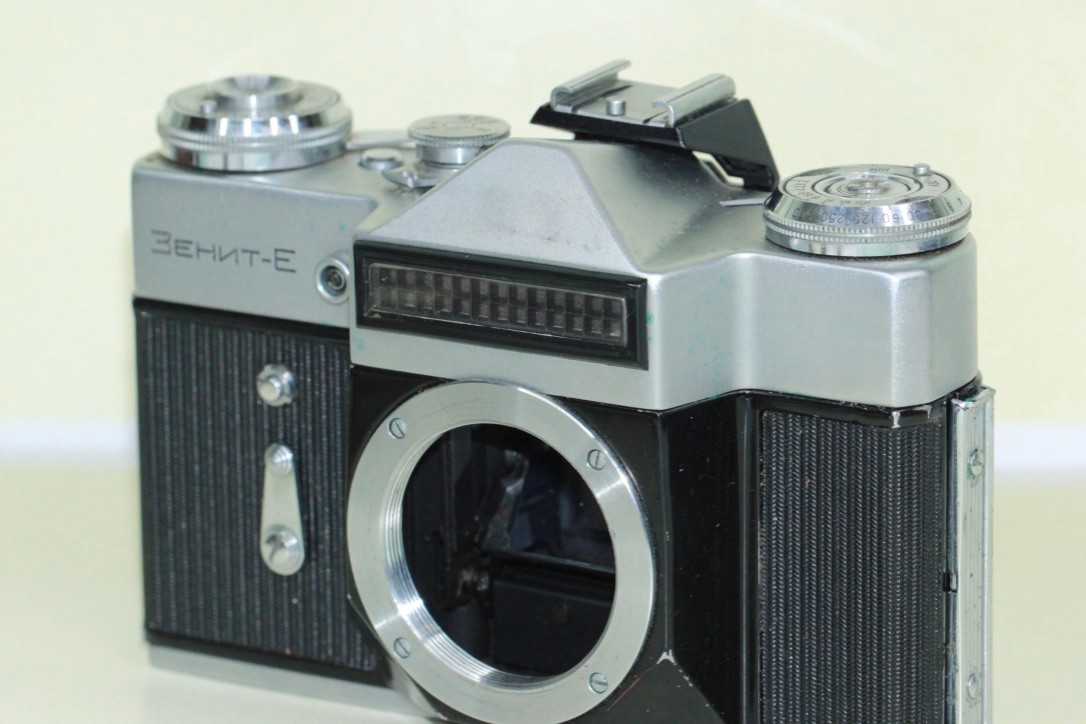
ZENIT E
The Zenit E is the most widely produced and internationally recognized Soviet 35mm single-lens reflex (SLR) camera. Introduced in 1965 by KMZ (Krasnogorskiy Mekhanicheskiy Zavod), it became a symbol of accessible photography behind the Iron Curtain and a common import in Western markets during the Cold War.
Overview
The Zenit E was developed as a simplified, mass-producible successor to earlier Zenit models such as the Zenit B and Zenit BT, incorporating lessons learned from the Zorki rangefinder and early SLR prototypes. Designed for durability and ease of use, the Zenit E targeted amateur photographers and state-sponsored educational and industrial institutions across the USSR and Eastern Bloc. Its rugged all-metal construction, mechanical reliability, and compatibility with the universal M42 screw mount made it a practical tool in environments where electronic cameras would be too fragile or expensive.
Over 12 million units were manufactured between 1965 and 1982, making the Zenit E one of the most-produced 35mm SLRs in history. It served as the backbone of Soviet consumer photography and was exported in large numbers to Europe, North America, and Asia under various brand names including Revue, BelOMO, and FED. The camera’s design prioritized mechanical simplicity over automation, featuring a fully manual exposure system and a selenium-cell exposure meter that required no batteries. This made it particularly valuable in regions with limited access to replacement batteries.
Within the Zenit lineup, the E model represented a standardization of features that would influence later variants such as the Zenit EM, TTL, and D. While lacking advanced features like through-the-lens metering or aperture-priority automation, the Zenit E established a benchmark for robust, no-frills SLR design that emphasized function over form.
Specifications
| Specification | Value |
| Type | Mechanical 35mm SLR |
| Film Format | 35mm (135 cartridge) |
| Years Produced | 1965–1982 |
| Lens Mount | M42 × 1mm screw mount (Praktica thread) |
| Shutter | Focal-plane cloth shutter, speeds 1/30 to 1/1000 sec, B (bulb), and X-sync at 1/30 sec |
| Metering | Center-weighted selenium-cell exposure meter (no battery required) |
| Exposure Modes | Manual only (shutter speed and aperture set manually) |
| Viewfinder | Fixed pentaprism eye-level viewfinder with microprism focusing spot |
| Dimensions | 145 × 90 × 55 mm; weight ≈ 620 g (body only, no lens) |
Key Features
- Battery-free selenium meter: The built-in exposure meter uses a selenium cell surrounding the lens mount, generating current from ambient light to power the needle indicator in the viewfinder—no batteries required.
- M42 lens compatibility: Supports a vast array of M42 lenses from Soviet, German, Japanese, and Eastern European manufacturers, including Helios-44, Jupiter-9, Carl Zeiss Jena, and Pentax Takumars.
- Mechanical reliability: Fully mechanical operation ensures functionality without batteries; shutter can be cocked and fired indefinitely.
- X-sync at 1/30 sec: Flash synchronization available via PC terminal and hot shoe, with a dedicated X-sync speed of 1/30 sec.
- Interchangeable viewfinder cover: The prism housing accepts standard 48mm filters for exposure meter calibration or lens protection.
Historical Context
The Zenit E was released during a period of increased Soviet industrial standardization and export expansion in consumer optics. It emerged shortly after the success of the Zenit B and was engineered to streamline production using die-cast zinc alloy chassis and simplified assembly techniques. The camera was heavily influenced by the pre-war German Contax D and post-war East German Praktica designs, particularly in its M42 mount adoption and internal layout.
At the time of its release, the Zenit E competed indirectly with Western SLRs such as the Pentax Spotmatic, Canon FX, and Nikkormat FT. However, it was not marketed as a professional tool but rather as an affordable, durable camera for students, hobbyists, and state photographers. Its rugged build made it suitable for harsh climates and field use, and its mechanical simplicity reduced maintenance needs—critical in regions with limited service infrastructure.
Despite its utilitarian design, the Zenit E gained a cult following in the West due to its low cost and compatibility with high-quality Soviet lenses. It was often sold in camera-and-lens kits featuring the Helios-44 58mm f/2 lens, which became renowned for its swirly bokeh and characterful rendering. While criticized for inconsistent build quality and crude ergonomics by Western standards, the Zenit E’s sheer numbers and global distribution cemented its place in photographic history.
Collectibility & Value
Today, the Zenit E is widely available on the secondhand market and is considered a low-cost entry point into vintage mechanical SLR photography. Individual units typically sell for $25–$75, with complete kits including lenses and cases reaching $100–$150 depending on condition. Fully functional examples with working selenium meters and clean viewfinders command a slight premium, though many meters degrade over time due to selenium fatigue.
When purchasing a Zenit E, collectors should inspect the shutter operation across all speeds, check for mirror bounce or sticking, and verify that the film advance lever operates smoothly. Common issues include stiff shutter release buttons, light seals degradation, and loss of meter responsiveness—often irreversible due to selenium cell aging. The camera’s mechanical simplicity makes most repairs feasible, but replacement parts are limited outside Eastern Europe.
While not a rare or high-value collectible, the Zenit E is prized for its historical significance, mechanical charm, and role in democratizing photography in the Eastern Bloc. It is frequently used by film enthusiasts experimenting with vintage lenses or seeking a fully manual shooting experience without reliance on electronics.
Similar Cameras
- Pentax Spotmatic – Japanese M42 SLR with TTL metering and superior ergonomics; direct contemporary and technical peer.
- Praktica FX2 – East German M42 SLR with similar mechanical layout and build quality; exported widely in Europe.
- FED 5 – Soviet rangefinder (not SLR), but shares industrial heritage and Cold War context.
- Yashica TL Electro-X – Japanese M42 SLR with electronic metering; represents the more advanced end of the M42 ecosystem.
- Zenit TTL – Later Soviet SLR with through-the-lens metering; direct successor in the Zenit line.
Repair & Maintenance
The Zenit E requires no batteries for operation, as its selenium-cell meter generates its own power. However, the meter needle may become sluggish or unresponsive over time due to selenium degradation—a common and typically irreversible condition. Mechanical servicing focuses on the focal-plane shutter, which can develop timing inaccuracies or cloth fatigue after decades of use.
Common maintenance issues include stiff film advance levers, sticky shutter speeds (especially 1/1000 sec), and worn light seals around the film chamber. The camera can be disassembled with basic tools, but precision is required when adjusting shutter tension or cleaning the mirror box. Replacement parts such as foam seals and curtain tension springs are available from specialty vintage camera suppliers.
Due to its simple design and widespread production, the Zenit E is considered moderately easy to repair for experienced technicians. However, inexperienced users should avoid opening the shutter mechanism without proper guidance, as misalignment can result in permanent damage. Regular use, proper storage, and occasional CLA (clean, lubricate, adjust) servicing will ensure long-term reliability.
eBay Listings



As an eBay Partner, we earn from qualifying purchases. This helps support our independent vintage technology research.
Related Models
- Zenit 12 (1983–1994)
- Zenit 122 (1990-2005)
- Zenit 3M (1962-1970)
- Zenit B (1968-1973)
- Zenit EM (1972-1985)
- Alpa 6 (1948-1953)
- Agfa Agfaflex
- Agfa Ambiflex
- Agfa Easy
- Agfa Futura Af zoom